< < ST08.2 : ST09.1 : ST09.2 > >
ST09.1: Wide Area Wireless Implementation
The Connected Eco-Driving service package provides customized real-time driving advice to drivers so that they can adjust their driving behavior to save fuel and reduce emissions. In this implementation, eco-driving advice is provided via wide area wireless communications. Information provided is tailored and geo-fenced so location-specific advice is offered.
Relevant Regions: Australia, Canada, European Union, and United States
- Enterprise
- Functional
- Physical
- Goals and Objectives
- Needs and Requirements
- Sources
- Security
- Standards
- System Requirements
Enterprise
Development Stage Roles and Relationships
Installation Stage Roles and Relationships
Operations and Maintenance Stage Roles and Relationships
(hide)
| Source | Destination | Role/Relationship |
|---|---|---|
| Driver | Vehicle | Operates |
| TIC Operator | Transportation Information Center | Operates |
| Transportation Information Center Maintainer | Transportation Information Center | Maintains |
| Transportation Information Center Manager | TIC Operator | System Usage Agreement |
| Transportation Information Center Manager | Transportation Information Center | Manages |
| Transportation Information Center Owner | Driver | Application Usage Agreement |
| Transportation Information Center Owner | Transportation Information Center Maintainer | System Maintenance Agreement |
| Transportation Information Center Owner | Transportation Information Center Manager | Operations Agreement |
| Transportation Information Center Owner | Vehicle Maintainer | Maintenance Data Exchange Agreement |
| Transportation Information Center Owner | Vehicle Owner | Information Exchange Agreement |
| Transportation Information Center Owner | Vehicle User | Service Usage Agreement |
| Transportation Information Center Supplier | Transportation Information Center Owner | Warranty |
| Vehicle Maintainer | Vehicle | Maintains |
| Vehicle Manager | Driver | System Usage Agreement |
| Vehicle Manager | Vehicle | Manages |
| Vehicle Owner | TIC Operator | Application Usage Agreement |
| Vehicle Owner | Transportation Information Center Maintainer | Maintenance Data Exchange Agreement |
| Vehicle Owner | Transportation Information Center Owner | Information Exchange Agreement |
| Vehicle Owner | Transportation Information Center User | Service Usage Agreement |
| Vehicle Owner | Vehicle Maintainer | System Maintenance Agreement |
| Vehicle Owner | Vehicle Manager | Operations Agreement |
| Vehicle Supplier | Vehicle Owner | Warranty |
Functional
This service package includes the following Functional View PSpecs:
Physical
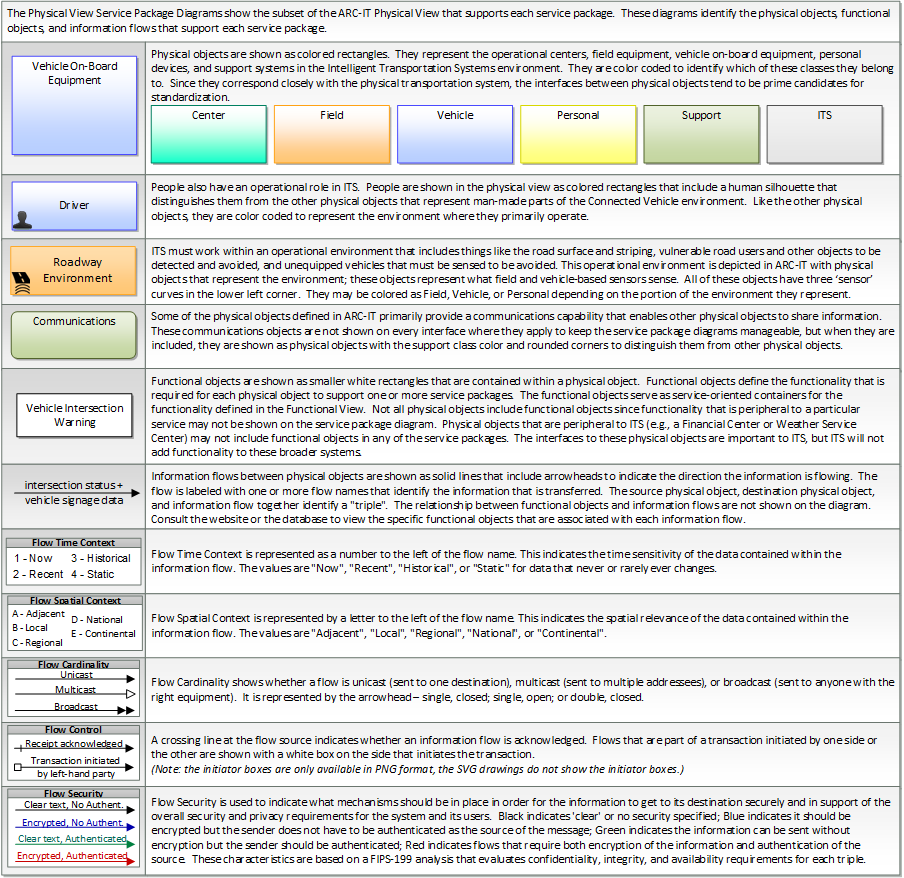
The physical diagram can be viewed in SVG or PNG format and the current format is SVG.SVG Diagram
PNG Diagram
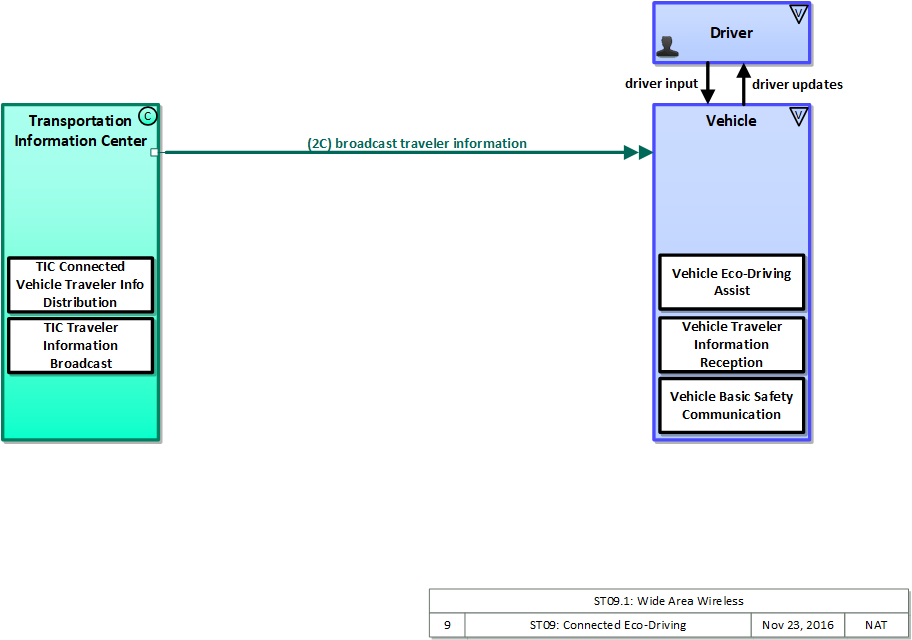
Includes Physical Objects:
| Physical Object | Class | Description |
|---|---|---|
| Driver | Vehicle | The 'Driver' represents the person that operates a vehicle on the roadway. Included are operators of private, transit, commercial, and emergency vehicles where the interactions are not particular to the type of vehicle (e.g., interactions supporting vehicle safety applications). The Driver originates driver requests and receives driver information that reflects the interactions which might be useful to all drivers, regardless of vehicle classification. Information and interactions which are unique to drivers of a specific vehicle type (e.g., fleet interactions with transit, commercial, or emergency vehicle drivers) are covered by separate objects. |
| Transportation Information Center | Center | The 'Transportation Information Center' collects, processes, stores, and disseminates transportation information to system operators and the traveling public. The physical object can play several different roles in an integrated ITS. In one role, the TIC provides a data collection, fusing, and repackaging function, collecting information from transportation system operators and redistributing this information to other system operators in the region and other TICs. In this information redistribution role, the TIC provides a bridge between the various transportation systems that produce the information and the other TICs and their subscribers that use the information. The second role of a TIC is focused on delivery of traveler information to subscribers and the public at large. Information provided includes basic advisories, traffic and road conditions, transit schedule information, yellow pages information, ride matching information, and parking information. The TIC is commonly implemented as a website or a web-based application service, but it represents any traveler information distribution service. |
| Vehicle | Vehicle | This 'Vehicle' physical object is used to model core capabilities that are common to more than one type of Vehicle. It provides the vehicle-based general sensory, processing, storage, and communications functions that support efficient, safe, and convenient travel. Many of these capabilities (e.g., see the Vehicle Safety service packages) apply to all vehicle types including personal vehicles (including motorcycles), commercial vehicles, emergency vehicles, transit vehicles, and maintenance vehicles. From this perspective, the Vehicle includes the common interfaces and functions that apply to all motorized vehicles. The radio(s) supporting V2V and V2I communications are a key component of the Vehicle. Both one-way and two-way communications options support a spectrum of information services from basic broadcast to advanced personalized information services. Advanced sensors, processors, enhanced driver interfaces, and actuators complement the driver information services so that, in addition to making informed mode and route selections, the driver travels these routes in a safer and more consistent manner. This physical object supports all six levels of driving automation as defined in SAE J3016. Initial collision avoidance functions provide 'vigilant co-pilot' driver warning capabilities. More advanced functions assume limited control of the vehicle to maintain lane position and safe headways. In the most advanced implementations, this Physical Object supports full automation of all aspects of the driving task, aided by communications with other vehicles in the vicinity and in coordination with supporting infrastructure subsystems. |
Includes Functional Objects:
| Functional Object | Description | Physical Object |
|---|---|---|
| TIC Situation Data Management | 'TIC Situation Data Management' manages connected vehicle situation data collection, quality controls, filtering, aggregation, and storage. Through this process, raw data reported by connected vehicles are transformed into information products that can be accessed and used to support transportation operations and traveler information. | Transportation Information Center |
| TIC Traveler Information Broadcast | 'TIC Traveler Information Broadcast' disseminates traveler information including traffic and road conditions, incident information, maintenance and construction information, event information, transit information, parking information, and weather information. The same information is broadcast to all equipped traveler interface systems and vehicles. | Transportation Information Center |
| Vehicle Eco-Driving Assist | 'Vehicle Eco-Driving Assist' provides customized real-time driving advice to drivers, allowing them to adjust behaviors to save fuel and reduce emissions. This advice includes recommended driving speeds, optimal acceleration and deceleration profiles based on prevailing traffic conditions, and local interactions with nearby vehicles, i.e., processing Basic Safety Messages (BSMs) to determine position and speed of vehicles that are between the host vehicle and the intersection. When approaching and departing signalized intersections, it uses intersection geometry information, the relative position and speed of vehicles ahead of it, and signal phase movement information to provide speed advice to the driver so that the driver can adapt the vehicle’s speed to pass the next traffic signal on green, decelerate to a stop in the most eco-friendly manner, or manage acceleration as the vehicle departs from a signalized intersection. It also provides feedback to drivers on their driving behavior to encourage them to drive in a more environmentally efficient manner. It may also support vehicle-assisted strategies, where the vehicle automatically implements the eco-driving strategy (e.g., changes gears, switches power sources, or reduces its speed in an eco-friendly manner as the vehicle approaches a traffic signal or queue). | Vehicle |
| Vehicle Situation Data Monitoring | 'Vehicle Situation Data Monitoring' is the highest-level representation of the functionality required to collect traffic and environmental situation data by monitoring and storing the experience of the vehicle as it travels through the road network. Collected data is aggregated into snapshots that are reported when communications is available and with flow control based on parameters provided by the infrastructure. Note that this functional object supports collection of data for areas remote from RSEs or other communications infrastructure. | Vehicle |
| Vehicle Traveler Information Reception | 'Vehicle Traveler Information Reception' receives advisories, vehicle signage data, and other driver information of use to all types of vehicles and drivers and presents this information to the driver using in-vehicle equipment. Information presented may include fixed sign information, traffic control device status (e.g., signal phase and timing data), advisory and detour information, warnings of adverse road and weather conditions, travel times, and other driver information. | Vehicle |
Includes Information Flows:
| Information Flow | Description |
|---|---|
| broadcast traveler information | General traveler information that contains traffic and road conditions, link travel times, incidents, advisories, restrictions, vehicle requirements, work zones, transit service information, weather information, parking information, and other related traveler information. This information is typically location-specific to the destination, includes a specification of the relevant geo-fence boundary, and time effectivity of the included information. |
| driver input | Driver input to the vehicle on-board equipment including configuration data, settings and preferences, interactive requests, and control commands. |
| driver updates | Information provided to the driver including visual displays, audible information and warnings, and haptic feedback. The updates inform the driver about current conditions, potential hazards, and the current status of vehicle on-board equipment. |
| vehicle situation data | This flow represents vehicle snapshots that may be provided by the vehicle to support traffic and environmental conditions monitoring. Snapshots are collected by the vehicle for specific events (e.g., when a sensor exceeds a threshold) or periodically and reported based on control parameters when communications is available. Traffic-related data includes snapshots of measured speed and heading and events including starts and stops, speed changes, and other vehicle control events. Environmental data may include measured air temperature, exterior light status, wiper status, sun sensor status, rain sensor status, traction control status, anti-lock brake status, and other collected vehicle system status and sensor information. The collected data is reported along with the location, heading, and time that the data was collected. |
| vehicle situation data parameters | A request for vehicle situation data that includes parameters used to control the data that is reported and the flow of data reported by the vehicle. This flow identifies the type of data/snapshots that are requested and reporting parameters such as snapshot frequency, filtering criteria (data thresholds for reporting), and reporting interval. |
Goals and Objectives
Associated Planning Factors and Goals
| Planning Factor | Goal |
|---|---|
| E. Protect and enhance the environment, promote energy conservation, improve the quality of life, and promote consistency between transportation improvements and State and local planned growth and economic development patterns; | Protect/Enhance the Environment |
Associated Objective Categories 
| Objective Category |
|---|
| Environment: Clean Air |
| System Efficiency: Energy Consumption |
Associated Objectives and Performance Measures
Needs and Requirements
| Need | Functional Object | Requirement | ||
|---|---|---|---|---|
| 01 | The vehicle driver needs to be able to receive customized real-time driving advice so that they can adjust their driving behavior to save fuel and reduce emissions. | TIC Situation Data Management | 01 | The center shall collect traffic probe data (speeds, travel times, etc.) from appropriately equipped vehicles and short range communications equipment. |
| 02 | The center shall collect environmental probe data (air temperature, exterior light status, wiper status, traction control status, etc.) from appropriately equipped vehicles and short range communications equipment. | |||
| 05 | The center shall aggregate collected traffic probe data, calculate route segment travel times, route segment speeds, route usage, and road weather information for dissemination to other centers. | |||
| TIC Traveler Information Broadcast | 01 | The center shall disseminate traffic and highway condition information to travelers, including incident information, detours and road closures, event information, recommended routes, and current speeds on specific routes. | ||
| 02 | The center shall disseminate maintenance and construction information to travelers, including scheduled maintenance and construction work activities and work zone activities. | |||
| 03 | The center shall disseminate transit routes and schedules, transit transfer options, transit fares, and real-time schedule adherence information to travelers. | |||
| 04 | The center shall disseminate parking information to travelers, including location, availability, and fees. | |||
| 06 | The center shall disseminate weather information to travelers. | |||
| 07 | The center shall disseminate event information to travelers. | |||
| 08 | The center shall disseminate air quality information to travelers. | |||
| 10 | The center shall provide the capability for a system operator to control the type and update frequency of broadcast traveler information. | |||
| Vehicle Eco-Driving Assist | 04 | The vehicle shall provide advisory speed to driver so that they can adjust their driving behavior to save fuel and reduce emissions. | ||
| 11 | The vehicle shall provide eco-driving recommendations to the driver. | |||
| Vehicle Situation Data Monitoring | 02 | The Vehicle shall collect data collection parameters from Centers. | ||
| 05 | The Vehicle shall provide data to Centers in accordance with data collection parameters provided by Centers/Connected Vehicle Roadside Equipment. | |||
| Vehicle Traveler Information Reception | 10 | The vehicle shall receive customized real-time driving advice so that the vehicle or the driver can adjust their driving behavior to save fuel and reduce emissions. | ||
| 22 | The vehicle shall receive formatted traffic information from a center and present it to the driver. | |||
| 02 | The connected vehicle needs to be able to automatically perform actions to implement eco-driving strategies. | Vehicle Eco-Driving Assist | 05 | The vehicle shall automatically adjust its operating parameters to implement the eco-driving strategy (e.g., changes gears, switches power sources, or reduces its speed in an eco-friendly manner). |
Related Sources
| Document Name | Version | Publication Date |
|---|---|---|
| None |
Security
In order to participate in this service package, each physical object should meet or exceed the following security levels.
| Physical Object Security | ||||
|---|---|---|---|---|
| Physical Object | Confidentiality | Integrity | Availability | Security Class |
| Transportation Information Center | Moderate | Moderate | Moderate | Class 2 |
| Vehicle | Moderate | Moderate | Moderate | Class 2 |
In order to participate in this service package, each information flow triple should meet or exceed the following security levels.
| Information Flow Security | |||||
|---|---|---|---|---|---|
| Source | Destination | Information Flow | Confidentiality | Integrity | Availability |
| Basis | Basis | Basis | |||
| Driver | Vehicle | driver input | Moderate | High | High |
| Data included in this flow may include origin and destination information, which should be protected from other's viewing as it may compromise the driver's privacy. | Commands from from the driver to the vehicle must be correct or the vehicle may behave in an unpredictable and possibly unsafe manner | Commands must always be able to be given or the driver has no control. | |||
| Transportation Information Center | Vehicle | broadcast traveler information | Not Applicable | Moderate | Moderate |
| By definition this is publicly broadcast data. | The distribution of this data is intended to be very large, as such the impact of corrupted data will be significant. Probably not HIGH, as there are other distribution channels for this data. | There are multiple channels for the delivery of this information, so if this one is not available, others will work. DISC: WYO suggests this is LOW. | |||
| Transportation Information Center | Vehicle | vehicle situation data parameters | Low | Moderate | Moderate |
| This isn't exactly a control flow, more like a 'suggestion flow', as the vehicle will always decide what to send. Probably no need for obfuscation. | Info should be accurate and should not be tampered so that the vehicle only discloses the correctly requested data | Parameters should be timely and readily available, but would not have severe/catastrophic consequences if not | |||
| Vehicle | Driver | driver updates | Not Applicable | Moderate | Moderate |
| This data is informing the driver about the safety of a nearby area. It should not contain anything sensitive, and does not matter if another person can observe it. | This is the information that is presented to the driver. If they receive incorrect information, they may act in an unsafe manner. However, there are other indicators that would alert them to any hazards, such as an oncoming vehicle or crossing safety lights. | If this information is not made available to the driver, then the system has not operated correctly. | |||
| Vehicle | Transportation Information Center | vehicle situation data | Moderate | Moderate | Low |
| Might be able to link multiple snapshots together and compromise some element of driver/traveler privacy. | Event driven data can be used for various mobility monitoring applications, and as operational decisions may be made based on mobility conditions, this data's accuracy should be preserved or decisions may not align with real situations. | While desireable, in most application contexts the provision of a single vehicle's data through this flow is not critical. | |||
Standards
The diagram here shows the primary standards associated with the physical objects and information flows in this service package. Click on the standard # to go to the page explaining that standard in more detail. The tables that follow the diagram list the standards associated with the information flows in this service package that should drive development decisions. Click on the standard name for more information from the Communications View about a particular standard, including the solutions and information flow triples associated with the standard and any gaps or overlaps. This table is based primarily on standards used in North America. For information concerning standards and communications solutions in other regions consult the Communications View.
This material should be considered 'draft for review' and may change separately from ARC-IT version revisions. The date on the diagram relates to the date of the physical service package diagram on which this is based; standards-related information should be considered up-to-date as of the 'last updated' date on this page.
Communication Standards: Standards associated with data, message or dialog definitions, communications protocols and management and security of data exchanges. All standards here are also illustrated in information flow triple communications view diagrams.
| Name | Title |
|---|---|
| ITS Application Entity | |
| ISO 14819-2 RDS-TMC Codes | Intelligent transport systems -- Traffic and travel information messages via traffic message coding -- Part 2: Event and information codes for Radio Data System -- Traffic Message Channel (RDS-TMC) using ALERT-C |
| ISO 14819-3 RDS-TMC Location Ref | Intelligent transport systems -- Traffic and travel information messages via traffic message coding -- Part 3: Location referencing for Radio Data System -- Traffic Message Channel (RDS-TMC) using ALERT-C |
| ISO 21219-15 TPEG2 - Traffic Event | Intelligent transport systems -- Traffic and travel information (TTI) via transport protocol experts group, generation 2 (TPEG2) -- Part 15: Traffic event compact (TPEG2-TEC) |
| SAE J2735 DSRC Message Set | V2X Communications Message Set Dictionary |
| Facilities Layer | |
| ISO 14819-1 RDS-TMC Protocol | Intelligent transport systems -- Traffic and travel information messages via traffic message coding -- Part 1: Coding protocol for Radio Data System -- Traffic Message Channel (RDS-TMC) using ALERT-C |
| Not Needed | No Standard Needed |
| Security Entity | |
| ISO 14819-6 RDS-TMC Encryption | Traffic and Traveller Information (TTI) -- TTI messages via traffic message coding -- Part 6: Encryption and conditional access for the Radio Data System -- Traffic Message Channel ALERT C coding |
| ISO 21219-24 TPEG2 - Light Encryption | Intelligent transport systems - Traffic and travel information (TTI) via transport protocol experts group, generation 2 (TPEG2) -- Part 24: Light encryption (TPEG2-LTE) |
| Proprietary | Proprietary |
| Secure Session Alternatives | Secure Session Alternatives |
| Management Entity | |
| Bundle: SNMPv3 MIB | SNMPv3 & Networking MIBs |
| ISO 21219-6 TPEG2 - Message Mgmt | Intelligent transport systems - Traffic and travel information via transport protocol experts group, generation 2(TPEG2) -- Part 6: Message management container (TPEG2-MMC) |
| Networking and Transport Layer | |
| Internet Transport Alternatives | Internet Transport Alternatives |
| IP Alternatives | Internet Protocol Alternative Set |
| Access Layer | |
| WAW Broadcast Alternatives | Wide-Area Wireless Broadcast Alternatives |
| Wireless Internet Alternatives (NA) | Wireless Internet Alternatives according to North American standards |
Physical Standards: Standards associated with device physical, environmental or performance requirements.
The following table lists the standards associated with physical objects in this service package. Click on the standard name for more information about a particular standard.
| Name | Title |
|---|---|
| ISO 24100 Probe Vehicle Data Protection | Intelligent transport systems -- Basic principles for personal data protection in probe vehicle information services |
| SAE J3361 Antenna requirements | V2X Antenna Coverage and Test Requirements for US FHWA Class 1 and Class 3-13 Class Vehicles |
| SAE J5001 OBU Standard | Onboard Unit Standard for Connected Vehicles |
Service-Level Standards: Standards associated service package structure, messaging patterns, user needs, requirements or similar systems-engineering content that describe one or more use cases satisfied by the service package.
No service-level standards have been identified for this service package.
System Requirements
| No System Requirements |