< < SU14.1 : SU15.1 : TI01.1 > >
SU15.1: Vulnerable Road User Device Transition Support Implementation
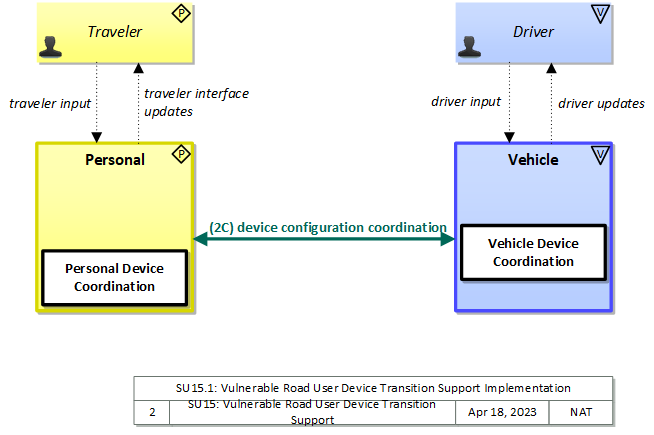
This service package supports the transition of a device used by a vulnerable road user (VRU) when they change from one mode in which they are vulnerable - walking, cycling, using a wheelchair, etc., to one in which they are less vulnerable, e.g., riding or driving a car, truck, emergency vehicle, transit vehicle, etc. This implementation is a holistic view of the SU15 service package, including all Physical Objects, Functional Objects, and Triples associated with the service package. It distinguishes between items that are fundamental to the service and items that are optional. Your specific implementation is likely to include the fundamental items and selected optional items, based on your specific project requirements.
Relevant Regions: Australia, Canada, European Union, and United States
- Enterprise
- Functional
- Physical
- Goals and Objectives
- Needs and Requirements
- Sources
- Security
- Standards
- System Requirements
Enterprise
Development Stage Roles and Relationships
Installation Stage Roles and Relationships
Operations and Maintenance Stage Roles and Relationships
(hide)
| Source | Destination | Role/Relationship |
|---|---|---|
| Driver | Vehicle | Operates |
| Personal Maintainer | Personal | Maintains |
| Personal Manager | Personal | Manages |
| Personal Manager | Traveler | System Usage Agreement |
| Personal Owner | Driver | Application Usage Agreement |
| Personal Owner | Personal Maintainer | System Maintenance Agreement |
| Personal Owner | Personal Manager | Operations Agreement |
| Personal Owner | Vehicle Maintainer | Maintenance Data Exchange Agreement |
| Personal Owner | Vehicle Owner | Expectation of Data Provision |
| Personal Owner | Vehicle User | Service Usage Agreement |
| Personal Supplier | Personal Owner | Warranty |
| Traveler | Personal | Operates |
| Vehicle Maintainer | Vehicle | Maintains |
| Vehicle Manager | Driver | System Usage Agreement |
| Vehicle Manager | Vehicle | Manages |
| Vehicle Owner | Personal Maintainer | Maintenance Data Exchange Agreement |
| Vehicle Owner | Personal Owner | Expectation of Data Provision |
| Vehicle Owner | Personal User | Service Usage Agreement |
| Vehicle Owner | Traveler | Application Usage Agreement |
| Vehicle Owner | Vehicle Maintainer | System Maintenance Agreement |
| Vehicle Owner | Vehicle Manager | Operations Agreement |
| Vehicle Supplier | Vehicle Owner | Warranty |
Functional
This service package includes the following Functional View PSpecs:
| Physical Object | Functional Object | PSpec Number | PSpec Name |
|---|---|---|---|
| Personal | Personal Device Coordination | 10.6.3.3 | Provide Personal Device Coordination |
| Vehicle | Vehicle Device Coordination | 10.6.3.2 | Provide Vehicle Device Coordination |
Physical
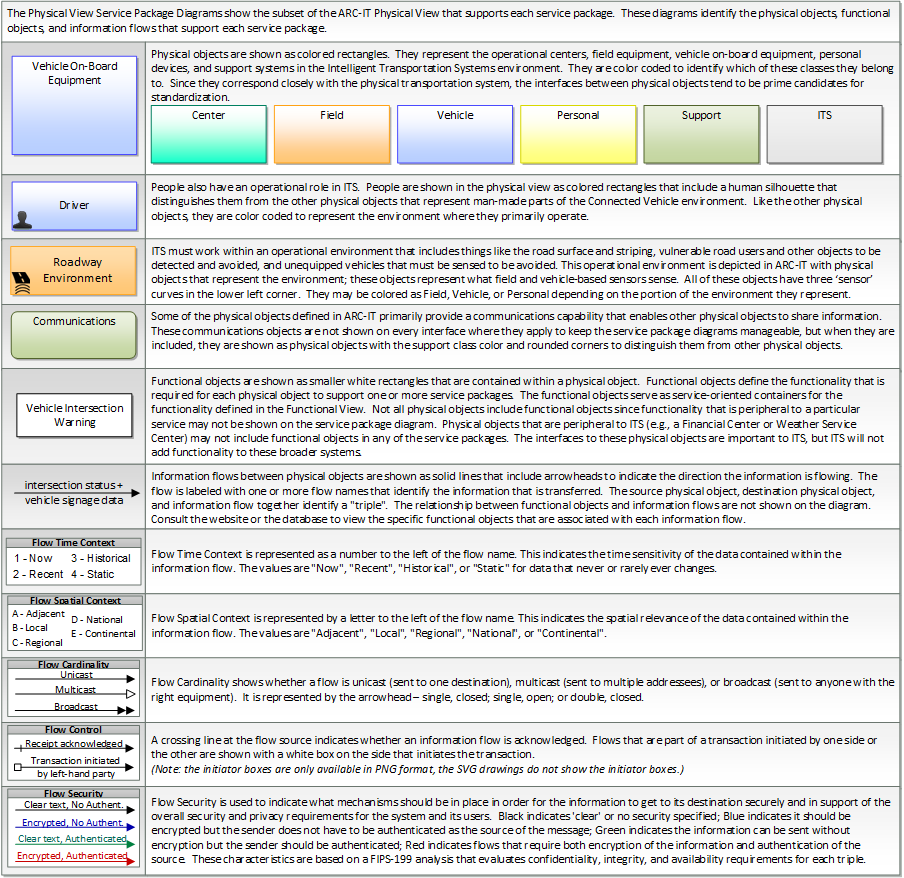
The physical diagram can be viewed in SVG or PNG format and the current format is SVG.SVG Diagram
PNG Diagram

Includes Physical Objects:
| Physical Object | Class | Description |
|---|---|---|
| Driver | Vehicle | The 'Driver' represents the person that operates a vehicle on the roadway. Included are operators of private, transit, commercial, and emergency vehicles where the interactions are not particular to the type of vehicle (e.g., interactions supporting vehicle safety applications). The Driver originates driver requests and receives driver information that reflects the interactions which might be useful to all drivers, regardless of vehicle classification. Information and interactions which are unique to drivers of a specific vehicle type (e.g., fleet interactions with transit, commercial, or emergency vehicle drivers) are covered by separate objects. |
| Personal | Personal | The 'Personal' physical object is used to model core capabilities that are common to more than one physical object in the 'Personal' class. It provides the general executive, management, and utility functions that may be shared by different types of personal devices. |
| Traveler | Personal | The 'Traveler' represents any individual who uses transportation services. The interfaces to the traveler provide general pre-trip and en-route information supporting trip planning, personal guidance, and requests for assistance in an emergency that are relevant to all transportation system users. It also represents users of a public transportation system and addresses interfaces these users have within a transit vehicle or at transit facilities such as roadside stops and transit centers. |
| Vehicle | Vehicle | This 'Vehicle' physical object is used to model core capabilities that are common to more than one type of Vehicle. It provides the vehicle-based general sensory, processing, storage, and communications functions that support efficient, safe, and convenient travel. Many of these capabilities (e.g., see the Vehicle Safety service packages) apply to all vehicle types including personal vehicles (including motorcycles), commercial vehicles, emergency vehicles, transit vehicles, and maintenance vehicles. From this perspective, the Vehicle includes the common interfaces and functions that apply to all motorized vehicles. The radio(s) supporting V2V and V2I communications are a key component of the Vehicle. Both one-way and two-way communications options support a spectrum of information services from basic broadcast to advanced personalized information services. Advanced sensors, processors, enhanced driver interfaces, and actuators complement the driver information services so that, in addition to making informed mode and route selections, the driver travels these routes in a safer and more consistent manner. This physical object supports all six levels of driving automation as defined in SAE J3016. Initial collision avoidance functions provide 'vigilant co-pilot' driver warning capabilities. More advanced functions assume limited control of the vehicle to maintain lane position and safe headways. In the most advanced implementations, this Physical Object supports full automation of all aspects of the driving task, aided by communications with other vehicles in the vicinity and in coordination with supporting infrastructure subsystems. |
Includes Functional Objects:
| Functional Object | Description | Physical Object |
|---|---|---|
| Personal Device Coordination | 'Personal Device Coordination' coordinates with the vehicle on-board equipment (Vehicle OBE), micromobility vehicle (MMV) OBE or similar vehicle class equipment so that the PID for the traveler is not broadcasting conflicting information or is interfering with the OBE for the vehicle that the traveler is traveling on. | Personal |
| Vehicle Device Coordination | 'Vehicle Device Coordination' coordinates with the personal information device (PID) to transition between modes when the device used by the traveler or personnel no longer needs to broadcast safety and other information as well as when it is time to transition back to the personal device. This function also supports cases in which the PID will serve as the proxy for the vehicle onboard equipment and will act as a bridge to provide the vehicle’s status and operating conditions to the PID. | Vehicle |
Includes Information Flows:
| Information Flow | Description |
|---|---|
| device configuration coordination | A handshake between a personal device and a vehicle so the personal device and vehicle don't interfere with each other or send conflicting information. This coordination may result in a personal information device (PID) carried by a traveler not transmitting its current location while on board vehicle, a transit vehicle, or a micromobility vehicle transmitting its vehicle profile and current location. For example, in the carry-in scenario, the personal device might go into a 'quiet' mode when carried into the vehicle that is already equipped with an integrated system that can broadcast safety messages. |
| driver input | Driver input to the vehicle on-board equipment including configuration data, settings and preferences, interactive requests, and control commands. |
| driver updates | Information provided to the driver including visual displays, audible information and warnings, and haptic feedback. The updates inform the driver about current conditions, potential hazards, and the current status of vehicle on-board equipment. |
| traveler input | User input from a traveler to summon assistance, request travel information, make a reservation, or request any other traveler service. |
| traveler interface updates | Visual or audio information (e.g., routes, messages, guidance, emergency information) that is provided to the traveler. |
Goals and Objectives
Associated Planning Factors and Goals
| Planning Factor | Goal |
|---|---|
| B. Increase the safety of the transportation system for motorized and nonmotorized users; | Reduce fatalities and injuries |
| C. Increase the security of the transportation system for motorized and nonmotorized users; | Improve security |
| D. Increase the accessibility and mobility of people and for freight; | Reduce congestion |
Associated Objective Categories 
| Objective Category |
|---|
| Safety: Vehicle Crashes and Fatalities |
| Transit Operations and Management: Safety |
Associated Objectives and Performance Measures
Needs and Requirements
| Need | Functional Object | Requirement | ||
|---|---|---|---|---|
| 01 | Travelers need to be protected from collisions while in the transportation environment. | Personal Device Coordination | 01 | The personal device shall provide safety advisories or warnings to the traveler when the traveler is not inside of a vehicle. |
| 02 | Travelers need to be kept informed of the status of their connected devices in order to know when they transition from one mode to another and that they are still transmitting and receiving pertinent safety information as applicable. | Personal Device Coordination | 02 | The personal device shall inform travelers of the mode of their device and whether they are currently receiving pertinent safety advisories or warnings. |
| 03 | The personal device shall receive a notification from a vehicle that the device is now on a moving vehicle and should transition to a mode where it does not provide personal safety notifications. | |||
| Vehicle Device Coordination | 01 | The vehicle shall notify a personal device that the traveler is in a moving vehicle so that the traveler device can transition modes to one that does not receive personal safety information. | ||
Related Sources
| Document Name | Version | Publication Date |
|---|---|---|
| None |
Security
In order to participate in this service package, each physical object should meet or exceed the following security levels.
| Physical Object Security | ||||
|---|---|---|---|---|
| Physical Object | Confidentiality | Integrity | Availability | Security Class |
| Personal | Low | High | Moderate | Class 3 |
| Vehicle | Low | High | Moderate | Class 3 |
In order to participate in this service package, each information flow triple should meet or exceed the following security levels.
| Information Flow Security | |||||
|---|---|---|---|---|---|
| Source | Destination | Information Flow | Confidentiality | Integrity | Availability |
| Basis | Basis | Basis | |||
| Driver | Vehicle | driver input | Moderate | High | High |
| Data included in this flow may include origin and destination information, which should be protected from other's viewing as it may compromise the driver's privacy. | Commands from from the driver to the vehicle must be correct or the vehicle may behave in an unpredictable and possibly unsafe manner | Commands must always be able to be given or the driver has no control. | |||
| Personal | Traveler | traveler interface updates | Not Applicable | Moderate | Moderate |
| Personalized data that includes directions and guidance for an individual, but eventually evident anyway. | Should be accurate as the Traveler will be relying on this information for routing and related choices. Lack of accuracy will result in lack of confidence from the traveler as well as an unsatisfactory trip, leading to a negative feedback spiral. | Users expect their devices to work. If information is not presented to the operator, the relevant applications simply won't be used. | |||
| Personal | Vehicle | device configuration coordination | Low | High | Moderate |
| Unlikely that any personal or not observable information is included here. | Misconfiguration could cause a malfunction or lead to undesireable vehicle behavior. Will only affect the one vehicle, but could be dangerous to the MMV operator. | Service cannot operate without this flow, and there is no alternative integrated solution. Listed as 'MODERATE' and not 'HIGH' only because loss of these services would be inconvenient and disadvantageous, particulary to vulnerable road users, but not catastrophic. | |||
| Traveler | Personal | traveler input | Not Applicable | Moderate | Low |
| This data is informing the vehicle of operational information that is relevant to the operation of the vehicle. It should not contain anything sensitive, and does not matter if another person can observe it. | While public, information must be correct or travelers may make incorrect decisions with regard to their travel plans. | Information is available through other means, though depending on the location this might not always be the case, in which case this would be MODERATE. | |||
| Vehicle | Driver | driver updates | Not Applicable | Moderate | Moderate |
| This data is informing the driver about the safety of a nearby area. It should not contain anything sensitive, and does not matter if another person can observe it. | This is the information that is presented to the driver. If they receive incorrect information, they may act in an unsafe manner. However, there are other indicators that would alert them to any hazards, such as an oncoming vehicle or crossing safety lights. | If this information is not made available to the driver, then the system has not operated correctly. | |||
| Vehicle | Personal | device configuration coordination | Low | High | Moderate |
| Unlikely that any personal or not observable information is included here. | Misconfiguration could cause a malfunction or lead to undesireable vehicle behavior. Will only affect the one vehicle, but could be dangerous to the MMV operator. | Service cannot operate without this flow, and there is no alternative integrated solution. Listed as 'MODERATE' and not 'HIGH' only because loss of these services would be inconvenient and disadvantageous, particulary to vulnerable road users, but not catastrophic. | |||
Standards
The diagram here shows the primary standards associated with the physical objects and information flows in this service package. Click on the standard # to go to the page explaining that standard in more detail. The tables that follow the diagram list the standards associated with the information flows in this service package that should drive development decisions. Click on the standard name for more information from the Communications View about a particular standard, including the solutions and information flow triples associated with the standard and any gaps or overlaps. This table is based primarily on standards used in North America. For information concerning standards and communications solutions in other regions consult the Communications View.
This material should be considered 'draft for review' and may change separately from ARC-IT version revisions. The date on the diagram relates to the date of the physical service package diagram on which this is based; standards-related information should be considered up-to-date as of the 'last updated' date on this page.
Communication Standards: Standards associated with data, message or dialog definitions, communications protocols and management and security of data exchanges. All standards here are also illustrated in information flow triple communications view diagrams.
No communication standards have been identified for this service package.
Physical Standards: Standards associated with device physical, environmental or performance requirements.
The following table lists the standards associated with physical objects in this service package. Click on the standard name for more information about a particular standard.
| Name | Title |
|---|---|
| SAE J3361 Antenna requirements | V2X Antenna Coverage and Test Requirements for US FHWA Class 1 and Class 3-13 Class Vehicles |
| SAE J5001 OBU Standard | Onboard Unit Standard for Connected Vehicles |
Service-Level Standards: Standards associated service package structure, messaging patterns, user needs, requirements or similar systems-engineering content that describe one or more use cases satisfied by the service package.
No service-level standards have been identified for this service package.
System Requirements
| No System Requirements |