< < PT05.3 : PT06.1 : PT07.1 > >
PT06.1: Transit Fleet Management Implementation
This service package supports automatic transit maintenance scheduling and monitoring. This implementation is a holistic view of the PT06 service package, including all Physical Objects, Functional Objects, and Triples associated with the service package. It distinguishes between items that are fundamental to the service and items that are optional. Your specific implementation is likely to include the fundamental items and selected optional items, based on your specific project requirements.
Relevant Regions: Australia, Canada, European Union, and United States
- Enterprise
- Functional
- Physical
- Goals and Objectives
- Needs and Requirements
- Sources
- Security
- Standards
- System Requirements
Enterprise
Development Stage Roles and Relationships
Installation Stage Roles and Relationships
Operations and Maintenance Stage Roles and Relationships
(hide)
| Source | Destination | Role/Relationship |
|---|---|---|
| Basic Transit Vehicle Maintainer | Basic Transit Vehicle | Maintains |
| Basic Transit Vehicle Manager | Basic Transit Vehicle | Manages |
| Basic Transit Vehicle Manager | Transit Vehicle Operator | System Usage Agreement |
| Basic Transit Vehicle Owner | Basic Transit Vehicle Maintainer | System Maintenance Agreement |
| Basic Transit Vehicle Owner | Basic Transit Vehicle Manager | Operations Agreement |
| Basic Transit Vehicle Owner | Transit Vehicle OBE Maintainer | Maintenance Data Exchange Agreement |
| Basic Transit Vehicle Owner | Transit Vehicle OBE Owner | Expectation of Data Provision |
| Basic Transit Vehicle Owner | Transit Vehicle OBE User | Service Usage Agreement |
| Basic Transit Vehicle Owner | Transit Vehicle Operator | Application Usage Agreement |
| Basic Transit Vehicle Owner | Transit Vehicle Operator | Vehicle Operating Agreement |
| Basic Transit Vehicle Supplier | Basic Transit Vehicle Owner | Warranty |
| Transit Management Center Maintainer | Transit Management Center | Maintains |
| Transit Management Center Manager | Transit Management Center | Manages |
| Transit Management Center Manager | Transit Operations Personnel | System Usage Agreement |
| Transit Management Center Owner | Transit Management Center Maintainer | System Maintenance Agreement |
| Transit Management Center Owner | Transit Management Center Manager | Operations Agreement |
| Transit Management Center Owner | Transit Vehicle OBE Maintainer | Maintenance Data Exchange Agreement |
| Transit Management Center Owner | Transit Vehicle OBE Owner | Information Exchange Agreement |
| Transit Management Center Owner | Transit Vehicle OBE User | Service Usage Agreement |
| Transit Management Center Owner | Transit Vehicle Operator | Application Usage Agreement |
| Transit Management Center Supplier | Transit Management Center Owner | Warranty |
| Transit Operations Personnel | Transit Management Center | Operates |
| Transit Vehicle OBE Maintainer | Transit Vehicle OBE | Maintains |
| Transit Vehicle OBE Manager | Transit Vehicle OBE | Manages |
| Transit Vehicle OBE Manager | Transit Vehicle Operator | System Usage Agreement |
| Transit Vehicle OBE Owner | Transit Management Center Maintainer | Maintenance Data Exchange Agreement |
| Transit Vehicle OBE Owner | Transit Management Center Owner | Information Exchange Agreement |
| Transit Vehicle OBE Owner | Transit Management Center User | Service Usage Agreement |
| Transit Vehicle OBE Owner | Transit Operations Personnel | Application Usage Agreement |
| Transit Vehicle OBE Owner | Transit Vehicle OBE Maintainer | System Maintenance Agreement |
| Transit Vehicle OBE Owner | Transit Vehicle OBE Manager | Operations Agreement |
| Transit Vehicle OBE Supplier | Transit Vehicle OBE Owner | Warranty |
| Transit Vehicle Operator | Basic Transit Vehicle | Operates |
| Transit Vehicle Operator | Transit Vehicle OBE | Operates |
Functional
This service package includes the following Functional View PSpecs:
Physical
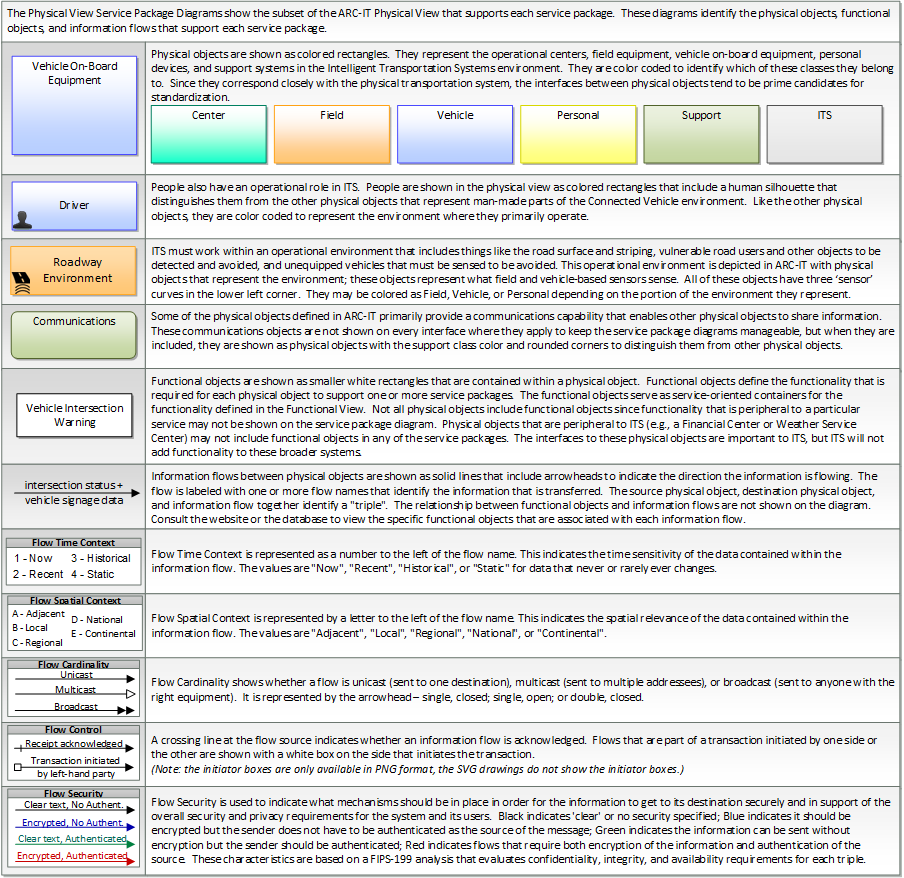
The physical diagram can be viewed in SVG or PNG format and the current format is SVG.SVG Diagram
PNG Diagram
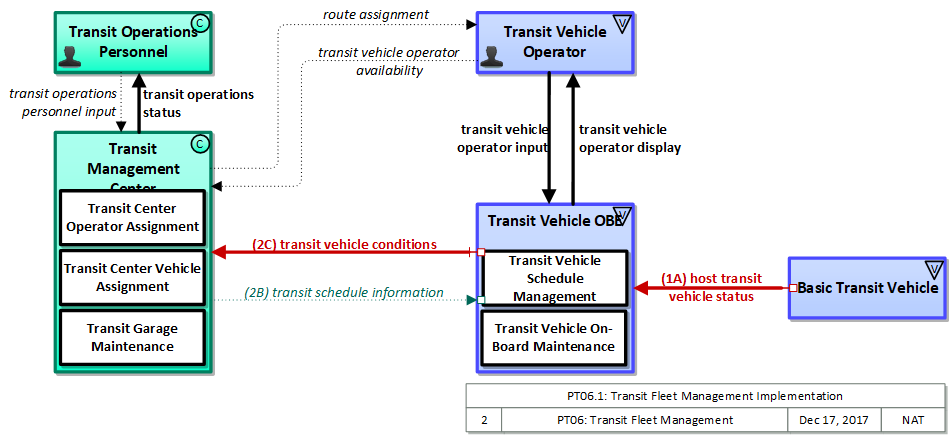

Includes Physical Objects:
| Physical Object | Class | Description |
|---|---|---|
| Basic Transit Vehicle | Vehicle | The 'Basic Transit Vehicle' represents the transit vehicle that hosts the on-board equipment that provides ITS functions. It includes a specialized and extended databus that is subject to different vehicle databus standards and hosts a broad range of components that are unique to a transit vehicle including the farebox and associated electronics, passenger counters, and transit security systems. The Transit Vehicle may represent a bus, paratransit vehicle, light rail vehicle, or other vehicle designed to carry passengers. |
| Transit Management Center | Center | The 'Transit Management Center' manages transit vehicle fleets and coordinates with other modes and transportation services. It provides operations, maintenance, customer information, planning and management functions for the transit property. It spans distinct central dispatch and garage management systems and supports the spectrum of fixed route, flexible route, paratransit services, transit rail, and bus rapid transit (BRT) service. The physical object's interfaces support communication between transit departments and with other operating entities such as emergency response services and traffic management systems. |
| Transit Operations Personnel | Center | 'Transit Operations Personnel' represents the people that are responsible for fleet management, maintenance operations, and scheduling activities of the transit system. These different roles represent a variety of individuals in the transit industry. Within the transit industry the person responsible for fleet management is known by many names: Street Supervisor, Starter, Dispatcher, Supervisor, Traffic Controller, Transportation Coordinator. This person actively monitors, controls, and modifies the transit fleet routes and schedules on a day to day basis (dynamic scheduling). The modifications will take account of abnormal situations such as vehicle breakdown, vehicle delay, detours around work zones or incidents (detour management, connection protection, and service restoration), and other causes of route or schedule deviations. Transit operations personnel are also responsible for demand responsive transit operation and for managing emergency situations within the transit network such as silent alarms on board transit vehicles, or the remote disabling of the vehicle. In addition the Transit Operations Personnel may be responsible for assigning vehicle operators to routes, checking vehicle operators in and out, and managing transit stop issues. This object also represents the personnel in the transit garage that are responsible for maintenance of the transit fleets, including monitoring vehicle status, matching vehicles with operators, and maintenance checking of transit vehicles. Finally, it represents the people responsible for planning, development, and management of transit routes and schedules. |
| Transit Vehicle OBE | Vehicle | The 'Transit Vehicle On-Board Equipment' (OBE) resides in a transit vehicle and provides the sensory, processing, storage, and communications functions necessary to support safe and efficient movement of passengers. The types of transit vehicles containing this physical object include buses, paratransit vehicles, light rail vehicles, other vehicles designed to carry passengers, and supervisory vehicles. It collects ridership levels and supports electronic fare collection. It supports a traffic signal prioritization function that communicates with the roadside physical object to improve on-schedule performance. Automated vehicle location enhances the information available to the transit operator enabling more efficient operations. On-board sensors support transit vehicle maintenance. The physical object supports on-board security and safety monitoring. This monitoring includes transit user or vehicle operator activated alarms (silent or audible), as well as surveillance and sensor equipment. The surveillance equipment includes video (e.g. CCTV cameras), audio systems and/or event recorder systems. It also furnishes travelers with real-time travel information, continuously updated schedules, transfer options, routes, and fares. A separate 'Vehicle OBE' physical object supports the general vehicle safety and driver information capabilities that apply to all vehicles, including transit vehicles. The Transit Vehicle OBE supplements these general capabilities with capabilities that are specific to transit vehicles. |
| Transit Vehicle Operator | Vehicle | The 'Transit Vehicle Operator' represents the person that receives and provides additional information that is specific to operating the ITS functions in all types of transit vehicles. The information received by the operator would include status of on-board systems. Additional information received depends upon the type of transit vehicle. In the case of fixed route transit vehicles, the Transit Vehicle Operator would receive operator instructions that might include actions to take to correct schedule deviations. In the case of flexible fixed routes and demand response routes the information would also include dynamic routing or passenger pickup information. |
Includes Functional Objects:
| Functional Object | Description | Physical Object |
|---|---|---|
| Transit Center Operator Assignment | 'Transit Center Operator Assignment' automates and supports the assignment of transit vehicle operators to runs. It assigns operators to runs in a fair manner while minimizing labor and overtime services, considering operator preferences and qualifications, and automatically tracking and validating the number of work hours performed by each individual operator. It also provides an exception handling process for the operator assignment function to generate supplemental operator assignments when required by changes during the operating day. | Transit Management Center |
| Transit Center Vehicle Assignment | 'Transit Center Vehicle Assignment' assigns individual transit vehicles to vehicle blocks and downloads this information to the transit vehicle. It also provides an exception handling process for the vehicle assignment function to generate new, supplemental vehicle assignments when required by changes during the operating day. It provides an inventory management function for the transit facility which stores functional attributes about each of the vehicles owned by the transit operator. These attributes permit the planning and assignment functions to match vehicles with routes based on suitability for the types of service required by the particular routes. | Transit Management Center |
| Transit Garage Maintenance | 'Transit Garage Maintenance' provides advanced maintenance functions for the transit property. It collects operational and maintenance data from transit vehicles, manages vehicle service histories, and monitors operators and vehicles. It collects vehicle mileage data and uses it to automatically generate preventative maintenance schedules for each vehicle by utilizing vehicle tracking data. In addition, it provides information to service personnel to support maintenance activities and records and verifies that maintenance work was performed. | Transit Management Center |
| Transit Vehicle On-Board Maintenance | 'Transit Vehicle On-Board Maintenance' collects and processes transit vehicle maintenance data on-board the vehicle, including mileage and vehicle operating conditions. This maintenance information is provided to the management center and used to schedule future vehicle maintenance and repair. | Transit Vehicle OBE |
| Transit Vehicle Schedule Management | 'Transit Vehicle Schedule Management' monitors schedule performance and identifies corrective actions when a deviation is detected. It provides two-way communication between the transit vehicle and center, enabling the center to communicate with the vehicle operator and monitor on-board systems. | Transit Vehicle OBE |
Includes Information Flows:
| Information Flow | Description |
|---|---|
| host transit vehicle status | Information provided to the ITS on-board equipment from other systems on the Transit Vehicle Platform. |
| route assignment | Route assignment information for transit vehicle operator. |
| transit operations personnel input | User input from transit operations personnel including instructions governing service availability, schedules, emergency response plans, transit personnel assignments, transit maintenance requirements, and other inputs that establish general system operating requirements and procedures. |
| transit operations status | Presentation of information to transit operations personnel including accumulated schedule and fare information, ridership and on-time performance information, emergency response plans, transit personnel information, maintenance records, and other information intended to support overall planning and management of a transit property. |
| transit schedule information | Current and projected transit schedule information used to initialize the transit vehicle with a vehicle assignment, monitor schedule performance, and develop corrective actions on-board. |
| transit vehicle conditions | Operating conditions of transit vehicle (e.g., engine running, oil pressure, fuel level and usage). It includes status of other on-board systems including user displays, passenger counters, and security systems. This overall status information is also collected from unused (out of service) vehicles. |
| transit vehicle operator availability | Transit vehicle operator availability data that can be used to develop vehicle operator assignments and detailed operations schedules. |
| transit vehicle operator display | Visual, audible, and tactile outputs to the transit vehicle operator including vehicle surveillance information, alarm information, vehicle system status, information from the operations center, and information indicating the status of all other on-board ITS services. |
| transit vehicle operator input | Transit vehicle operator inputs to on-board ITS equipment, including tactile and verbal inputs. Includes authentication information, on-board system control, emergency requests, and fare transaction data. |
Goals and Objectives
Associated Planning Factors and Goals
| Planning Factor | Goal |
|---|---|
| H. Emphasize the preservation of the existing transportation system; | Maintain infrastructure asset system |
Associated Objective Categories 
| Objective Category |
|---|
| Preservation: Transit Maintenance |
Associated Objectives and Performance Measures
Needs and Requirements
| Need | Functional Object | Requirement | ||
|---|---|---|---|---|
| 01 | Transit Operations needs to able to remotely monitor transit vehicle operating conditions in order to determine if maintenance of the vehicle is needed. | Transit Garage Maintenance | 01 | The center shall collect operational and maintenance data from transit vehicles. |
| 02 | The center shall monitor the condition of a transit vehicle to analyze brake, drive train, sensors, fuel, steering, tire, processor, communications equipment, and transit vehicle mileage to identify mileage based maintenance, out-of-specification or imminent failure conditions. | |||
| Transit Vehicle On-Board Maintenance | 01 | The transit vehicle shall collect and process vehicle mileage data available to sensors on-board. | ||
| 02 | The transit vehicle shall collect and process the transit vehicle's operating conditions such as engine temperature, oil pressure, brake wear, internal lighting, environmental controls, etc. | |||
| 03 | The transit vehicle shall transmit vehicle maintenance data to the center to be used for scheduling future vehicle maintenance. | |||
| 02 | Transit Operations needs to be able to perform maintenance scheduling of transit vehicles including real time requests for actions by the vehicle operator. | Transit Garage Maintenance | 03 | The center shall generate transit vehicle maintenance schedules that identify the maintenance or repair to be performed and when the work is to be done. |
| 04 | The center shall generate transit vehicle availability listings, current and forecast, to support transit vehicle assignment planning based, in part, on the transit vehicle maintenance schedule. | |||
| 05 | The center shall assign technicians to a transit vehicle maintenance schedule, based upon such factors as personnel eligibility, work assignments, preferences and seniority. | |||
| 06 | The center shall verify that the transit vehicle maintenance activities were performed correctly, using the transit vehicle's status, the maintenance personnel's work assignment, and the transit maintenance schedules. | |||
| 07 | The center shall generate a time-stamped maintenance log of all maintenance activities performed on a transit vehicle. | |||
| 08 | The center shall provide transit operations personnel with the capability to update transit vehicle maintenance information and receive reports on all transit vehicle operations data. | |||
| Transit Vehicle Schedule Management | 01 | The transit vehicle shall receive a vehicle assignment including transit route information, transit service instructions, traffic information, road conditions, and other information for the operator. | ||
| 03 | Transit Operations needs to be able to assign specific vehicles to blocks in order to perform vehicle allocation. | Transit Center Vehicle Assignment | 01 | The center shall assign individual transit vehicles to transit blocks. |
| 02 | The center shall download vehicle assignments to the transit vehicle prior to the start of the day’s operations. | |||
| 03 | The center shall provide an exception handling process for the vehicle assignment function. This process shall generate new supplemental vehicle assignments as required due to change events which occur during the operating day. | |||
| 04 | The center shall provide an inventory management function for the transit facility that stores functional attributes about each vehicle owned by the transit operator. The functional attributes permit the planning and assignment functions to match vehicles with routes based on suitability for the types of service required by the particular routes. | |||
| 05 | The center shall generate transit vehicle availability listings, current and forecast, to support transit vehicle assignment planning. | |||
| 06 | The center shall provide transit operations personnel with the capability to update transit vehicle assignments and receive reports on transit vehicle inventory status. | |||
| 04 | Transit Operations needs to be able to assign transit operators to runs. | Transit Center Operator Assignment | 01 | The center shall maintain records of a transit vehicle operator's performance. This may be done utilizing standardized performance evaluation criteria set forth by governmental regulations and transit operating company policies, assessing the transit vehicle operator's driving history, and assessing comments from the transit vehicle operator's supervisor(s) as well as noting any moving violations or accidents, supervisor comments, government regulations, and company policies. |
| 02 | The center shall assess the transit vehicle operator's availability based on previous work assignments, accumulated hours, plus health and vacation commitments. | |||
| 03 | The center shall assign transit vehicle operators to transit schedules based on their eligibility, route preferences, seniority, and transit vehicle availability. | |||
| 04 | The center shall provide an interface through which the transit vehicle operator information can be maintained - either from the transit vehicle operator, center personnel, or other functions. | |||
| 05 | The center shall generate supplemental vehicle operator assignments as required due to change events that occur during the operating day. | |||
Related Sources
| Document Name | Version | Publication Date |
|---|---|---|
| None |
Security
In order to participate in this service package, each physical object should meet or exceed the following security levels.
| Physical Object Security | ||||
|---|---|---|---|---|
| Physical Object | Confidentiality | Integrity | Availability | Security Class |
| Basic Transit Vehicle | ||||
| Transit Management Center | Moderate | Moderate | Moderate | Class 2 |
| Transit Vehicle OBE | Moderate | Moderate | Moderate | Class 2 |
In order to participate in this service package, each information flow triple should meet or exceed the following security levels.
| Information Flow Security | |||||
|---|---|---|---|---|---|
| Source | Destination | Information Flow | Confidentiality | Integrity | Availability |
| Basis | Basis | Basis | |||
| Basic Transit Vehicle | Transit Vehicle OBE | host transit vehicle status | Moderate | Moderate | Moderate |
| This can include some sensitive data. However, other data, such as vehicle location and motion will then be broadcast. There also may be proprietary information included in this. DISC THEA believes this to be LOW: "sensor data is not confidential; harm should not come from seeing status." | This is used later on to determine whether a vehicle should request priority at an intersection. If this information is incorrect the vehicle may make false requests. All other flows that use the data from this flow have a MODERATE integrity requirement, therefore, this must also have a MODERATE integrity requirement. DISC: THEA believes this should be HIGH: "sensor data needs to be accurate and should not be tampered with." | This information would need to be available immediately for the application to work.DISC: THEA believes this should be HIGH: "sensor data must be consistently available to feed BSMs broadcast at 10Hz, notifications, etc.." | |||
| Transit Management Center | Transit Operations Personnel | transit operations status | Moderate | High | High |
| Backoffice operations flows should have minimal protection from casual viewing, as otherwise imposters could gain illicit control or information that should not be generally available. | Backoffice operations flows should generally be correct and available as these are the primary interface between operators and system. | Backoffice operations flows should generally be correct and available as these are the primary interface between operators and system. | |||
| Transit Management Center | Transit Vehicle OBE | transit schedule information | Low | Moderate | Moderate |
| This information is not sensitive. It is generally made public, to support transit system functionality. | This data contains the vehicle assignment. It should be accurate, and not easily modified. However, the bus drivers will have some knowledge about what a reasonable configuration is, and should be able to notice any unusual configurations, such as all busses being a #27. | This information is necessary for the TSP to work correctly. A few missed messages will not have a large impact. The Transit Management Center needs to know if the TV OBE does not receive the message, so it can resend it. | |||
| Transit Management Center | Transit Vehicle Operator | route assignment | Moderate | High | High |
| Backoffice operations flows should have minimal protection from casual viewing, as otherwise imposters could gain illicit control or information that should not be generally available. | Backoffice operations flows should generally be correct and available as these are the primary interface between operators and system. | Backoffice operations flows should generally be correct and available as these are the primary interface between operators and system. | |||
| Transit Operations Personnel | Transit Management Center | transit operations personnel input | Moderate | High | High |
| Backoffice operations flows should have minimal protection from casual viewing, as otherwise imposters could gain illicit control or information that should not be generally available. | Backoffice operations flows should generally be correct and available as these are the primary interface between operators and system. | Backoffice operations flows should generally be correct and available as these are the primary interface between operators and system. | |||
| Transit Vehicle OBE | Transit Management Center | transit vehicle conditions | Moderate | Moderate | Moderate |
| Basic diagnostic information should not be sensitive, but any warnings or alarms could be, particularly if they are related to an incident or hostile event related to the vehicle. Such information could be used as part of damage assessment or target identification. | This needs to be accurate to properly schedule maintenance activities (for the basic maintenance data items) and to properly respond to warning indicators. If corrupted or unavailable, there could be a significant repurcussion for the vehicle and by extension, the vehicle operator. | This needs to be accurate to properly schedule maintenance activities (for the basic maintenance data items) and to properly respond to warning indicators. If corrupted or unavailable, there could be a significant repurcussion for the vehicle and by extension, the vehicle operator. | |||
| Transit Vehicle OBE | Transit Vehicle Operator | transit vehicle operator display | Low | Moderate | Low |
| This should not include any sensitive information. It would be possible for a person standing behind the driver to observe the information transmitted. | Some minimal guarantee of data integrity is necessary for all C-ITS flows. This entire application should not directly affect the drivers driving habits. The operator should still be slowing and stopping at yellow or red lights, along with observing all other driving regulations. DISC: Original V2I analysis classified this as LOW. | Even if the operator is not made aware of the signal preemption, the system should still operate correctly. The operator should be using the traffic lights to influence their decision about whether or not to stop, not the display. | |||
| Transit Vehicle Operator | Transit Management Center | transit vehicle operator availability | Moderate | Moderate | Moderate |
| PII by definition, including when an operator may be working and when he may not. | Will be used to make operator assignments; if this data is corrupted or not available those assignments may be made in error. | Will be used to make operator assignments; if this data is corrupted or not available those assignments may be made in error or not include those operators for whom the flow was interrupted. | |||
| Transit Vehicle Operator | Transit Vehicle OBE | transit vehicle operator input | Low | Moderate | Low |
| This information is transmitted through systems on board the Transit Vehicle. Even if the vehicle were compromised and these communications monitored, most of this information is directly observable. | Some minimal guarantee of data integrity is necessary for all C-ITS flows. If this is compromised, it could result in an incorrect signal priority request, which has minimal impact. DISC: Original V2I analysis classified this as LOW. | A delay in reporting this may result in a signal priority request not going through, which has minimal impact. | |||
Standards
The diagram here shows the primary standards associated with the physical objects and information flows in this service package. Click on the standard # to go to the page explaining that standard in more detail. The tables that follow the diagram list the standards associated with the information flows in this service package that should drive development decisions. Click on the standard name for more information from the Communications View about a particular standard, including the solutions and information flow triples associated with the standard and any gaps or overlaps. This table is based primarily on standards used in North America. For information concerning standards and communications solutions in other regions consult the Communications View.
This material should be considered 'draft for review' and may change separately from ARC-IT version revisions. The date on the diagram relates to the date of the physical service package diagram on which this is based; standards-related information should be considered up-to-date as of the 'last updated' date on this page.
Communication Standards: Standards associated with data, message or dialog definitions, communications protocols and management and security of data exchanges. All standards here are also illustrated in information flow triple communications view diagrams.
| Name | Title |
|---|---|
| ITS Application Entity | |
| General Transit Feed Specification - Schedule | General Transit Feed Specification |
| TCIP - Data | Transit Communications Interface Profiles - TCIP Data and Dialog Definitions |
| Facilities Layer | |
| Encoding Alternatives | Encoding schemes that can be used as alternatives |
| IETF RFC 4180 CSV Files | Common Format and MIME Type for Comma-Separated Values (CSV) Files |
| IETF RFC 7159 JSON | The JavaScript Object Notation (JSON) Data Interchange Format |
| IETF RFC 9110 HTTP Semantics | HTTP Semantics |
| IETF RFC 9112 HTTP/1.1 | HTTP/1.1 |
| ISO 21320-1 ZIP | Information technology — Document Container File — Part 1: Core |
| Security Entity | |
| Secure Session Alternatives | Secure Session Alternatives |
| Management Entity | |
| Bundle: SNMPv3 MIB | SNMPv3 & Networking MIBs |
| Networking and Transport Layer | |
| Internet Transport Alternatives | Internet Transport Alternatives |
| IP Alternatives | Internet Protocol Alternative Set |
| Access Layer | |
| Wireless Internet Alternatives (NA) | Wireless Internet Alternatives according to North American standards |
Physical Standards: Standards associated with device physical, environmental or performance requirements.
The following table lists the standards associated with physical objects in this service package. Click on the standard name for more information about a particular standard.
| Name | Title |
|---|---|
| ISO 24100 Probe Vehicle Data Protection | Intelligent transport systems -- Basic principles for personal data protection in probe vehicle information services |
| SAE J3361 Antenna requirements | V2X Antenna Coverage and Test Requirements for US FHWA Class 1 and Class 3-13 Class Vehicles |
| SAE J5001 OBU Standard | Onboard Unit Standard for Connected Vehicles |
Service-Level Standards: Standards associated service package structure, messaging patterns, user needs, requirements or similar systems-engineering content that describe one or more use cases satisfied by the service package.
No service-level standards have been identified for this service package.
System Requirements
| No System Requirements |