Kind: Subsystem
Class: Vehicle
Type: System
Transit Vehicle OBE
Overview
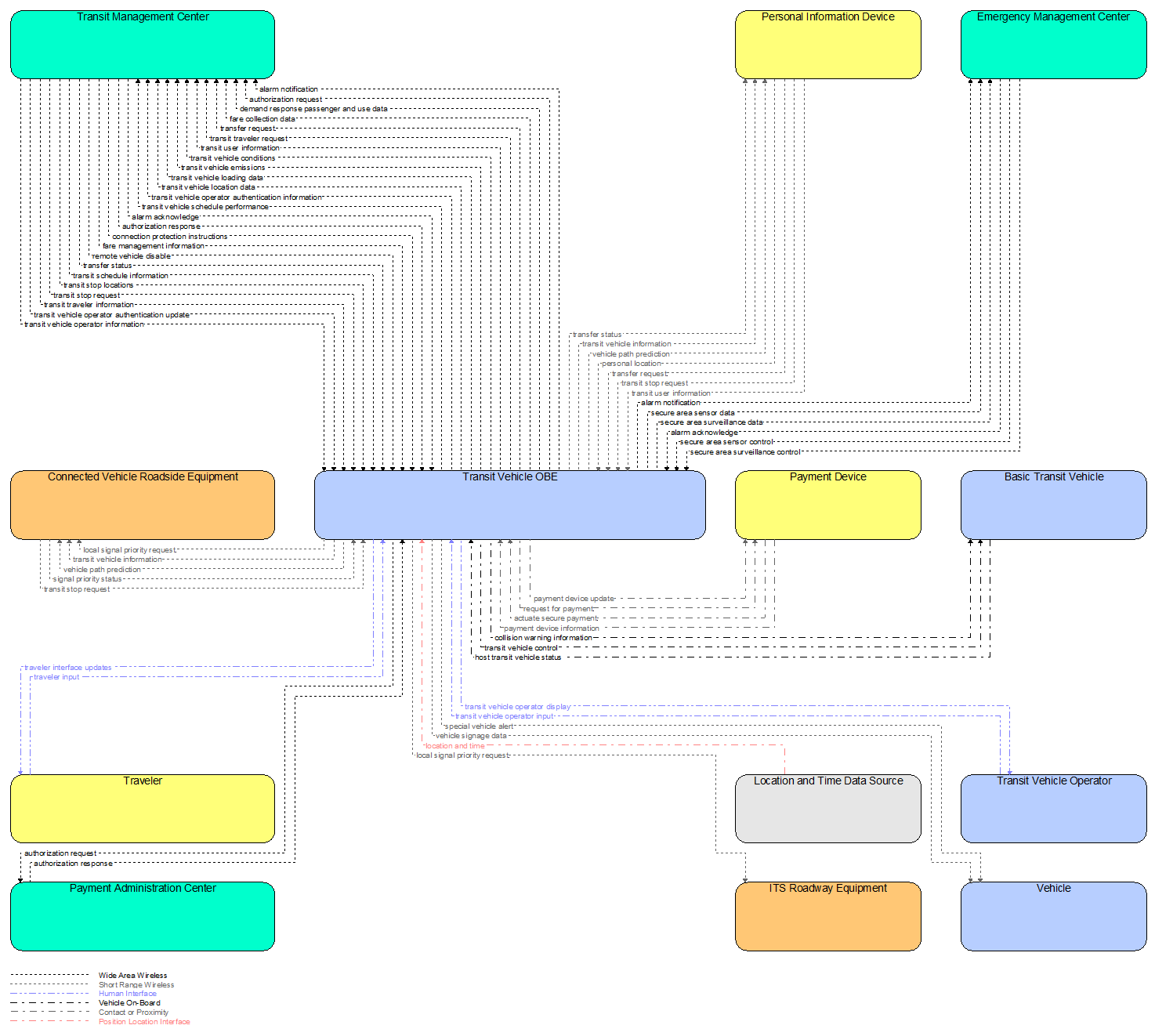
The 'Transit Vehicle On-Board Equipment' (OBE) resides in a transit vehicle and provides the sensory, processing, storage, and communications functions necessary to support safe and efficient movement of passengers. The types of transit vehicles containing this physical object include buses, paratransit vehicles, light rail vehicles, other vehicles designed to carry passengers, and supervisory vehicles. It collects ridership levels and supports electronic fare collection. It supports a traffic signal prioritization function that communicates with the roadside physical object to improve on-schedule performance. Automated vehicle location enhances the information available to the transit operator enabling more efficient operations. On-board sensors support transit vehicle maintenance. The physical object supports on-board security and safety monitoring. This monitoring includes transit user or vehicle operator activated alarms (silent or audible), as well as surveillance and sensor equipment. The surveillance equipment includes video (e.g. CCTV cameras), audio systems and/or event recorder systems. It also furnishes travelers with real-time travel information, continuously updated schedules, transfer options, routes, and fares. A separate 'Vehicle OBE' physical object supports the general vehicle safety and driver information capabilities that apply to all vehicles, including transit vehicles. The Transit Vehicle OBE supplements these general capabilities with capabilities that are specific to transit vehicles.
This physical object is included in the following Service Packages:
- PS10: Wide-Area Alert
- PT01: Transit Vehicle Tracking
- PT02: Transit Fixed-Route Operations
- PT03: Dynamic Transit Operations
- PT04: Transit Fare Collection Management
- PT05: Transit Security
- PT06: Transit Fleet Management
- PT07: Transit Passenger Counting
- PT08: Transit Traveler Information
- PT09: Transit Signal Priority
- PT10: Intermittent Bus Lanes
- PT11: Transit Pedestrian Indication
- PT12: Transit Vehicle at Station/Stop Warnings
- PT13: Vehicle Turning Right in Front of a Transit Vehicle
- PT14: Multi-modal Coordination
- PT15: Transit Stop Request
- PT16: Route ID for the Visually Impaired
- PT17: Transit Connection Protection
- PT18: Low Speed Automated Driving for Predefined Routes
- ST01: Emissions Monitoring
- TI05: Integrated Multi-Modal Electronic Payment
- TI07: In-Vehicle Signage
- VS04: Special Vehicle Alert
Functionality
Triples
Security
This physical object has the following security levels for the associated service packages.
Interfaces Diagram
Standards
The following table lists the standards associated with the physical object itself (as opposed to standards associated with an interface). For standards related to interfaces, see the specific information flow triple pages.
| Name | Title |
|---|---|
| ISO 21734-1 Automated Bus framework | Intelligent transport systems — Performance testing for connectivity and safety functions of automated driving buses in public transport Part 1: General framework |
| ISO 21734-2 Automated Bus requirements | Public transport — Performance testing for connectivity and safety functions of automated driving bus Part 2: Performance requirements and test procedures |
| ISO/SAE PAS 22736 Automation Taxonomy | Taxonomy and Definitions for Terms Related to Driving Automation Systems for On-Road Motor Vehicles |
| SAE J3016 Automation Taxonomy | Taxonomy and Definitions for Terms Related to Driving Automation Systems for On-Road Motor Vehicles |
| SAE J3361 Antenna requirements | V2X Antenna Coverage and Test Requirements for US FHWA Class 1 and Class 3-13 Class Vehicles |
| SAE J5001 OBU Standard | Onboard Unit Standard for Connected Vehicles |