< < TM06.2 : TM07.1 : TM08.1 > >
TM07.1: Regional Traffic Management Implementation
This service package provides for the sharing of information and control among traffic management centers to support regional traffic management strategies. This implementation is a holistic view of the TM07 service package, including all Physical Objects, Functional Objects, and Triples associated with the service package. It distinguishes between items that are fundamental to the service and items that are optional. Your specific implementation is likely to include the fundamental items and selected optional items, based on your specific project requirements.
Relevant Regions: Australia, Canada, European Union, and United States
- Enterprise
- Functional
- Physical
- Goals and Objectives
- Needs and Requirements
- Sources
- Security
- Standards
- System Requirements
Enterprise
Development Stage Roles and Relationships
Installation Stage Roles and Relationships
Operations and Maintenance Stage Roles and Relationships
(hide)
| Source | Destination | Role/Relationship |
|---|---|---|
| Other Traffic Management Centers Maintainer | Other Traffic Management Centers | Maintains |
| Other Traffic Management Centers Manager | Other Traffic Management Centers | Manages |
| Other Traffic Management Centers Manager | Other Traffic Management Centers Operator | System Usage Agreement |
| Other Traffic Management Centers Operator | Other Traffic Management Centers | Operates |
| Other Traffic Management Centers Owner | Other Traffic Management Centers Maintainer | System Maintenance Agreement |
| Other Traffic Management Centers Owner | Other Traffic Management Centers Manager | Operations Agreement |
| Other Traffic Management Centers Owner | Traffic Management Center Maintainer | Maintenance Data Exchange Agreement |
| Other Traffic Management Centers Owner | Traffic Management Center Owner | Information Exchange Agreement |
| Other Traffic Management Centers Owner | Traffic Management Center User | Service Usage Agreement |
| Other Traffic Management Centers Owner | Traffic Operations Personnel | Application Usage Agreement |
| Other Traffic Management Centers Supplier | Other Traffic Management Centers Owner | Warranty |
| Traffic Management Center Maintainer | Traffic Management Center | Maintains |
| Traffic Management Center Manager | Traffic Management Center | Manages |
| Traffic Management Center Manager | Traffic Operations Personnel | System Usage Agreement |
| Traffic Management Center Owner | Other Traffic Management Centers Maintainer | Maintenance Data Exchange Agreement |
| Traffic Management Center Owner | Other Traffic Management Centers Operator | Application Usage Agreement |
| Traffic Management Center Owner | Other Traffic Management Centers Owner | Information Exchange Agreement |
| Traffic Management Center Owner | Other Traffic Management Centers User | Service Usage Agreement |
| Traffic Management Center Owner | Traffic Management Center Maintainer | System Maintenance Agreement |
| Traffic Management Center Owner | Traffic Management Center Manager | Operations Agreement |
| Traffic Management Center Supplier | Traffic Management Center Owner | Warranty |
| Traffic Operations Personnel | Traffic Management Center | Operates |
Functional
This service package includes the following Functional View PSpecs:
Physical
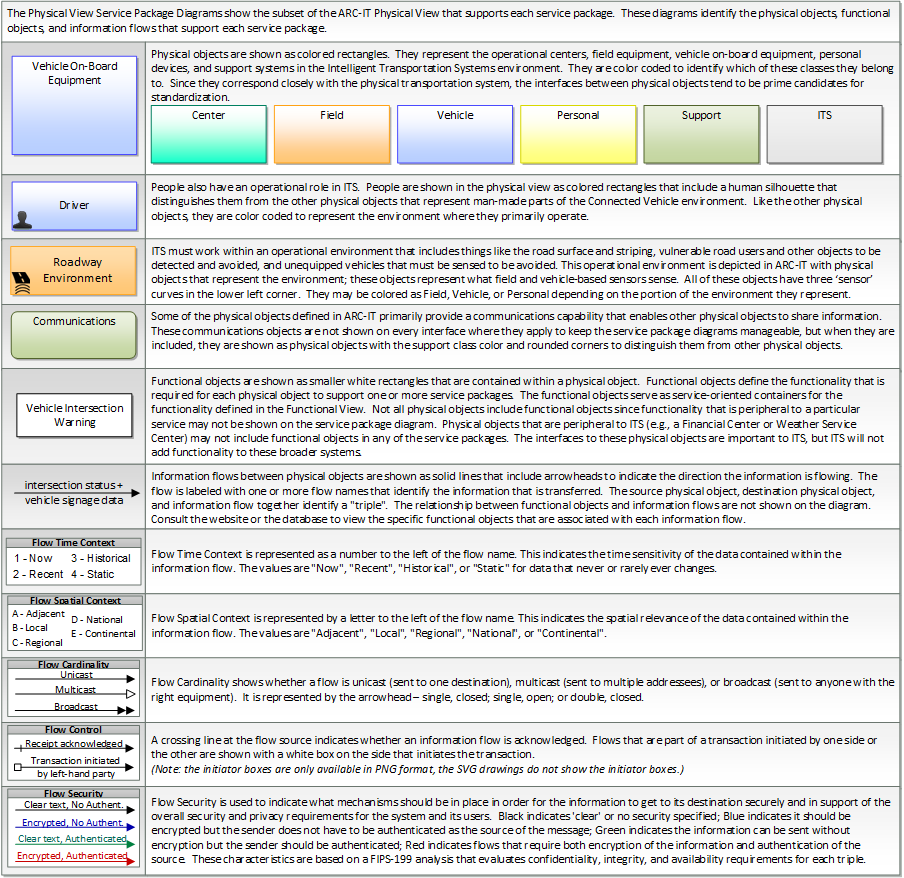
The physical diagram can be viewed in SVG or PNG format and the current format is SVG.SVG Diagram
PNG Diagram
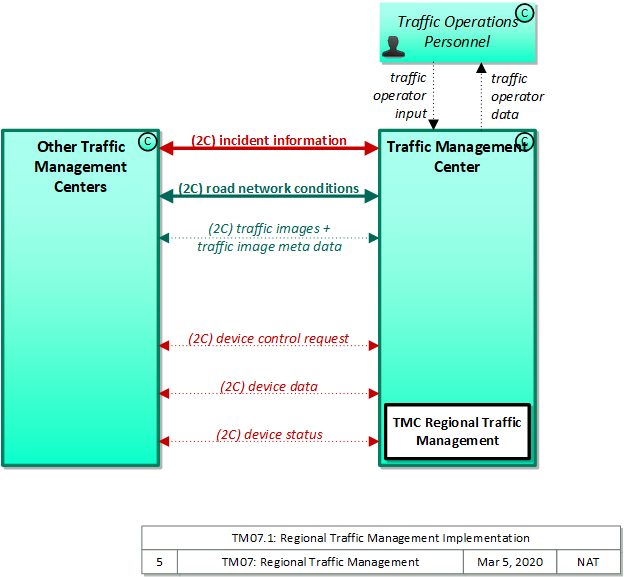

Includes Physical Objects:
| Physical Object | Class | Description |
|---|---|---|
| Other Traffic Management Centers | Center | Representing another Traffic Management Center, 'Other Traffic Management Centers' is intended to provide a source and destination for information exchange between peer (e.g. inter-regional) traffic management functions. It enables traffic management activities to be coordinated across different jurisdictional areas. |
| Traffic Management Center | Center | The 'Traffic Management Center' monitors and controls traffic and the road network. It represents centers that manage a broad range of transportation facilities including freeway systems, rural and suburban highway systems, and urban and suburban traffic control systems. It communicates with ITS Roadway Equipment and Connected Vehicle Roadside Equipment (RSE) to monitor and manage traffic flow and monitor the condition of the roadway, surrounding environmental conditions, and field equipment status. It manages traffic and transportation resources to support allied agencies in responding to, and recovering from, incidents ranging from minor traffic incidents through major disasters. |
| Traffic Operations Personnel | Center | 'Traffic Operations Personnel' represents the people that operate a traffic management center. These personnel interact with traffic control systems, traffic surveillance systems, incident management systems, work zone management systems, and travel demand management systems. They provide operator data and command inputs to direct system operations to varying degrees depending on the type of system and the deployment scenario. |
Includes Functional Objects:
| Functional Object | Description | Physical Object |
|---|---|---|
| TMC Regional Traffic Management | 'TMC Regional Traffic Management' supports coordination between Traffic Management Centers in order to share traffic information between centers as well as control of traffic management field equipment. This coordination supports wide area optimization and regional coordination that spans jurisdictional boundaries; for example, coordinated signal control in a metropolitan area or coordination between freeway operations and arterial signal control within a corridor. | Traffic Management Center |
Includes Information Flows:
| Information Flow | Description |
|---|---|
| device control request | Request for device control action |
| device data | Data from detectors, environmental sensor stations, roadside equipment, and traffic control devices, including device inventory information. |
| device status | Status information from devices |
| incident information | Notification of existence of incident and expected severity, location, time and nature of incident. As additional information is gathered and the incident evolves, updated incident information is provided. Incidents include any event that impacts transportation system operation ranging from routine incidents (e.g., disabled vehicle at the side of the road) through large-scale natural or human-caused disasters that involve loss of life, injuries, extensive property damage, and multi-jurisdictional response. This also includes special events, closures, and other planned events that may impact the transportation system. |
| road network conditions | Current and forecasted traffic information, road and weather conditions, and other road network status. Either raw data, processed data, or some combination of both may be provided by this flow. Information on diversions and alternate routes, closures, and special traffic restrictions (lane/shoulder use, weight restrictions, width restrictions, HOV requirements) in effect is included. |
| traffic image meta data | Meta data that describes traffic images. Traffic images (video) are in another flow. |
| traffic images | High fidelity, real-time traffic images suitable for surveillance monitoring by the operator or for use in machine vision applications. This flow includes the images. Meta data that describes the images is contained in another flow. |
| traffic operator data | Presentation of traffic operations data to the operator including traffic conditions, current operating status of field equipment, maintenance activity status, incident status, video images, security alerts, emergency response plan updates and other information. This data keeps the operator appraised of current road network status, provides feedback to the operator as traffic control actions are implemented, provides transportation security inputs, and supports review of historical data and preparation for future traffic operations activities. |
| traffic operator input | User input from traffic operations personnel including requests for information, configuration changes, commands to adjust current traffic control strategies (e.g., adjust signal timing plans, change DMS messages), and other traffic operations data entry. |
Goals and Objectives
Associated Planning Factors and Goals
| Planning Factor | Goal |
|---|---|
| A. Support the economic vitality of the metropolitan area, especially by enabling global competitiveness, productivity, and efficiency; | Improve freight network |
| D. Increase the accessibility and mobility of people and for freight; | Reduce congestion |
| E. Protect and enhance the environment, promote energy conservation, improve the quality of life, and promote consistency between transportation improvements and State and local planned growth and economic development patterns; | Protect/Enhance the Environment |
| F. Enhance the integration and connectivity of the transportation system, across and between modes, for people and freight; | Enhance integration and connectivity |
| G. Promote efficient system management and operation; | Improve efficiency |
| I. Improve the resiliency and reliability of the transportation system and reduce or mitigate stormwater impacts of surface transportation; | Improve resiliency and reliability |
| J. Enhance travel and tourism. | Support travel and tourism |
Associated Objective Categories 
Associated Objectives and Performance Measures
Needs and Requirements
| Need | Functional Object | Requirement | ||
|---|---|---|---|---|
| 01 | Traffic Operations need to exchange traffic and incident data with other Traffic Management Centers in order to support regional coordination spanning jurisdictional boundaries. | TMC Regional Traffic Management | 01 | The center shall exchange traffic information with other traffic management centers including incident information, congestion data, traffic data, signal timing plans, and real-time signal control information. |
| 02 | Traffic Operations need to exchange traffic control data with other traffic management centers to support inter-jurisdictional, real-time coordinated traffic signal control systems and coordination between freeway operations and traffic signal control within a corridor. | TMC Regional Traffic Management | 02 | The center shall exchange traffic control information with other traffic management centers to support remote monitoring and control of traffic management devices (e.g. signs, sensors, signals, cameras, etc.). |
Related Sources
| Document Name | Version | Publication Date |
|---|---|---|
| None |
Security
In order to participate in this service package, each physical object should meet or exceed the following security levels.
| Physical Object Security | ||||
|---|---|---|---|---|
| Physical Object | Confidentiality | Integrity | Availability | Security Class |
| Other Traffic Management Centers | High | High | Moderate | Class 4 |
| Traffic Management Center | High | High | Moderate | Class 4 |
In order to participate in this service package, each information flow triple should meet or exceed the following security levels.
| Information Flow Security | |||||
|---|---|---|---|---|---|
| Source | Destination | Information Flow | Confidentiality | Integrity | Availability |
| Basis | Basis | Basis | |||
| Other Traffic Management Centers | Traffic Management Center | device control request | Moderate | High | Moderate |
| Control flows, even for seemingly innocent devices, should be kept confidential to minimize attack vectors. While an individual installation may not be particularly impacted by a cyberattack of its sensor network, another installation might be severely impacted, and different installations are likely to use similar methods, so compromising one leads to compromising all. | Control flows, even for seemingly innocent devices, should have MODERATE integrity at minimum, just to guarantee that intended control messages are received. Incorrect, corrupted, intercepted and modified control messages can or will result in target field devices not behaving according to operator intent. The severity of this depends on the type of device, which is why some devices are set MODERATE and some HIGH. | There should be multiple mechanisms for this information to arrive at the end recipient. If this is the only mechanism, should be raised to MODERATE. | |||
| Other Traffic Management Centers | Traffic Management Center | device data | Moderate | Moderate | Low |
| Contains device identity, location and capabilities. If this information were available to a cybercriminal, it may make his task easier and compromise the systems involved. | If this is corrupted, the other center will not properly understand the device capabilities and not properly leverage them, costing performance. | Probably does not need to be updated often. | |||
| Other Traffic Management Centers | Traffic Management Center | device status | Moderate | Moderate | Moderate |
| Device status information should be concealed, as an unauthorized observer could use this to reverse engineer device control systems. | Device status information needs to be available and correct, or the controlling system may take inappropriate maintenance action, costing time and money. | Device status information needs to be available and correct, or the controlling system may take inappropriate maintenance action, costing time and money. | |||
| Other Traffic Management Centers | Traffic Management Center | incident information | High | Moderate | Moderate |
| This data contains all of the information regarding the incident. This could include personal information regarding persons involved in the incident. It could also include sensitive information regarding special events or closures. | Incident response and planning details need to be accurate or incorrect decisions or expectations may result, having a significant impact on mobility and operations. | Real-time access to incident response information is important to management of transportation assets and incident response assets, but does not warrant 'High' because this flow is about adjacent centers, and has no direct impact on the response being given. | |||
| Other Traffic Management Centers | Traffic Management Center | road network conditions | Low | Moderate | Moderate |
| No harm should come from seeing this data, as it is eventually intended for public consumption. | While accuracy of this data is important for decision making purposes, applications should be able to corroborate the data in many instances. Thus MODERATE generally. | Depends on the application; if mobility decisions that affect large numbers of travelers are made based on this data, then it is MODERATE. In more modest circumstances, it may be LOW. | |||
| Other Traffic Management Centers | Traffic Management Center | traffic image meta data | Low | Moderate | Moderate |
| Traffic image data is generally intended for public consumption, and in any event is already video captured in the public arena, so this must be LOW. | While accuracy of this data is important for decision making purposes, applications should be able to cfunction without it. Thus MODERATE generally. | While accuracy of this data is important for decision making purposes, applications should be able to function without it. Thus MODERATE generally. | |||
| Other Traffic Management Centers | Traffic Management Center | traffic images | Low | Moderate | Low |
| Traffic image data is generally intended for public consumption, and in any event is already video captured in the public arena, so this must be LOW. | Generally transportation coordination information should be correct between source and destination, or inappropriate actions may be taken. | While useful, there is no signficant impact if this flow is not available. | |||
| Traffic Management Center | Other Traffic Management Centers | device control request | Moderate | High | Moderate |
| Control flows, even for seemingly innocent devices, should be kept confidential to minimize attack vectors. While an individual installation may not be particularly impacted by a cyberattack of its sensor network, another installation might be severely impacted, and different installations are likely to use similar methods, so compromising one leads to compromising all. | Control flows, even for seemingly innocent devices, should have MODERATE integrity at minimum, just to guarantee that intended control messages are received. Incorrect, corrupted, intercepted and modified control messages can or will result in target field devices not behaving according to operator intent. The severity of this depends on the type of device, which is why some devices are set MODERATE and some HIGH. | There should be multiple mechanisms for this information to arrive at the end recipient. If this is the only mechanism, should be raised to MODERATE. | |||
| Traffic Management Center | Other Traffic Management Centers | device data | Moderate | Moderate | Low |
| Contains device identity, location and capabilities. If this information were available to a cybercriminal, it may make his task easier and compromise the systems involved. | info needs to be accurate and should not be tampered but should be able to cope with some bad data; includes inventory data which could lead to loss of assets if compromised | data should be timely and readily available, but should not have limited consequences if not | |||
| Traffic Management Center | Other Traffic Management Centers | device status | Moderate | Moderate | Low |
| Device status information should be concealed, as an unauthorized observer could use this to reverse engineer device control systems. | info needs to be accurate and should not be tampered but should be able to cope with some bad data' could delay maintenance actions or waste resources checking devices that are actually in good status | status infor should be timely and readily available, but should have very limited consequences if not | |||
| Traffic Management Center | Other Traffic Management Centers | incident information | High | Moderate | Moderate |
| This data contains all of the information regarding the incident. This could include personal information regarding persons involved in the incident. It could also include sensitive information regarding special events or closures. | Minor discrepancies in this data should not have a catastrophic effect, but it should be reasonably controlled and accurate. | A few missed messages should not have a significant effect. However, most messages should make it through and the TMC should be able to know if the EMC has received a message. | |||
| Traffic Management Center | Other Traffic Management Centers | road network conditions | Low | Moderate | Moderate |
| encrypted; but no harm should come from seeing this data | info needs to be accurate and should not be tampered but should be able to cope with some bad data; should be able to confirm conditions by other mechanisms | condition info should be timely and readily available so that TMCs are aware of current traffic info, conditions, restrictions, etc. but should not have severe/catastrophic consequences if not | |||
| Traffic Management Center | Other Traffic Management Centers | traffic image meta data | Low | Moderate | Moderate |
| Traffic image data is generally intended for public consumption, and in any event is already video captured in the public arena, so this must be LOW. | While accuracy of this data is important for decision making purposes, applications should be able to cfunction without it. Thus MODERATE generally. | While accuracy of this data is important for decision making purposes, applications should be able to function without it. Thus MODERATE generally. | |||
| Traffic Management Center | Other Traffic Management Centers | traffic images | Low | Moderate | Moderate |
| Traffic image data is generally intended for public consumption, and in any event is already video captured in the public arena, so this must be LOW. | While accuracy of this data is important for decision making purposes, applications should be able to cfunction without it. Thus MODERATE generally. | While accuracy of this data is important for decision making purposes, applications should be able to cfunction without it. Thus MODERATE generally. | |||
| Traffic Management Center | Traffic Operations Personnel | traffic operator data | Moderate | Moderate | Moderate |
| Backoffice operations flows should have minimal protection from casual viewing, as otherwise imposters could gain illicit control or information that should not be generally available. | Information presented to backoffice system operators must be consistent or the operator may perform actions that are not appropriate to the real situation. | The backoffice system operator should have access to system operation. If this interface is down then control is effectively lost, as without feedback from the system the operator has no way of knowing what is the correct action to take. | |||
| Traffic Operations Personnel | Traffic Management Center | traffic operator input | Moderate | High | High |
| Backoffice operations flows should have minimal protection from casual viewing, as otherwise imposters could gain illicit control or information that should not be generally available. | Backoffice operations flows should generally be correct and available as these are the primary interface between operators and system. | Backoffice operations flows should generally be correct and available as these are the primary interface between operators and system. | |||
Standards
The diagram here shows the primary standards associated with the physical objects and information flows in this service package. Click on the standard # to go to the page explaining that standard in more detail. The tables that follow the diagram list the standards associated with the information flows in this service package that should drive development decisions. Click on the standard name for more information from the Communications View about a particular standard, including the solutions and information flow triples associated with the standard and any gaps or overlaps. This table is based primarily on standards used in North America. For information concerning standards and communications solutions in other regions consult the Communications View.
This material should be considered 'draft for review' and may change separately from ARC-IT version revisions. The date on the diagram relates to the date of the physical service package diagram on which this is based; standards-related information should be considered up-to-date as of the 'last updated' date on this page.
Communication Standards: Standards associated with data, message or dialog definitions, communications protocols and management and security of data exchanges. All standards here are also illustrated in information flow triple communications view diagrams.
| Name | Title |
|---|---|
| ITS Application Entity | |
| ITE TMDD Vol 2 | Traffic Management Data Dictionary Standard for the Center-to-Center Communications: Volume 2: Design Content |
| Facilities Layer | |
| NTCIP 2306 C2C Alternatives | Application Profile for XML in ITS Center to Center Communications (AP-C2CXML) |
| Security Entity | |
| Secure Session Alternatives | Secure Session Alternatives |
| Management Entity | |
| Bundle: SNMPv3 MIB | SNMPv3 & Networking MIBs |
| W3C WSDL | Web Services Description Language (WSDL) 1.1 |
| Networking and Transport Layer | |
| IETF RFC 9293 TCP | Transmission Control Protocol |
| IP Alternatives | Internet Protocol Alternative Set |
| Access Layer | |
| Internet Subnet Alternatives | Internet Subnet Alternatives |
Physical Standards: Standards associated with device physical, environmental or performance requirements.
The following table lists the standards associated with physical objects in this service package. Click on the standard name for more information about a particular standard.
| Name | Title |
|---|---|
| ISO 24100 Probe Vehicle Data Protection | Intelligent transport systems -- Basic principles for personal data protection in probe vehicle information services |
Service-Level Standards: Standards associated service package structure, messaging patterns, user needs, requirements or similar systems-engineering content that describe one or more use cases satisfied by the service package.
No service-level standards have been identified for this service package.
System Requirements
| No System Requirements |