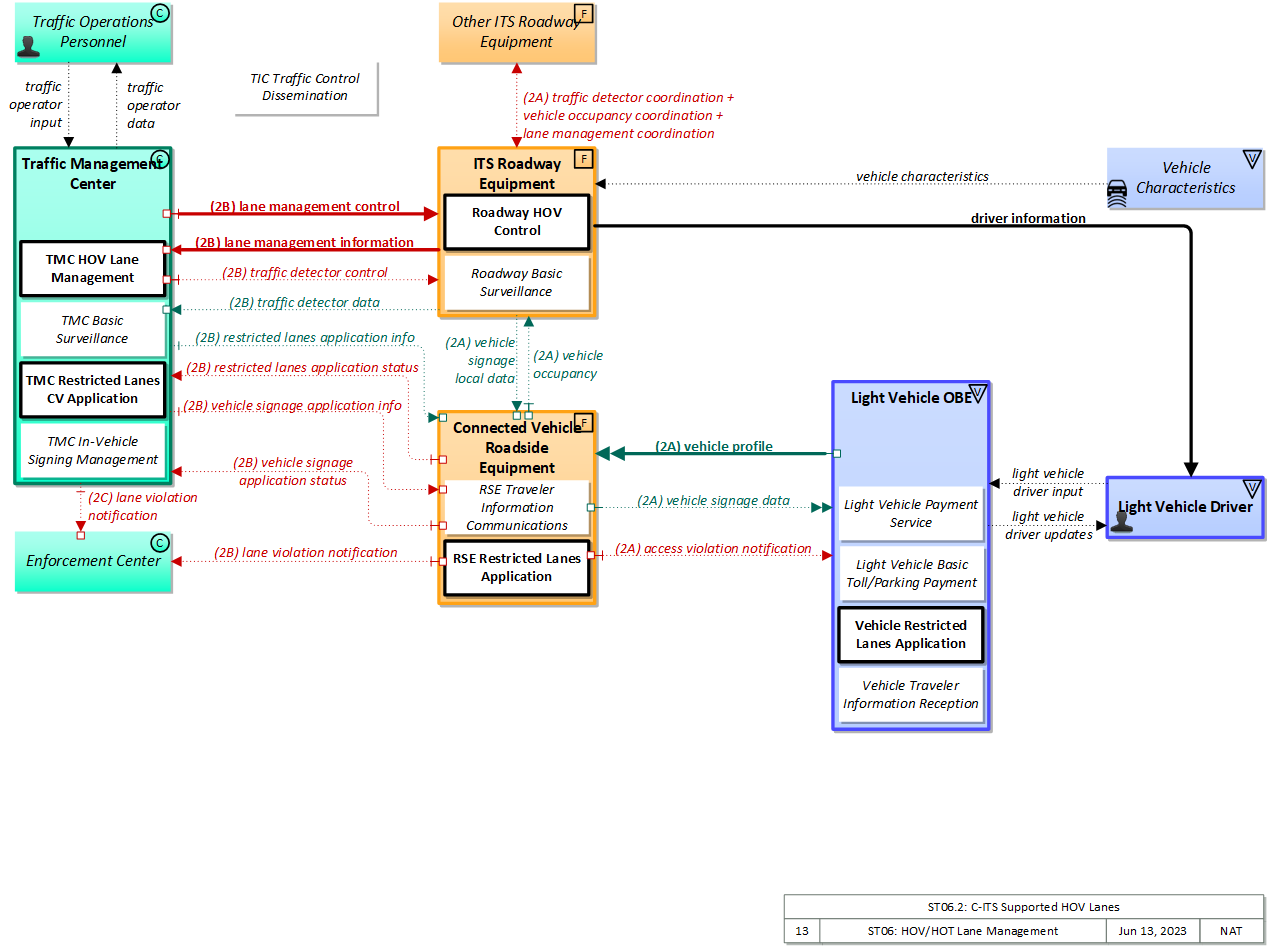
| Source |
Destination |
Role/Relationship |
| Connected Vehicle Roadside Equipment Developer | Connected Vehicle Roadside Equipment |
Develops( hide) An Enterprise creates the target Resource or Document. The Enterprise that engineers a traffic signal controller ( ITS Roadway Equipment), or designs a vehicle (Basic Vehicle) or authors a technical standard will have the Develops role. |
| Connected Vehicle Roadside Equipment Developer | Enforcement Center Developer |
Application Interface Specification( hide) The definition of an interface between two application components that operate on two distinct pieces of hardware. The Application Interface Specification is specific to the application in question. |
| Connected Vehicle Roadside Equipment Developer | ITS Roadway Equipment Developer |
Application Interface Specification( hide) The definition of an interface between two application components that operate on two distinct pieces of hardware. The Application Interface Specification is specific to the application in question. |
| Connected Vehicle Roadside Equipment Developer | Light Vehicle OBE Developer |
Application Interface Specification( hide) The definition of an interface between two application components that operate on two distinct pieces of hardware. The Application Interface Specification is specific to the application in question. |
| Connected Vehicle Roadside Equipment Developer | Traffic Management Center Developer |
Application Interface Specification( hide) The definition of an interface between two application components that operate on two distinct pieces of hardware. The Application Interface Specification is specific to the application in question. |
| Enforcement Center Developer | Enforcement Center |
Develops( hide) An Enterprise creates the target Resource or Document. The Enterprise that engineers a traffic signal controller ( ITS Roadway Equipment), or designs a vehicle (Basic Vehicle) or authors a technical standard will have the Develops role. |
| ITS Roadway Equipment Developer | Connected Vehicle Roadside Equipment Developer |
Application Interface Specification( hide) The definition of an interface between two application components that operate on two distinct pieces of hardware. The Application Interface Specification is specific to the application in question. |
| ITS Roadway Equipment Developer | ITS Roadway Equipment |
Develops( hide) An Enterprise creates the target Resource or Document. The Enterprise that engineers a traffic signal controller ( ITS Roadway Equipment), or designs a vehicle (Basic Vehicle) or authors a technical standard will have the Develops role. |
| ITS Roadway Equipment Developer | Other ITS Roadway Equipment Developer |
Application Interface Specification( hide) The definition of an interface between two application components that operate on two distinct pieces of hardware. The Application Interface Specification is specific to the application in question. |
| ITS Roadway Equipment Developer | Traffic Management Center Developer |
Application Interface Specification( hide) The definition of an interface between two application components that operate on two distinct pieces of hardware. The Application Interface Specification is specific to the application in question. |
| Light Vehicle OBE Developer | Connected Vehicle Roadside Equipment Developer |
Application Interface Specification( hide) The definition of an interface between two application components that operate on two distinct pieces of hardware. The Application Interface Specification is specific to the application in question. |
| Light Vehicle OBE Developer | Light Vehicle OBE |
Develops( hide) An Enterprise creates the target Resource or Document. The Enterprise that engineers a traffic signal controller ( ITS Roadway Equipment), or designs a vehicle (Basic Vehicle) or authors a technical standard will have the Develops role. |
| Other ITS Roadway Equipment Developer | ITS Roadway Equipment Developer |
Application Interface Specification( hide) The definition of an interface between two application components that operate on two distinct pieces of hardware. The Application Interface Specification is specific to the application in question. |
| Other ITS Roadway Equipment Developer | Other ITS Roadway Equipment |
Develops( hide) An Enterprise creates the target Resource or Document. The Enterprise that engineers a traffic signal controller ( ITS Roadway Equipment), or designs a vehicle (Basic Vehicle) or authors a technical standard will have the Develops role. |
| Traffic Management Center Developer | Connected Vehicle Roadside Equipment Developer |
Application Interface Specification( hide) The definition of an interface between two application components that operate on two distinct pieces of hardware. The Application Interface Specification is specific to the application in question. |
| Traffic Management Center Developer | Enforcement Center Developer |
Application Interface Specification( hide) The definition of an interface between two application components that operate on two distinct pieces of hardware. The Application Interface Specification is specific to the application in question. |
| Traffic Management Center Developer | ITS Roadway Equipment Developer |
Application Interface Specification( hide) The definition of an interface between two application components that operate on two distinct pieces of hardware. The Application Interface Specification is specific to the application in question. |
| Traffic Management Center Developer | Traffic Management Center |
Develops( hide) An Enterprise creates the target Resource or Document. The Enterprise that engineers a traffic signal controller ( ITS Roadway Equipment), or designs a vehicle (Basic Vehicle) or authors a technical standard will have the Develops role. |
| Transportation Information Center Developer | Light Vehicle OBE Developer |
Application Interface Specification( hide) The definition of an interface between two application components that operate on two distinct pieces of hardware. The Application Interface Specification is specific to the application in question. |
| Transportation Information Center Developer | Transportation Information Center |
Develops( hide) An Enterprise creates the target Resource or Document. The Enterprise that engineers a traffic signal controller ( ITS Roadway Equipment), or designs a vehicle (Basic Vehicle) or authors a technical standard will have the Develops role. |
| Source |
Destination |
Role/Relationship |
| Connected Vehicle Roadside Equipment Installer | Connected Vehicle Roadside Equipment |
Installs( hide) An Enterprise performs the initial delivery, integration and configuration of the target Resource. This might be a system integrator, a state DOT Enterprise performing its own installation, or a device supplier that performs on-site installation. |
| Connected Vehicle Roadside Equipment Owner | Connected Vehicle Roadside Equipment Installer |
Installation Agreement( hide) An agreement whereupon one party installs a system on behalf of a second party. |
| Connected Vehicle Roadside Equipment Owner | Connected Vehicle Roadside Equipment Verifier |
Verification Agreement( hide) An agreement for one party to verify that a system owned by the second party operates according to the system's design. |
| Enforcement Center Installer | Enforcement Center |
Installs( hide) An Enterprise performs the initial delivery, integration and configuration of the target Resource. This might be a system integrator, a state DOT Enterprise performing its own installation, or a device supplier that performs on-site installation. |
| Enforcement Center Owner | Enforcement Center Installer |
Installation Agreement( hide) An agreement whereupon one party installs a system on behalf of a second party. |
| Enforcement Center Owner | Enforcement Center Verifier |
Verification Agreement( hide) An agreement for one party to verify that a system owned by the second party operates according to the system's design. |
| ITS Roadway Equipment Installer | ITS Roadway Equipment |
Installs( hide) An Enterprise performs the initial delivery, integration and configuration of the target Resource. This might be a system integrator, a state DOT Enterprise performing its own installation, or a device supplier that performs on-site installation. |
| ITS Roadway Equipment Owner | ITS Roadway Equipment Installer |
Installation Agreement( hide) An agreement whereupon one party installs a system on behalf of a second party. |
| ITS Roadway Equipment Owner | ITS Roadway Equipment Verifier |
Verification Agreement( hide) An agreement for one party to verify that a system owned by the second party operates according to the system's design. |
| Light Vehicle OBE Installer | Light Vehicle OBE |
Installs( hide) An Enterprise performs the initial delivery, integration and configuration of the target Resource. This might be a system integrator, a state DOT Enterprise performing its own installation, or a device supplier that performs on-site installation. |
| Light Vehicle OBE Owner | Light Vehicle OBE Installer |
Installation Agreement( hide) An agreement whereupon one party installs a system on behalf of a second party. |
| Light Vehicle OBE Owner | Light Vehicle OBE Verifier |
Verification Agreement( hide) An agreement for one party to verify that a system owned by the second party operates according to the system's design. |
| Other ITS Roadway Equipment Installer | Other ITS Roadway Equipment |
Installs( hide) An Enterprise performs the initial delivery, integration and configuration of the target Resource. This might be a system integrator, a state DOT Enterprise performing its own installation, or a device supplier that performs on-site installation. |
| Other ITS Roadway Equipment Owner | Other ITS Roadway Equipment Installer |
Installation Agreement( hide) An agreement whereupon one party installs a system on behalf of a second party. |
| Other ITS Roadway Equipment Owner | Other ITS Roadway Equipment Verifier |
Verification Agreement( hide) An agreement for one party to verify that a system owned by the second party operates according to the system's design. |
| Traffic Management Center Installer | Traffic Management Center |
Installs( hide) An Enterprise performs the initial delivery, integration and configuration of the target Resource. This might be a system integrator, a state DOT Enterprise performing its own installation, or a device supplier that performs on-site installation. |
| Traffic Management Center Owner | Traffic Management Center Installer |
Installation Agreement( hide) An agreement whereupon one party installs a system on behalf of a second party. |
| Traffic Management Center Owner | Traffic Management Center Verifier |
Verification Agreement( hide) An agreement for one party to verify that a system owned by the second party operates according to the system's design. |
| Transportation Information Center Installer | Transportation Information Center |
Installs( hide) An Enterprise performs the initial delivery, integration and configuration of the target Resource. This might be a system integrator, a state DOT Enterprise performing its own installation, or a device supplier that performs on-site installation. |
| Transportation Information Center Owner | Transportation Information Center Installer |
Installation Agreement( hide) An agreement whereupon one party installs a system on behalf of a second party. |
| Transportation Information Center Owner | Transportation Information Center Verifier |
Verification Agreement( hide) An agreement for one party to verify that a system owned by the second party operates according to the system's design. |
| Source |
Destination |
Role/Relationship |
| Connected Vehicle Roadside Equipment Maintainer | Connected Vehicle Roadside Equipment |
Maintains( hide) An Enterprise administers the hardware and software that comprise the target Resource. The entity that takes the ‘maintains’ role typically is delegated authority by the entity with the “Owns” or "Manages" roles, depending on the environment. The maintainer interacts with the target Resource so as to keep that Resource in the Operational state. |
| Connected Vehicle Roadside Equipment Manager | Connected Vehicle Roadside Equipment |
Manages( hide) The Enterprise that is accountable for performing actions with a Resource, typically in support of one of the key operations-related roles (operates, installs, maintains). This authority is typically delegated by the Enterprise with the "Owns" role, and commonly accomplished by delegation to Human E-Objects with the "operates", "installs" or "maintains" roles, depending on the context. |
| Connected Vehicle Roadside Equipment Manager | Connected Vehicle Roadside Equipment Operator |
System Usage Agreement( hide) An agreement granting operational use of a system to a Human with the operates role responsible for management of the system. |
| Connected Vehicle Roadside Equipment Operator | Connected Vehicle Roadside Equipment |
Operates( hide) A Human that is accountable for performing actions with a Resource, typically in support of one of the key operations-related roles (operates, installs, maintains). This is the person at the console or behind the wheel. |
| Connected Vehicle Roadside Equipment Owner | Connected Vehicle Roadside Equipment Maintainer |
System Maintenance Agreement( hide) An agreement for one party to maintain the operational status of a system on behalf of the party with ownership control of the system. |
| Connected Vehicle Roadside Equipment Owner | Connected Vehicle Roadside Equipment Manager |
Operations Agreement( hide) An agreement where one entity agrees to operate a device or application on behalf of another, device/application controlling entity. |
| Connected Vehicle Roadside Equipment Owner | Enforcement Center Maintainer |
Maintenance Data Exchange Agreement( hide) An agreement that states one entity will provide data related to maintenance of an application component to the other entity. |
| Connected Vehicle Roadside Equipment Owner | Enforcement Center Operator |
Application Usage Agreement( hide) An agreement in which one entity that controls an application component's use gives the other entity the necessary tools and permission to operate that application or application component. |
| Connected Vehicle Roadside Equipment Owner | Enforcement Center Owner |
Information Provision Agreement( hide) An agreement where one party agrees to provide information to another party. This is a unidirectional agreement. |
| Connected Vehicle Roadside Equipment Owner | Enforcement Center User |
Service Usage Agreement( hide) An agreement between the provider of a service and a user. Stipulates the terms and conditions of service usage. |
| Connected Vehicle Roadside Equipment Owner | ITS Roadway Equipment Maintainer |
Maintenance Data Exchange Agreement( hide) An agreement that states one entity will provide data related to maintenance of an application component to the other entity. |
| Connected Vehicle Roadside Equipment Owner | ITS Roadway Equipment Owner |
Information Exchange and Action Agreement( hide) An agreement to exchange information, which may include data or control information; the exact information to be exchanged may vary from agreement to agreement. This also includes a specification for action that shall, should or may be taken by one party in response to this information. |
| Connected Vehicle Roadside Equipment Owner | ITS Roadway Equipment User |
Service Usage Agreement( hide) An agreement between the provider of a service and a user. Stipulates the terms and conditions of service usage. |
| Connected Vehicle Roadside Equipment Owner | Light Vehicle Driver |
Application Usage Agreement( hide) An agreement in which one entity that controls an application component's use gives the other entity the necessary tools and permission to operate that application or application component. |
| Connected Vehicle Roadside Equipment Owner | Light Vehicle OBE Maintainer |
Maintenance Data Exchange Agreement( hide) An agreement that states one entity will provide data related to maintenance of an application component to the other entity. |
| Connected Vehicle Roadside Equipment Owner | Light Vehicle OBE Owner |
Expectation of Information Provision( hide) An expectation where one party believes another party will provide it information whenever such information is likely relevant to the recipient. |
| Connected Vehicle Roadside Equipment Owner | Light Vehicle OBE User |
Service Usage Agreement( hide) An agreement between the provider of a service and a user. Stipulates the terms and conditions of service usage. |
| Connected Vehicle Roadside Equipment Owner | Maint and Constr Field Personnel |
Application Usage Agreement( hide) An agreement in which one entity that controls an application component's use gives the other entity the necessary tools and permission to operate that application or application component. |
| Connected Vehicle Roadside Equipment Owner | Traffic Management Center Maintainer |
Maintenance Data Exchange Agreement( hide) An agreement that states one entity will provide data related to maintenance of an application component to the other entity. |
| Connected Vehicle Roadside Equipment Owner | Traffic Management Center Owner |
Information Exchange Agreement( hide) An agreement to exchange information, which may include data or control information; the exact information to be exchanged may vary from agreement to agreement. |
| Connected Vehicle Roadside Equipment Owner | Traffic Management Center User |
Service Usage Agreement( hide) An agreement between the provider of a service and a user. Stipulates the terms and conditions of service usage. |
| Connected Vehicle Roadside Equipment Owner | Traffic Operations Personnel |
Application Usage Agreement( hide) An agreement in which one entity that controls an application component's use gives the other entity the necessary tools and permission to operate that application or application component. |
| Connected Vehicle Roadside Equipment Supplier | Connected Vehicle Roadside Equipment Owner |
Warranty( hide) A guarantee or promise made by one entity to another, that provides assurance of the functionality and performance of a subsystem. |
| Enforcement Center Maintainer | Enforcement Center |
Maintains( hide) An Enterprise administers the hardware and software that comprise the target Resource. The entity that takes the ‘maintains’ role typically is delegated authority by the entity with the “Owns” or "Manages" roles, depending on the environment. The maintainer interacts with the target Resource so as to keep that Resource in the Operational state. |
| Enforcement Center Manager | Enforcement Center |
Manages( hide) The Enterprise that is accountable for performing actions with a Resource, typically in support of one of the key operations-related roles (operates, installs, maintains). This authority is typically delegated by the Enterprise with the "Owns" role, and commonly accomplished by delegation to Human E-Objects with the "operates", "installs" or "maintains" roles, depending on the context. |
| Enforcement Center Manager | Enforcement Center Operator |
System Usage Agreement( hide) An agreement granting operational use of a system to a Human with the operates role responsible for management of the system. |
| Enforcement Center Operator | Enforcement Center |
Operates( hide) A Human that is accountable for performing actions with a Resource, typically in support of one of the key operations-related roles (operates, installs, maintains). This is the person at the console or behind the wheel. |
| Enforcement Center Owner | Enforcement Center Maintainer |
System Maintenance Agreement( hide) An agreement for one party to maintain the operational status of a system on behalf of the party with ownership control of the system. |
| Enforcement Center Owner | Enforcement Center Manager |
Operations Agreement( hide) An agreement where one entity agrees to operate a device or application on behalf of another, device/application controlling entity. |
| Enforcement Center Supplier | Enforcement Center Owner |
Warranty( hide) A guarantee or promise made by one entity to another, that provides assurance of the functionality and performance of a subsystem. |
| ITS Roadway Equipment Maintainer | ITS Roadway Equipment |
Maintains( hide) An Enterprise administers the hardware and software that comprise the target Resource. The entity that takes the ‘maintains’ role typically is delegated authority by the entity with the “Owns” or "Manages" roles, depending on the environment. The maintainer interacts with the target Resource so as to keep that Resource in the Operational state. |
| ITS Roadway Equipment Manager | ITS Roadway Equipment |
Manages( hide) The Enterprise that is accountable for performing actions with a Resource, typically in support of one of the key operations-related roles (operates, installs, maintains). This authority is typically delegated by the Enterprise with the "Owns" role, and commonly accomplished by delegation to Human E-Objects with the "operates", "installs" or "maintains" roles, depending on the context. |
| ITS Roadway Equipment Manager | Maint and Constr Field Personnel |
System Usage Agreement( hide) An agreement granting operational use of a system to a Human with the operates role responsible for management of the system. |
| ITS Roadway Equipment Owner | Connected Vehicle Roadside Equipment Maintainer |
Maintenance Data Exchange Agreement( hide) An agreement that states one entity will provide data related to maintenance of an application component to the other entity. |
| ITS Roadway Equipment Owner | Connected Vehicle Roadside Equipment Operator |
Application Usage Agreement( hide) An agreement in which one entity that controls an application component's use gives the other entity the necessary tools and permission to operate that application or application component. |
| ITS Roadway Equipment Owner | Connected Vehicle Roadside Equipment Owner |
Information Exchange and Action Agreement( hide) An agreement to exchange information, which may include data or control information; the exact information to be exchanged may vary from agreement to agreement. This also includes a specification for action that shall, should or may be taken by one party in response to this information. |
| ITS Roadway Equipment Owner | Connected Vehicle Roadside Equipment User |
Service Usage Agreement( hide) An agreement between the provider of a service and a user. Stipulates the terms and conditions of service usage. |
| ITS Roadway Equipment Owner | ITS Roadway Equipment Maintainer |
System Maintenance Agreement( hide) An agreement for one party to maintain the operational status of a system on behalf of the party with ownership control of the system. |
| ITS Roadway Equipment Owner | ITS Roadway Equipment Manager |
Operations Agreement( hide) An agreement where one entity agrees to operate a device or application on behalf of another, device/application controlling entity. |
| ITS Roadway Equipment Owner | Other ITS Roadway Equipment Maintainer |
Maintenance Data Exchange Agreement( hide) An agreement that states one entity will provide data related to maintenance of an application component to the other entity. |
| ITS Roadway Equipment Owner | Other ITS Roadway Equipment Operator |
Application Usage Agreement( hide) An agreement in which one entity that controls an application component's use gives the other entity the necessary tools and permission to operate that application or application component. |
| ITS Roadway Equipment Owner | Other ITS Roadway Equipment Owner |
Information Exchange and Action Agreement( hide) An agreement to exchange information, which may include data or control information; the exact information to be exchanged may vary from agreement to agreement. This also includes a specification for action that shall, should or may be taken by one party in response to this information. |
| ITS Roadway Equipment Owner | Other ITS Roadway Equipment User |
Service Usage Agreement( hide) An agreement between the provider of a service and a user. Stipulates the terms and conditions of service usage. |
| ITS Roadway Equipment Owner | Traffic Management Center Maintainer |
Maintenance Data Exchange Agreement( hide) An agreement that states one entity will provide data related to maintenance of an application component to the other entity. |
| ITS Roadway Equipment Owner | Traffic Management Center Owner |
Information Exchange Agreement( hide) An agreement to exchange information, which may include data or control information; the exact information to be exchanged may vary from agreement to agreement. |
| ITS Roadway Equipment Owner | Traffic Management Center User |
Service Usage Agreement( hide) An agreement between the provider of a service and a user. Stipulates the terms and conditions of service usage. |
| ITS Roadway Equipment Owner | Traffic Operations Personnel |
Application Usage Agreement( hide) An agreement in which one entity that controls an application component's use gives the other entity the necessary tools and permission to operate that application or application component. |
| ITS Roadway Equipment Supplier | ITS Roadway Equipment Owner |
Warranty( hide) A guarantee or promise made by one entity to another, that provides assurance of the functionality and performance of a subsystem. |
| Light Vehicle Driver | Light Vehicle OBE |
Operates( hide) A Human that is accountable for performing actions with a Resource, typically in support of one of the key operations-related roles (operates, installs, maintains). This is the person at the console or behind the wheel. |
| Light Vehicle OBE Maintainer | Light Vehicle OBE |
Maintains( hide) An Enterprise administers the hardware and software that comprise the target Resource. The entity that takes the ‘maintains’ role typically is delegated authority by the entity with the “Owns” or "Manages" roles, depending on the environment. The maintainer interacts with the target Resource so as to keep that Resource in the Operational state. |
| Light Vehicle OBE Manager | Light Vehicle Driver |
System Usage Agreement( hide) An agreement granting operational use of a system to a Human with the operates role responsible for management of the system. |
| Light Vehicle OBE Manager | Light Vehicle OBE |
Manages( hide) The Enterprise that is accountable for performing actions with a Resource, typically in support of one of the key operations-related roles (operates, installs, maintains). This authority is typically delegated by the Enterprise with the "Owns" role, and commonly accomplished by delegation to Human E-Objects with the "operates", "installs" or "maintains" roles, depending on the context. |
| Light Vehicle OBE Owner | Connected Vehicle Roadside Equipment Maintainer |
Maintenance Data Exchange Agreement( hide) An agreement that states one entity will provide data related to maintenance of an application component to the other entity. |
| Light Vehicle OBE Owner | Connected Vehicle Roadside Equipment Operator |
Application Usage Agreement( hide) An agreement in which one entity that controls an application component's use gives the other entity the necessary tools and permission to operate that application or application component. |
| Light Vehicle OBE Owner | Connected Vehicle Roadside Equipment Owner |
Expectation of Data Provision( hide) An expectation where one party believes another party will provide data on a regular and recurring basis, and that that data will be useful to the receiver in the context of the receiver's application. This thus includes some expectation of data fields, timeliness, quality, precision and similar qualities of data. |
| Light Vehicle OBE Owner | Connected Vehicle Roadside Equipment User |
Service Usage Agreement( hide) An agreement between the provider of a service and a user. Stipulates the terms and conditions of service usage. |
| Light Vehicle OBE Owner | Light Vehicle OBE Maintainer |
System Maintenance Agreement( hide) An agreement for one party to maintain the operational status of a system on behalf of the party with ownership control of the system. |
| Light Vehicle OBE Owner | Light Vehicle OBE Manager |
Operations Agreement( hide) An agreement where one entity agrees to operate a device or application on behalf of another, device/application controlling entity. |
| Light Vehicle OBE Supplier | Light Vehicle OBE Owner |
Warranty( hide) A guarantee or promise made by one entity to another, that provides assurance of the functionality and performance of a subsystem. |
| Maint and Constr Field Personnel | ITS Roadway Equipment |
Operates( hide) A Human that is accountable for performing actions with a Resource, typically in support of one of the key operations-related roles (operates, installs, maintains). This is the person at the console or behind the wheel. |
| Other ITS Roadway Equipment Maintainer | Other ITS Roadway Equipment |
Maintains( hide) An Enterprise administers the hardware and software that comprise the target Resource. The entity that takes the ‘maintains’ role typically is delegated authority by the entity with the “Owns” or "Manages" roles, depending on the environment. The maintainer interacts with the target Resource so as to keep that Resource in the Operational state. |
| Other ITS Roadway Equipment Manager | Other ITS Roadway Equipment |
Manages( hide) The Enterprise that is accountable for performing actions with a Resource, typically in support of one of the key operations-related roles (operates, installs, maintains). This authority is typically delegated by the Enterprise with the "Owns" role, and commonly accomplished by delegation to Human E-Objects with the "operates", "installs" or "maintains" roles, depending on the context. |
| Other ITS Roadway Equipment Manager | Other ITS Roadway Equipment Operator |
System Usage Agreement( hide) An agreement granting operational use of a system to a Human with the operates role responsible for management of the system. |
| Other ITS Roadway Equipment Operator | Other ITS Roadway Equipment |
Operates( hide) A Human that is accountable for performing actions with a Resource, typically in support of one of the key operations-related roles (operates, installs, maintains). This is the person at the console or behind the wheel. |
| Other ITS Roadway Equipment Owner | ITS Roadway Equipment Maintainer |
Maintenance Data Exchange Agreement( hide) An agreement that states one entity will provide data related to maintenance of an application component to the other entity. |
| Other ITS Roadway Equipment Owner | ITS Roadway Equipment Owner |
Information Exchange and Action Agreement( hide) An agreement to exchange information, which may include data or control information; the exact information to be exchanged may vary from agreement to agreement. This also includes a specification for action that shall, should or may be taken by one party in response to this information. |
| Other ITS Roadway Equipment Owner | ITS Roadway Equipment User |
Service Usage Agreement( hide) An agreement between the provider of a service and a user. Stipulates the terms and conditions of service usage. |
| Other ITS Roadway Equipment Owner | Maint and Constr Field Personnel |
Application Usage Agreement( hide) An agreement in which one entity that controls an application component's use gives the other entity the necessary tools and permission to operate that application or application component. |
| Other ITS Roadway Equipment Owner | Other ITS Roadway Equipment Maintainer |
System Maintenance Agreement( hide) An agreement for one party to maintain the operational status of a system on behalf of the party with ownership control of the system. |
| Other ITS Roadway Equipment Owner | Other ITS Roadway Equipment Manager |
Operations Agreement( hide) An agreement where one entity agrees to operate a device or application on behalf of another, device/application controlling entity. |
| Other ITS Roadway Equipment Supplier | Other ITS Roadway Equipment Owner |
Warranty( hide) A guarantee or promise made by one entity to another, that provides assurance of the functionality and performance of a subsystem. |
| TIC Operator | Transportation Information Center |
Operates( hide) A Human that is accountable for performing actions with a Resource, typically in support of one of the key operations-related roles (operates, installs, maintains). This is the person at the console or behind the wheel. |
| Traffic Management Center Maintainer | Traffic Management Center |
Maintains( hide) An Enterprise administers the hardware and software that comprise the target Resource. The entity that takes the ‘maintains’ role typically is delegated authority by the entity with the “Owns” or "Manages" roles, depending on the environment. The maintainer interacts with the target Resource so as to keep that Resource in the Operational state. |
| Traffic Management Center Manager | Traffic Management Center |
Manages( hide) The Enterprise that is accountable for performing actions with a Resource, typically in support of one of the key operations-related roles (operates, installs, maintains). This authority is typically delegated by the Enterprise with the "Owns" role, and commonly accomplished by delegation to Human E-Objects with the "operates", "installs" or "maintains" roles, depending on the context. |
| Traffic Management Center Manager | Traffic Operations Personnel |
System Usage Agreement( hide) An agreement granting operational use of a system to a Human with the operates role responsible for management of the system. |
| Traffic Management Center Owner | Connected Vehicle Roadside Equipment Maintainer |
Maintenance Data Exchange Agreement( hide) An agreement that states one entity will provide data related to maintenance of an application component to the other entity. |
| Traffic Management Center Owner | Connected Vehicle Roadside Equipment Operator |
Application Usage Agreement( hide) An agreement in which one entity that controls an application component's use gives the other entity the necessary tools and permission to operate that application or application component. |
| Traffic Management Center Owner | Connected Vehicle Roadside Equipment Owner |
Information Exchange Agreement( hide) An agreement to exchange information, which may include data or control information; the exact information to be exchanged may vary from agreement to agreement. |
| Traffic Management Center Owner | Connected Vehicle Roadside Equipment User |
Service Usage Agreement( hide) An agreement between the provider of a service and a user. Stipulates the terms and conditions of service usage. |
| Traffic Management Center Owner | Enforcement Center Maintainer |
Maintenance Data Exchange Agreement( hide) An agreement that states one entity will provide data related to maintenance of an application component to the other entity. |
| Traffic Management Center Owner | Enforcement Center Operator |
Application Usage Agreement( hide) An agreement in which one entity that controls an application component's use gives the other entity the necessary tools and permission to operate that application or application component. |
| Traffic Management Center Owner | Enforcement Center Owner |
Information Provision Agreement( hide) An agreement where one party agrees to provide information to another party. This is a unidirectional agreement. |
| Traffic Management Center Owner | Enforcement Center User |
Service Usage Agreement( hide) An agreement between the provider of a service and a user. Stipulates the terms and conditions of service usage. |
| Traffic Management Center Owner | ITS Roadway Equipment Maintainer |
Maintenance Data Exchange Agreement( hide) An agreement that states one entity will provide data related to maintenance of an application component to the other entity. |
| Traffic Management Center Owner | ITS Roadway Equipment Owner |
Information Exchange Agreement( hide) An agreement to exchange information, which may include data or control information; the exact information to be exchanged may vary from agreement to agreement. |
| Traffic Management Center Owner | ITS Roadway Equipment User |
Service Usage Agreement( hide) An agreement between the provider of a service and a user. Stipulates the terms and conditions of service usage. |
| Traffic Management Center Owner | Maint and Constr Field Personnel |
Application Usage Agreement( hide) An agreement in which one entity that controls an application component's use gives the other entity the necessary tools and permission to operate that application or application component. |
| Traffic Management Center Owner | Traffic Management Center Maintainer |
System Maintenance Agreement( hide) An agreement for one party to maintain the operational status of a system on behalf of the party with ownership control of the system. |
| Traffic Management Center Owner | Traffic Management Center Manager |
Operations Agreement( hide) An agreement where one entity agrees to operate a device or application on behalf of another, device/application controlling entity. |
| Traffic Management Center Supplier | Traffic Management Center Owner |
Warranty( hide) A guarantee or promise made by one entity to another, that provides assurance of the functionality and performance of a subsystem. |
| Traffic Operations Personnel | Traffic Management Center |
Operates( hide) A Human that is accountable for performing actions with a Resource, typically in support of one of the key operations-related roles (operates, installs, maintains). This is the person at the console or behind the wheel. |
| Transportation Information Center Maintainer | Transportation Information Center |
Maintains( hide) An Enterprise administers the hardware and software that comprise the target Resource. The entity that takes the ‘maintains’ role typically is delegated authority by the entity with the “Owns” or "Manages" roles, depending on the environment. The maintainer interacts with the target Resource so as to keep that Resource in the Operational state. |
| Transportation Information Center Manager | TIC Operator |
System Usage Agreement( hide) An agreement granting operational use of a system to a Human with the operates role responsible for management of the system. |
| Transportation Information Center Manager | Transportation Information Center |
Manages( hide) The Enterprise that is accountable for performing actions with a Resource, typically in support of one of the key operations-related roles (operates, installs, maintains). This authority is typically delegated by the Enterprise with the "Owns" role, and commonly accomplished by delegation to Human E-Objects with the "operates", "installs" or "maintains" roles, depending on the context. |
| Transportation Information Center Owner | Light Vehicle Driver |
Application Usage Agreement( hide) An agreement in which one entity that controls an application component's use gives the other entity the necessary tools and permission to operate that application or application component. |
| Transportation Information Center Owner | Light Vehicle OBE Maintainer |
Maintenance Data Exchange Agreement( hide) An agreement that states one entity will provide data related to maintenance of an application component to the other entity. |
| Transportation Information Center Owner | Light Vehicle OBE Owner |
Information Provision Agreement( hide) An agreement where one party agrees to provide information to another party. This is a unidirectional agreement. |
| Transportation Information Center Owner | Light Vehicle OBE User |
Service Usage Agreement( hide) An agreement between the provider of a service and a user. Stipulates the terms and conditions of service usage. |
| Transportation Information Center Owner | Transportation Information Center Maintainer |
System Maintenance Agreement( hide) An agreement for one party to maintain the operational status of a system on behalf of the party with ownership control of the system. |
| Transportation Information Center Owner | Transportation Information Center Manager |
Operations Agreement( hide) An agreement where one entity agrees to operate a device or application on behalf of another, device/application controlling entity. |
| Transportation Information Center Supplier | Transportation Information Center Owner |
Warranty( hide) A guarantee or promise made by one entity to another, that provides assurance of the functionality and performance of a subsystem. |