< < TI01.2 : TI02.1 : TI03.1 > >
TI02.1: Personalized Traveler Information Implementation
This service package provides tailored information in response to a traveler request. This implementation is a holistic view of the TI02 service package, including all Physical Objects, Functional Objects, and Triples associated with the service package. It distinguishes between items that are fundamental to the service and items that are optional. Your specific implementation is likely to include the fundamental items and selected optional items, based on your specific project requirements.
Relevant Regions: Australia, Canada, European Union, and United States
- Enterprise
- Functional
- Physical
- Goals and Objectives
- Needs and Requirements
- Sources
- Security
- Standards
- System Requirements
Enterprise
Development Stage Roles and Relationships
Installation Stage Roles and Relationships
Operations and Maintenance Stage Roles and Relationships
(hide)
| Source | Destination | Role/Relationship |
|---|---|---|
| Border Inspection System Maintainer | Border Inspection System | Maintains |
| Border Inspection System Manager | Border Inspection System | Manages |
| Border Inspection System Manager | Border Inspection System Operator | System Usage Agreement |
| Border Inspection System Operator | Border Inspection System | Operates |
| Border Inspection System Owner | Border Inspection System Maintainer | System Maintenance Agreement |
| Border Inspection System Owner | Border Inspection System Manager | Operations Agreement |
| Border Inspection System Owner | TIC Operator | Application Usage Agreement |
| Border Inspection System Owner | Transportation Information Center Maintainer | Maintenance Data Exchange Agreement |
| Border Inspection System Owner | Transportation Information Center Owner | Information Provision Agreement |
| Border Inspection System Owner | Transportation Information Center User | Service Usage Agreement |
| Border Inspection System Supplier | Border Inspection System Owner | Warranty |
| Emergency Management Center Maintainer | Emergency Management Center | Maintains |
| Emergency Management Center Manager | Emergency Management Center | Manages |
| Emergency Management Center Manager | Emergency Personnel | System Usage Agreement |
| Emergency Management Center Owner | Emergency Management Center Maintainer | System Maintenance Agreement |
| Emergency Management Center Owner | Emergency Management Center Manager | Operations Agreement |
| Emergency Management Center Owner | TIC Operator | Application Usage Agreement |
| Emergency Management Center Owner | Transportation Information Center Maintainer | Maintenance Data Exchange Agreement |
| Emergency Management Center Owner | Transportation Information Center Owner | Information Provision Agreement |
| Emergency Management Center Owner | Transportation Information Center User | Service Usage Agreement |
| Emergency Management Center Supplier | Emergency Management Center Owner | Warranty |
| Emergency Personnel | Emergency Management Center | Operates |
| Emissions Management Center Maintainer | Emissions Management Center | Maintains |
| Emissions Management Center Manager | Emissions Management Center | Manages |
| Emissions Management Center Manager | Emissions Management Operator | System Usage Agreement |
| Emissions Management Center Owner | Emissions Management Center Maintainer | System Maintenance Agreement |
| Emissions Management Center Owner | Emissions Management Center Manager | Operations Agreement |
| Emissions Management Center Owner | TIC Operator | Application Usage Agreement |
| Emissions Management Center Owner | Transportation Information Center Maintainer | Maintenance Data Exchange Agreement |
| Emissions Management Center Owner | Transportation Information Center Owner | Information Provision Agreement |
| Emissions Management Center Owner | Transportation Information Center User | Service Usage Agreement |
| Emissions Management Center Supplier | Emissions Management Center Owner | Warranty |
| Emissions Management Operator | Emissions Management Center | Operates |
| Event Promoter System Maintainer | Event Promoter System | Maintains |
| Event Promoter System Manager | Event Promoter System | Manages |
| Event Promoter System Manager | Event Promoter System Operator | System Usage Agreement |
| Event Promoter System Operator | Event Promoter System | Operates |
| Event Promoter System Owner | Event Promoter System Maintainer | System Maintenance Agreement |
| Event Promoter System Owner | Event Promoter System Manager | Operations Agreement |
| Event Promoter System Owner | TIC Operator | Application Usage Agreement |
| Event Promoter System Owner | Transportation Information Center Maintainer | Maintenance Data Exchange Agreement |
| Event Promoter System Owner | Transportation Information Center Owner | Information Provision Agreement |
| Event Promoter System Owner | Transportation Information Center User | Service Usage Agreement |
| Event Promoter System Supplier | Event Promoter System Owner | Warranty |
| Light Vehicle Driver | Light Vehicle OBE | Operates |
| Light Vehicle OBE Maintainer | Light Vehicle OBE | Maintains |
| Light Vehicle OBE Manager | Light Vehicle Driver | System Usage Agreement |
| Light Vehicle OBE Manager | Light Vehicle OBE | Manages |
| Light Vehicle OBE Owner | Light Vehicle OBE Maintainer | System Maintenance Agreement |
| Light Vehicle OBE Owner | Light Vehicle OBE Manager | Operations Agreement |
| Light Vehicle OBE Owner | TIC Operator | Application Usage Agreement |
| Light Vehicle OBE Owner | Transportation Information Center Maintainer | Maintenance Data Exchange Agreement |
| Light Vehicle OBE Owner | Transportation Information Center Owner | Information Exchange Agreement |
| Light Vehicle OBE Owner | Transportation Information Center User | Service Usage Agreement |
| Light Vehicle OBE Supplier | Light Vehicle OBE Owner | Warranty |
| Maint and Constr Center Personnel | Maint and Constr Management Center | Operates |
| Maint and Constr Management Center Maintainer | Maint and Constr Management Center | Maintains |
| Maint and Constr Management Center Manager | Maint and Constr Center Personnel | System Usage Agreement |
| Maint and Constr Management Center Manager | Maint and Constr Management Center | Manages |
| Maint and Constr Management Center Owner | Maint and Constr Management Center Maintainer | System Maintenance Agreement |
| Maint and Constr Management Center Owner | Maint and Constr Management Center Manager | Operations Agreement |
| Maint and Constr Management Center Owner | TIC Operator | Application Usage Agreement |
| Maint and Constr Management Center Owner | Transportation Information Center Maintainer | Maintenance Data Exchange Agreement |
| Maint and Constr Management Center Owner | Transportation Information Center Owner | Information Provision Agreement |
| Maint and Constr Management Center Owner | Transportation Information Center User | Service Usage Agreement |
| Maint and Constr Management Center Supplier | Maint and Constr Management Center Owner | Warranty |
| Media Maintainer | Media | Maintains |
| Media Manager | Media | Manages |
| Media Manager | Media Operator | System Usage Agreement |
| Media Operator | Media | Operates |
| Media Owner | Media Maintainer | System Maintenance Agreement |
| Media Owner | Media Manager | Operations Agreement |
| Media Supplier | Media Owner | Warranty |
| Other Transportation Information Centers Maintainer | Other Transportation Information Centers | Maintains |
| Other Transportation Information Centers Manager | Other Transportation Information Centers | Manages |
| Other Transportation Information Centers Manager | Other Transportation Information Centers Operator | System Usage Agreement |
| Other Transportation Information Centers Operator | Other Transportation Information Centers | Operates |
| Other Transportation Information Centers Owner | Other Transportation Information Centers Maintainer | System Maintenance Agreement |
| Other Transportation Information Centers Owner | Other Transportation Information Centers Manager | Operations Agreement |
| Other Transportation Information Centers Owner | TIC Operator | Application Usage Agreement |
| Other Transportation Information Centers Owner | Transportation Information Center Maintainer | Maintenance Data Exchange Agreement |
| Other Transportation Information Centers Owner | Transportation Information Center Owner | Information Exchange Agreement |
| Other Transportation Information Centers Owner | Transportation Information Center User | Service Usage Agreement |
| Other Transportation Information Centers Supplier | Other Transportation Information Centers Owner | Warranty |
| Parking Management Center Maintainer | Parking Management Center | Maintains |
| Parking Management Center Manager | Parking Management Center | Manages |
| Parking Management Center Manager | Parking Manager | System Usage Agreement |
| Parking Management Center Owner | Parking Management Center Maintainer | System Maintenance Agreement |
| Parking Management Center Owner | Parking Management Center Manager | Operations Agreement |
| Parking Management Center Owner | TIC Operator | Application Usage Agreement |
| Parking Management Center Owner | Transportation Information Center Maintainer | Maintenance Data Exchange Agreement |
| Parking Management Center Owner | Transportation Information Center Owner | Information Provision Agreement |
| Parking Management Center Owner | Transportation Information Center User | Service Usage Agreement |
| Parking Management Center Supplier | Parking Management Center Owner | Warranty |
| Parking Manager | Parking Management Center | Operates |
| Payment Administration Center Maintainer | Payment Administration Center | Maintains |
| Payment Administration Center Manager | Payment Administration Center | Manages |
| Payment Administration Center Manager | Payment Administrator | System Usage Agreement |
| Payment Administration Center Owner | Payment Administration Center Maintainer | System Maintenance Agreement |
| Payment Administration Center Owner | Payment Administration Center Manager | Operations Agreement |
| Payment Administration Center Owner | TIC Operator | Application Usage Agreement |
| Payment Administration Center Owner | Transportation Information Center Maintainer | Maintenance Data Exchange Agreement |
| Payment Administration Center Owner | Transportation Information Center Owner | Information Provision Agreement |
| Payment Administration Center Owner | Transportation Information Center User | Service Usage Agreement |
| Payment Administration Center Supplier | Payment Administration Center Owner | Warranty |
| Payment Administrator | Payment Administration Center | Operates |
| Personal Information Device Maintainer | Personal Information Device | Maintains |
| Personal Information Device Manager | Personal Information Device | Manages |
| Personal Information Device Manager | Traveler | System Usage Agreement |
| Personal Information Device Owner | Personal Information Device Maintainer | System Maintenance Agreement |
| Personal Information Device Owner | Personal Information Device Manager | Operations Agreement |
| Personal Information Device Owner | Social Media Maintainer | Maintenance Data Exchange Agreement |
| Personal Information Device Owner | Social Media Operator | Application Usage Agreement |
| Personal Information Device Owner | Social Media Owner | Information Exchange and Action Agreement |
| Personal Information Device Owner | Social Media User | Service Usage Agreement |
| Personal Information Device Owner | TIC Operator | Application Usage Agreement |
| Personal Information Device Owner | Transportation Information Center Maintainer | Maintenance Data Exchange Agreement |
| Personal Information Device Owner | Transportation Information Center Owner | Information Exchange and Action Agreement |
| Personal Information Device Owner | Transportation Information Center User | Service Usage Agreement |
| Personal Information Device Supplier | Personal Information Device Owner | Warranty |
| Social Media Maintainer | Social Media | Maintains |
| Social Media Manager | Social Media | Manages |
| Social Media Manager | Social Media Operator | System Usage Agreement |
| Social Media Operator | Social Media | Operates |
| Social Media Owner | Personal Information Device Maintainer | Maintenance Data Exchange Agreement |
| Social Media Owner | Personal Information Device Owner | Information Exchange Agreement |
| Social Media Owner | Personal Information Device User | Service Usage Agreement |
| Social Media Owner | Social Media Maintainer | System Maintenance Agreement |
| Social Media Owner | Social Media Manager | Operations Agreement |
| Social Media Owner | TIC Operator | Application Usage Agreement |
| Social Media Owner | Transportation Information Center Maintainer | Maintenance Data Exchange Agreement |
| Social Media Owner | Transportation Information Center Owner | Information Exchange Agreement |
| Social Media Owner | Transportation Information Center User | Service Usage Agreement |
| Social Media Owner | Traveler | Application Usage Agreement |
| Social Media Supplier | Social Media Owner | Warranty |
| Surface Transportation Weather Service Maintainer | Surface Transportation Weather Service | Maintains |
| Surface Transportation Weather Service Manager | Surface Transportation Weather Service | Manages |
| Surface Transportation Weather Service Manager | Surface Transportation Weather Service Operator | System Usage Agreement |
| Surface Transportation Weather Service Operator | Surface Transportation Weather Service | Operates |
| Surface Transportation Weather Service Owner | Surface Transportation Weather Service Maintainer | System Maintenance Agreement |
| Surface Transportation Weather Service Owner | Surface Transportation Weather Service Manager | Operations Agreement |
| Surface Transportation Weather Service Owner | TIC Operator | Application Usage Agreement |
| Surface Transportation Weather Service Owner | Transportation Information Center Maintainer | Maintenance Data Exchange Agreement |
| Surface Transportation Weather Service Owner | Transportation Information Center Owner | Information Provision Agreement |
| Surface Transportation Weather Service Owner | Transportation Information Center User | Service Usage Agreement |
| Surface Transportation Weather Service Supplier | Surface Transportation Weather Service Owner | Warranty |
| TIC Operator | Transportation Information Center | Operates |
| Traffic Management Center Maintainer | Traffic Management Center | Maintains |
| Traffic Management Center Manager | Traffic Management Center | Manages |
| Traffic Management Center Manager | Traffic Operations Personnel | System Usage Agreement |
| Traffic Management Center Owner | TIC Operator | Application Usage Agreement |
| Traffic Management Center Owner | Traffic Management Center Maintainer | System Maintenance Agreement |
| Traffic Management Center Owner | Traffic Management Center Manager | Operations Agreement |
| Traffic Management Center Owner | Transportation Information Center Maintainer | Maintenance Data Exchange Agreement |
| Traffic Management Center Owner | Transportation Information Center Owner | Information Provision Agreement |
| Traffic Management Center Owner | Transportation Information Center User | Service Usage Agreement |
| Traffic Management Center Supplier | Traffic Management Center Owner | Warranty |
| Traffic Operations Personnel | Traffic Management Center | Operates |
| Transit Management Center Maintainer | Transit Management Center | Maintains |
| Transit Management Center Manager | Transit Management Center | Manages |
| Transit Management Center Manager | Transit Operations Personnel | System Usage Agreement |
| Transit Management Center Owner | TIC Operator | Application Usage Agreement |
| Transit Management Center Owner | Transit Management Center Maintainer | System Maintenance Agreement |
| Transit Management Center Owner | Transit Management Center Manager | Operations Agreement |
| Transit Management Center Owner | Transportation Information Center Maintainer | Maintenance Data Exchange Agreement |
| Transit Management Center Owner | Transportation Information Center Owner | Information Provision Agreement |
| Transit Management Center Owner | Transportation Information Center User | Service Usage Agreement |
| Transit Management Center Supplier | Transit Management Center Owner | Warranty |
| Transit Operations Personnel | Transit Management Center | Operates |
| Transportation Information Center Maintainer | Transportation Information Center | Maintains |
| Transportation Information Center Manager | TIC Operator | System Usage Agreement |
| Transportation Information Center Manager | Transportation Information Center | Manages |
| Transportation Information Center Owner | Light Vehicle Driver | Application Usage Agreement |
| Transportation Information Center Owner | Light Vehicle OBE Maintainer | Maintenance Data Exchange Agreement |
| Transportation Information Center Owner | Light Vehicle OBE Owner | Information Exchange Agreement |
| Transportation Information Center Owner | Light Vehicle OBE User | Service Usage Agreement |
| Transportation Information Center Owner | Media Maintainer | Maintenance Data Exchange Agreement |
| Transportation Information Center Owner | Media Operator | Application Usage Agreement |
| Transportation Information Center Owner | Media Owner | Information Provision Agreement |
| Transportation Information Center Owner | Media User | Service Usage Agreement |
| Transportation Information Center Owner | Other Transportation Information Centers Maintainer | Maintenance Data Exchange Agreement |
| Transportation Information Center Owner | Other Transportation Information Centers Operator | Application Usage Agreement |
| Transportation Information Center Owner | Other Transportation Information Centers Owner | Information Exchange Agreement |
| Transportation Information Center Owner | Other Transportation Information Centers User | Service Usage Agreement |
| Transportation Information Center Owner | Personal Information Device Maintainer | Maintenance Data Exchange Agreement |
| Transportation Information Center Owner | Personal Information Device Owner | Information Exchange Agreement |
| Transportation Information Center Owner | Personal Information Device User | Service Usage Agreement |
| Transportation Information Center Owner | Social Media Maintainer | Maintenance Data Exchange Agreement |
| Transportation Information Center Owner | Social Media Operator | Application Usage Agreement |
| Transportation Information Center Owner | Social Media Owner | Information Exchange Agreement |
| Transportation Information Center Owner | Social Media User | Service Usage Agreement |
| Transportation Information Center Owner | Transportation Information Center Maintainer | System Maintenance Agreement |
| Transportation Information Center Owner | Transportation Information Center Manager | Operations Agreement |
| Transportation Information Center Owner | Traveler | Application Usage Agreement |
| Transportation Information Center Owner | Traveler Information Voice System Maintainer | Maintenance Data Exchange Agreement |
| Transportation Information Center Owner | Traveler Information Voice System Operator | Application Usage Agreement |
| Transportation Information Center Owner | Traveler Information Voice System Owner | Information Exchange Agreement |
| Transportation Information Center Owner | Traveler Information Voice System User | Service Usage Agreement |
| Transportation Information Center Owner | Traveler Support Equipment Maintainer | Maintenance Data Exchange Agreement |
| Transportation Information Center Owner | Traveler Support Equipment Owner | Information Exchange Agreement |
| Transportation Information Center Owner | Traveler Support Equipment User | Service Usage Agreement |
| Transportation Information Center Supplier | Transportation Information Center Owner | Warranty |
| Traveler | Personal Information Device | Operates |
| Traveler | Traveler Support Equipment | Operates |
| Traveler Information Voice System Maintainer | Traveler Information Voice System | Maintains |
| Traveler Information Voice System Manager | Traveler Information Voice System | Manages |
| Traveler Information Voice System Manager | Traveler Information Voice System Operator | System Usage Agreement |
| Traveler Information Voice System Operator | Traveler Information Voice System | Operates |
| Traveler Information Voice System Owner | TIC Operator | Application Usage Agreement |
| Traveler Information Voice System Owner | Transportation Information Center Maintainer | Maintenance Data Exchange Agreement |
| Traveler Information Voice System Owner | Transportation Information Center Owner | Information Exchange Agreement |
| Traveler Information Voice System Owner | Transportation Information Center User | Service Usage Agreement |
| Traveler Information Voice System Owner | Traveler Information Voice System Maintainer | System Maintenance Agreement |
| Traveler Information Voice System Owner | Traveler Information Voice System Manager | Operations Agreement |
| Traveler Information Voice System Supplier | Traveler Information Voice System Owner | Warranty |
| Traveler Support Equipment Maintainer | Traveler Support Equipment | Maintains |
| Traveler Support Equipment Manager | Traveler | System Usage Agreement |
| Traveler Support Equipment Manager | Traveler Support Equipment | Manages |
| Traveler Support Equipment Owner | TIC Operator | Application Usage Agreement |
| Traveler Support Equipment Owner | Transportation Information Center Maintainer | Maintenance Data Exchange Agreement |
| Traveler Support Equipment Owner | Transportation Information Center Owner | Information Exchange Agreement |
| Traveler Support Equipment Owner | Transportation Information Center User | Service Usage Agreement |
| Traveler Support Equipment Owner | Traveler Support Equipment Maintainer | System Maintenance Agreement |
| Traveler Support Equipment Owner | Traveler Support Equipment Manager | Operations Agreement |
| Traveler Support Equipment Supplier | Traveler Support Equipment Owner | Warranty |
| Weather Service System Maintainer | Weather Service System | Maintains |
| Weather Service System Manager | Weather Service System | Manages |
| Weather Service System Manager | Weather Service System Operator | System Usage Agreement |
| Weather Service System Operator | Weather Service System | Operates |
| Weather Service System Owner | TIC Operator | Application Usage Agreement |
| Weather Service System Owner | Transportation Information Center Maintainer | Maintenance Data Exchange Agreement |
| Weather Service System Owner | Transportation Information Center Owner | Information Provision Agreement |
| Weather Service System Owner | Transportation Information Center User | Service Usage Agreement |
| Weather Service System Owner | Weather Service System Maintainer | System Maintenance Agreement |
| Weather Service System Owner | Weather Service System Manager | Operations Agreement |
| Weather Service System Supplier | Weather Service System Owner | Warranty |
Functional
This service package includes the following Functional View PSpecs:
Physical
The physical diagram can be viewed in SVG or PNG format and the current format is SVG.SVG Diagram
PNG Diagram
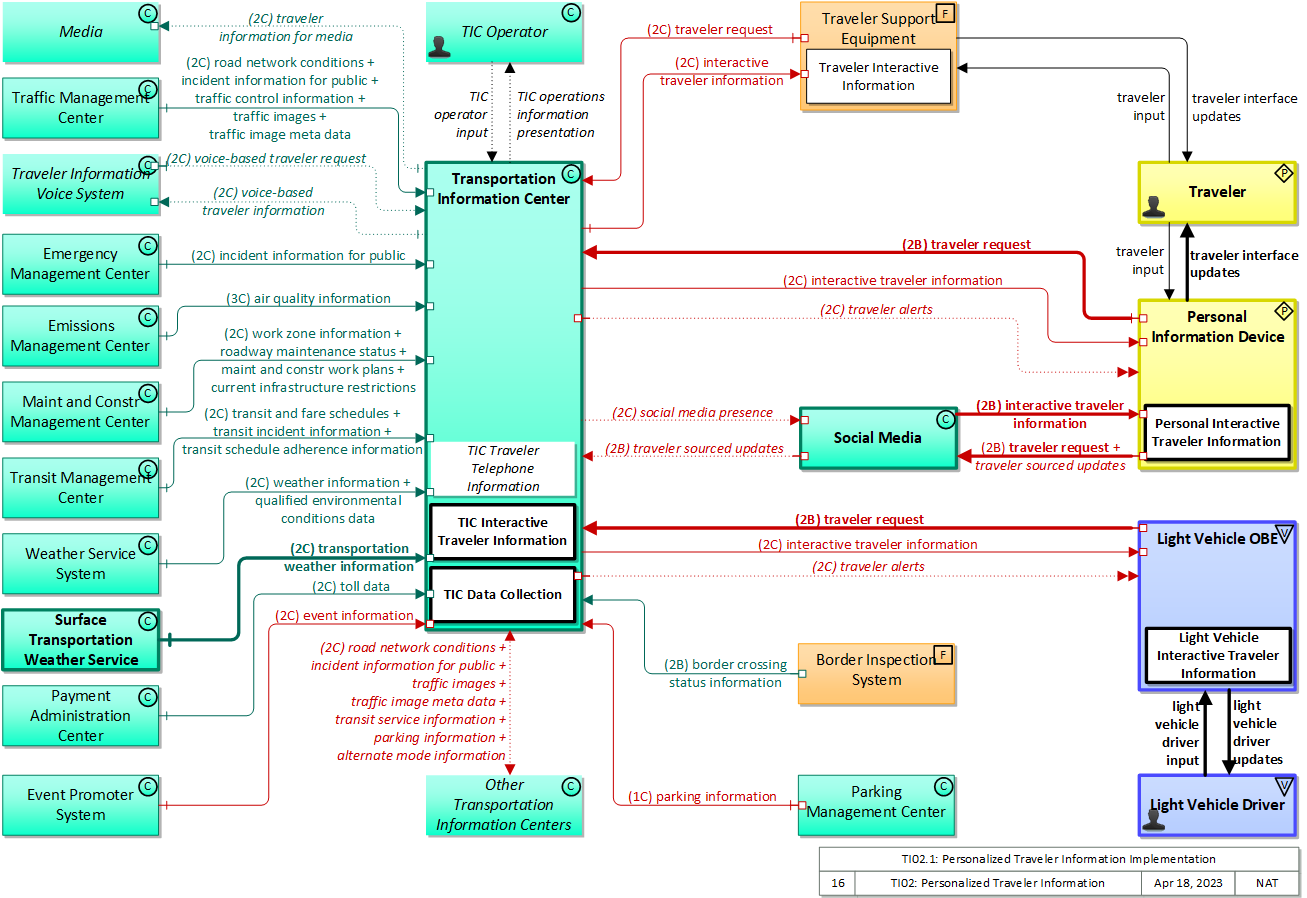
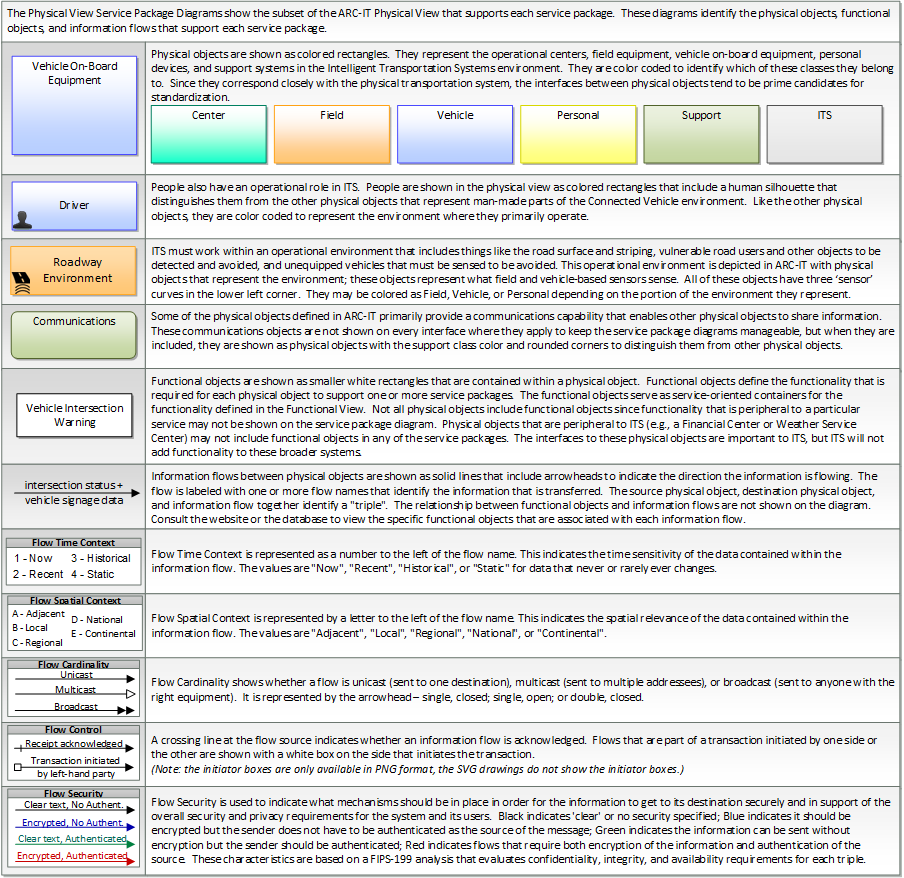

Includes Physical Objects:
| Physical Object | Class | Description |
|---|---|---|
| Border Inspection System | Field | 'Border Inspection System' represents data systems used at the border for the inspection of people or goods. It supports immigration, customs (trade), agricultural, and FDA inspections as applicable. It includes sensors and surveillance systems to identify and classify drivers and their cargo as they approach a border crossing, the systems used to interface with the back-office administration systems and provide information on status of the crossing or events. |
| Emergency Management Center | Center | The 'Emergency Management Center' represents systems that support incident management, disaster response and evacuation, security monitoring, and other security and public safety-oriented ITS applications. It includes the functions associated with fixed and mobile public safety communications centers including public safety call taker and dispatch centers operated by police (including transit police), fire, and emergency medical services. It includes the functions associated with Emergency Operations Centers that are activated at local, regional, state, and federal levels for emergencies and the portable and transportable systems that support Incident Command System operations at an incident. This Center also represents systems associated with towing and recovery, freeway service patrols, HAZMAT response teams, and mayday service providers. It manages sensor and surveillance equipment used to enhance transportation security of the roadway infrastructure (including bridges, tunnels, interchanges, and other key roadway segments) and the public transportation system (including transit vehicles, public areas such as transit stops and stations, facilities such as transit yards, and transit infrastructure such as rail, bridges, tunnels, or bus guideways). It provides security/surveillance services to improve traveler security in public areas not a part of the public transportation system. It monitors alerts, advisories, and other threat information and prepares for and responds to identified emergencies. It coordinates emergency response involving multiple agencies with peer centers. It stores, coordinates, and utilizes emergency response and evacuation plans to facilitate this coordinated response. Emergency situation information including damage assessments, response status, evacuation information, and resource information are shared The Emergency Management Center also provides a focal point for coordination of the emergency and evacuation information that is provided to the traveling public, including wide-area alerts when immediate public notification is warranted. It tracks and manages emergency vehicle fleets using real-time road network status and routing information from the other centers to aid in selecting the emergency vehicle(s) and routes, and works with other relevant centers to tailor traffic control to support emergency vehicle ingress and egress, implementation of special traffic restrictions and closures, evacuation traffic control plans, and other special strategies that adapt the transportation system to better meet the unique demands of an emergency. |
| Emissions Management Center | Center | The 'Emissions Management Center' provides the capabilities for air quality managers to monitor and manage air quality. These capabilities include collecting emissions data from distributed emissions sensors (included in ITS Roadway Equipment) and directly from connected vehicles. The sensors monitor general air quality and also monitor the emissions of individual vehicles on the roadway. The measures are collected, processed, and used to support environmental monitoring applications. |
| Event Promoter System | Center | 'Event Promoter System' represents Special Event Sponsors that have knowledge of events that may impact travel on roadways or other modal means. Examples of special event sponsors include sporting events, conventions, motorcades/parades, and public/political events. These promoters interface to the ITS to provide event information such as date, time, estimated duration, location, and any other information pertinent to traffic movement in the surrounding area. |
| Light Vehicle Driver | Vehicle | The 'Light Vehicle Driver' represents the person that operates a light vehicle on the roadway. This physical object covers the interactions that are specific to light, passenger vehicles. See also the 'Driver' physical object that covers interactions that are shared by operators of light, transit, commercial, and emergency vehicles where the interactions are not particular to the type of vehicle. |
| Light Vehicle OBE | Vehicle | The 'Light Vehicle OBE' includes traveler-oriented capabilities that apply to passenger cars, trucks, and motorcycles that are used for personal travel. The rules vary by jurisdiction, but generally light vehicles are restricted in their weight and the maximum number of passengers they can carry. In ARC-IT, the Light Vehicle OBE represents vehicles that are operated as personal vehicles that are not part of a vehicle fleet and are not used commercially; thus, the choice between the various vehicle subsystems should be based more on how the vehicle is used than how much the vehicle weighs. See also the 'Vehicle' subsystem that includes the general safety and information services that apply to all types of vehicles, including light vehicles. |
| Maint and Constr Management Center | Center | The 'Maint and Constr Management Center' monitors and manages roadway infrastructure construction and maintenance activities. Representing both public agencies and private contractors that provide these functions, this physical object manages fleets of maintenance, construction, or special service vehicles (e.g., snow and ice control equipment). The physical object receives a wide range of status information from these vehicles and performs vehicle dispatch, routing, and resource management for the vehicle fleets and associated equipment. The physical object participates in incident response by deploying maintenance and construction resources to an incident scene, in coordination with other center physical objects. The physical object manages equipment at the roadside, including environmental sensors and automated systems that monitor and mitigate adverse road and surface weather conditions. It manages the repair and maintenance of both non-ITS and ITS equipment including the traffic controllers, detectors, dynamic message signs, signals, and other equipment associated with the roadway infrastructure. Weather information is collected and fused with other data sources and used to support advanced decision support systems. The physical object remotely monitors and manages ITS capabilities in work zones, gathering, storing, and disseminating work zone information to other systems. It manages traffic in the vicinity of the work zone and advises drivers of work zone status (either directly at the roadside or through an interface with the Transportation Information Center or Traffic Management Center physical objects.) Construction and maintenance activities are tracked and coordinated with other systems, improving the quality and accuracy of information available regarding closures and other roadway construction and maintenance activities. |
| Media | Center | 'Media' represents the information systems that provide traffic reports, travel conditions, and other transportation-related news services to the traveling public through radio, TV, and other media. Traffic and travel advisory information that are collected by ITS are provided to this object. It is also a source for traffic flow information, incident and special event information, and other events that may have implications for the transportation system. |
| Other Transportation Information Centers | Center | Representing another Transportation Information Center, this object is intended to provide a source and destination for ITS information flows between peer information and service provider functions. It enables cooperative information sharing between providers as conditions warrant. |
| Parking Management Center | Center | The 'Parking Management Center' manages one or more parking lots by providing configuration and control of field infrastructure, user account management and interfaces with financial systems to manage payment. This p-object takes the back office portion of the Parking Management System's functionality as it was defined in ARC-IT 8.3 and prior. |
| Payment Administration Center | Center | The 'Payment Administration Center' provides general payment administration capabilities and supports the electronic transfer of funds from the customer to the transportation system operator or other service provider. Charges can be recorded for tolls, vehicle-mileage charging, congestion charging, or other goods and services. It supports traveler enrollment and collection of both pre-payment and post-payment transportation fees in coordination with the financial infrastructure supporting electronic payment transactions. The system may establish and administer escrow accounts depending on the clearinghouse scheme and the type of payments involved. It may post a transaction to the customer account, generate a bill (for post-payment accounts), debit an escrow account, or interface to a financial infrastructure to debit a customer designated account. It supports communications with the ITS Roadway Payment Equipment to support fee collection operations. As an alternative, a wide-area wireless interface can be used to communicate directly with vehicle equipment. It also sets and administers the pricing structures and may implement road pricing policies in coordination with the Traffic Management Center. |
| Personal Information Device | Personal | The 'Personal Information Device' provides the capability for travelers to receive formatted traveler information wherever they are. Capabilities include traveler information, trip planning, and route guidance. Frequently a smart phone, the Personal Information Device provides travelers with the capability to receive route planning and other personally focused transportation services from the infrastructure in the field, at home, at work, or while en-route. Personal Information Devices may operate independently or may be linked with vehicle on-board equipment. This subsystem also supports safety related services with the capability to broadcast safety messages and initiate a distress signal or request for help. |
| Social Media | Center | 'Social Media' provides forums for social interaction and opportunities for gathering and distributing traveler information. These sites provide crowd sourced information and the opportunity to provide traveler information to specific communities of interest. Examples include Facebook, Twitter, and LinkedIn. Each social media platform offers its own tools and API that allow integration of web content into a shared social media experience. |
| Surface Transportation Weather Service | Center | The 'Surface Transportation Weather Service' represents the providers of value-added sector-specific meteorological services. These providers utilize National Weather Service data and predictions, road condition information and local environmental data provided by traffic management or maintenance organizations, and their own models to provide surface transportation related weather observations and forecasts including pavement temperature and conditions. |
| TIC Operator | Center | This 'TIC Operator' represents the person or people that monitor and manage traveler information services provided by the Transportation Information Center. |
| Traffic Management Center | Center | The 'Traffic Management Center' monitors and controls traffic and the road network. It represents centers that manage a broad range of transportation facilities including freeway systems, rural and suburban highway systems, and urban and suburban traffic control systems. It communicates with ITS Roadway Equipment and Connected Vehicle Roadside Equipment (RSE) to monitor and manage traffic flow and monitor the condition of the roadway, surrounding environmental conditions, and field equipment status. It manages traffic and transportation resources to support allied agencies in responding to, and recovering from, incidents ranging from minor traffic incidents through major disasters. |
| Transit Management Center | Center | The 'Transit Management Center' manages transit vehicle fleets and coordinates with other modes and transportation services. It provides operations, maintenance, customer information, planning and management functions for the transit property. It spans distinct central dispatch and garage management systems and supports the spectrum of fixed route, flexible route, paratransit services, transit rail, and bus rapid transit (BRT) service. The physical object's interfaces support communication between transit departments and with other operating entities such as emergency response services and traffic management systems. |
| Transportation Information Center | Center | The 'Transportation Information Center' collects, processes, stores, and disseminates transportation information to system operators and the traveling public. The physical object can play several different roles in an integrated ITS. In one role, the TIC provides a data collection, fusing, and repackaging function, collecting information from transportation system operators and redistributing this information to other system operators in the region and other TICs. In this information redistribution role, the TIC provides a bridge between the various transportation systems that produce the information and the other TICs and their subscribers that use the information. The second role of a TIC is focused on delivery of traveler information to subscribers and the public at large. Information provided includes basic advisories, traffic and road conditions, transit schedule information, yellow pages information, ride matching information, and parking information. The TIC is commonly implemented as a website or a web-based application service, but it represents any traveler information distribution service. |
| Traveler | Personal | The 'Traveler' represents any individual who uses transportation services. The interfaces to the traveler provide general pre-trip and en-route information supporting trip planning, personal guidance, and requests for assistance in an emergency that are relevant to all transportation system users. It also represents users of a public transportation system and addresses interfaces these users have within a transit vehicle or at transit facilities such as roadside stops and transit centers. |
| Traveler Information Voice System | Center | The 'Traveler Information Voice System' provides the caller interface and voice processing (voice recognition/synthesis) that supports voice-enabled traveler telephone information systems. It provides wireline and wireless caller access to 511 systems and other telephone access mechanisms like 7 or 10 digit local access numbers. It represents the boundary of the architecture where a call is received and processed and includes voice portal capabilities in scenarios where a distinct voice portal exists between ITS Centers and telecommunications providers. The terminator gathers traveler information, alerts, and advisories from information service provider(s) and uses this information to support voice-based interactions with a traveler. |
| Traveler Support Equipment | Field | 'Traveler Support Equipment' provides access to traveler information at transit stations, transit stops, other fixed sites along travel routes (e.g., rest stops, merchant locations), and major trip generation locations such as special event centers, hotels, office complexes, amusement parks, and theaters. Traveler information access points include kiosks and informational displays supporting varied levels of interaction and information access. At transit stops this might be simple displays providing schedule information and imminent arrival signals. This may be extended to include multi-modal information including traffic conditions and transit schedules to support mode and route selection at major trip generation sites. Personalized route planning and route guidance information can also be provided based on criteria supplied by the traveler. It also supports service enrollment and electronic payment of transit fares. In addition to the traveler information provision, it also enhances security in public areas by supporting traveler activated silent alarms. |
| Weather Service System | Center | The 'Weather Service System' provides weather, hydrologic, and climate information and warnings of hazardous weather including thunderstorms, flooding, hurricanes, tornadoes, winter weather, tsunamis, and climate events. It provides atmospheric weather observations and forecasts that are collected and derived by the National Weather Service, private sector providers, and various research organizations. The interface provides formatted weather data products suitable for on-line processing and integration with other ITS data products as well as Doppler radar images, satellite images, severe storm warnings, and other products that are formatted for presentation to various ITS users. |
Includes Functional Objects:
| Functional Object | Description | Physical Object |
|---|---|---|
| Light Vehicle Interactive Traveler Information | 'Light Vehicle Interactive Traveler Information' provides drivers with personalized traveler information including traffic and road conditions, transit information, maintenance and construction information, multimodal information, event information, and weather information. The provided information is tailored based on driver requests. Both one-time requests for information and on-going information streams based on a submitted traveler profile and preferences are supported. | Light Vehicle OBE |
| Personal Interactive Traveler Information | 'Personal Interactive Traveler Information' provides traffic information, road conditions, transit information, yellow pages (traveler services) information, special event information, and other traveler information that is specifically tailored based on the traveler's request and/or previously submitted traveler profile information. It also supports interactive services that support enrollment, account management, and payments for transportation services. The interactive traveler information capability is provided by personal devices including personal computers and personal portable devices such as smart phones. | Personal Information Device |
| TIC Data Collection | 'TIC Data Collection' collects transportation-related data from other centers, performs data quality checks on the collected data and then consolidates, verifies, and refines the data and makes it available in a consistent format to applications that support operational data sharing between centers and deliver traveler information to end-users. A broad range of data is collected including traffic and road conditions, transit data, pathway information, emergency information and advisories, weather data, special event information, traveler services, parking, multimodal data, and toll/pricing data. It also shares data with other transportation information centers. | Transportation Information Center |
| TIC Interactive Traveler Information | 'TIC Interactive Traveler Information' disseminates personalized traveler information including traffic and road conditions, transit information, parking information, maintenance and construction information, multimodal information, event information, and weather information. Tailored information is provided based on the traveler's request in this interactive service. | Transportation Information Center |
| TIC Traveler Telephone Information | 'TIC Traveler Telephone Information' services voice-based traveler requests for information that supports traveler telephone information systems like 511. It takes requests for traveler information, which could be voice-formatted traveler requests, dual-tone multi-frequency (DTMF)-based requests, or a simple traveler information request, and returns the requested traveler information in the proper format. In addition to servicing requests for traveler information, it also collects and forwards alerts and advisories to traveler telephone information systems. | Transportation Information Center |
| Traveler Interactive Information | 'Traveler Interactive Information' provides traffic information, road conditions, transit information, yellow pages (traveler services) information, special event information, and other traveler information that is specifically tailored based on the traveler's request and/or previously submitted traveler profile information. It also supports interactive services that support enrollment, account management, and payments for transportation services. The interactive traveler information capability is provided by a public traveler interface, such as a kiosk. | Traveler Support Equipment |
| Vehicle Traveler Information Reception | 'Vehicle Traveler Information Reception' receives advisories, vehicle signage data, and other driver information of use to all types of vehicles and drivers and presents this information to the driver using in-vehicle equipment. Information presented may include fixed sign information, traffic control device status (e.g., signal phase and timing data), advisory and detour information, warnings of adverse road and weather conditions, travel times, and other driver information. | Vehicle |
Includes Information Flows:
| Information Flow | Description |
|---|---|
| air quality information | Aggregated region-wide measured air quality data and possible pollution incident information. |
| alternate mode information | Schedule information for alternate mode transportation providers such as air, ferry, and passenger-carrying heavy rail. This also includes details of incidents and other service disruptions that have occurred in the alternative mode. This also includes measures of service demand that supports assessment of their impact on the road network. |
| border crossing status information | Port of entry status including current wait-times, lane configuration and status including closures and restrictions, and notification of incidents at the border |
| current infrastructure restrictions | Restrictions levied on transportation asset usage based on infrastructure design, surveys, tests, or analyses. This includes standard facility design height, width, and weight restrictions, special restrictions such as spring weight restrictions, and temporary facility restrictions that are imposed during maintenance and construction. |
| event information | Special event information for travelers. This would include a broader array of information than the similar "event plans" that conveys only information necessary to support traffic management for the event. |
| incident information for public | Report of current desensitized incident information prepared for public dissemination. |
| interactive traveler information | Traveler information provided in response to a traveler request. The provided information includes traffic and road conditions, advisories, incidents, restrictions, payment information, transit services, parking information, weather information, and other travel-related data updates and confirmations. |
| light vehicle driver input | Driver input to the light vehicle on-board equipment including configuration data, settings and preferences, interactive requests, and control commands. |
| light vehicle driver updates | Information provided to the light vehicle driver including visual displays, audible information and warnings, and haptic feedback. The updates inform the driver about current conditions, potential hazards, and the current status of vehicle on-board equipment. |
| maint and constr work plans | Future construction and maintenance work schedules and activities including anticipated closures with anticipated impact to the roadway, alternate routes, anticipated delays, closure times, and durations. |
| parking information | General parking information and status, including current parking availability, parking pricing, and parking space availability information, including features like number and type of electric charging spots. |
| qualified environmental conditions data | Current road conditions (e.g., surface temperature, subsurface temperature, moisture, icing, treatment status) and surface weather conditions (e.g., air temperature, wind speed, precipitation, visibility) that has had quality checks performed on it and has been formatted and consolidated by the Clarus system. Attributes relating to the data collection (and aggregation) are also included. |
| road network conditions | Current and forecasted traffic information, road and weather conditions, and other road network status. Either raw data, processed data, or some combination of both may be provided by this flow. Information on diversions and alternate routes, closures, and special traffic restrictions (lane/shoulder use, weight restrictions, width restrictions, HOV requirements) in effect is included. |
| roadway maintenance status | Summary of maintenance fleet operations affecting the road network. This includes the status of winter maintenance (snow plow schedule and current status). |
| social media presence | Each social media platform offers its own tools and API that allow integration of web content into a social media experience. This interface establishes a social media presence for traveler information sites, providing current traveler information to subscribers. |
| TIC operations information presentation | Presentation of information to the TIC Operator including current operational status, parameters for broadcast information settings, route selection controls, and travel optimization algorithms. |
| TIC operator input | User input from the TIC system operator including requests to monitor current system operation and inputs to affect system operation including tuning and performance enhancement parameters to traveler information algorithms. |
| toll data | Current toll schedules for different types of vehicles as well as advanced toll payment information. |
| traffic control information | Represents the flow of traffic control and status information between centers. This is reporting only, not actual control. This specifically includes the current state of any demand management strategies that have been implemented. |
| traffic image meta data | Meta data that describes traffic images. Traffic images (video) are in another flow. |
| traffic images | High fidelity, real-time traffic images suitable for surveillance monitoring by the operator or for use in machine vision applications. This flow includes the images. Meta data that describes the images is contained in another flow. |
| transit and fare schedules | Transit service information including routes, schedules, and fare information. This also includes on-demand service information. |
| transit incident information | Information on transit incidents that impact transit services for public dissemination. |
| transit schedule adherence information | Dynamic transit schedule adherence and transit vehicle location information. |
| transit service information | Transit service information including routes, schedules, and fare information as well as dynamic transit schedule adherence and transit vehicle location information. |
| transportation weather information | Current and forecast road conditions and weather information (e.g., surface condition, flooding, wind advisories, visibility, etc.) associated with the transportation network. This information is of a resolution, timeliness, and accuracy to be useful in transportation decision making. |
| traveler alerts | Traveler information alerts reporting congestion, incidents, adverse road or weather conditions, restrictions, vehicle requirements, parking availability, transit service delays or interruptions, and other information that may impact the traveler. Relevant alerts are provided based on traveler-supplied profile information including trip characteristics and preferences. |
| traveler information for media | General traveler information regarding incidents, unusual traffic conditions, transit issues, or other advisory information that has been desensitized and provided to the media. |
| traveler input | User input from a traveler to summon assistance, request travel information, make a reservation, or request any other traveler service. |
| traveler interface updates | Visual or audio information (e.g., routes, messages, guidance, emergency information) that is provided to the traveler. |
| traveler request | A request for traveler information including traffic, transit, toll, parking, road weather conditions, event, and passenger rail information. The request identifies the type of information, the area of interest, parameters that are used to prioritize or filter the returned information, and sorting preferences. |
| traveler sourced updates | Traveler posts on traffic and road conditions, parking availability, transit services, traveler services, shelter information, hazards, debris, obstacles, and other real-time crowd-sourced data that may be shared with other travelers. |
| voice-based traveler information | Traveler information sent to the telecommunications systems for traveler information terminator. This flow may represent the bulk transfer of traveler information, including traffic conditions, incident information, transit information and weather and road condition information. It may be specially formatted for voice-based traveler information. |
| voice-based traveler request | The electronic traveler information request from the telecommunications systems for traveler information terminator. It may be specifically formatted for voice-based traveler requests. The request can be a general subscription intended to initiate a continuous or regular data stream or a specific request intended to initiate a one-time response from the recipient. |
| weather information | Accumulated forecasted and current weather data (e.g., temperature, pressure, wind speed, wind direction, humidity, precipitation, visibility, light conditions, etc.). |
| work zone information | Summary of maintenance and construction work zone activities affecting the road network including the nature of the maintenance or construction activity, location, impact to the roadway, expected time(s) and duration of impact, anticipated delays, alternate routes, and suggested speed limits. This information may be augmented with images that provide a visual indication of current work zone status and traffic impacts. |
Goals and Objectives
Associated Planning Factors and Goals
| Planning Factor | Goal |
|---|---|
| A. Support the economic vitality of the metropolitan area, especially by enabling global competitiveness, productivity, and efficiency; | Improve freight network |
| B. Increase the safety of the transportation system for motorized and nonmotorized users; | Reduce fatalities and injuries |
| D. Increase the accessibility and mobility of people and for freight; | Reduce congestion |
| F. Enhance the integration and connectivity of the transportation system, across and between modes, for people and freight; | Enhance integration and connectivity |
| G. Promote efficient system management and operation; | Improve efficiency |
| I. Improve the resiliency and reliability of the transportation system and reduce or mitigate stormwater impacts of surface transportation; | Improve resiliency and reliability |
| J. Enhance travel and tourism. | Support travel and tourism |
Associated Objective Categories 
Associated Objectives and Performance Measures
Needs and Requirements
| Need | Functional Object | Requirement | ||
|---|---|---|---|---|
| 01 | Traveler Information needs to be able to collect timely, accurate, and reliable traffic, transit, and other road conditions data from multiple sources in order to inform individual travelers of the latest conditions affecting their travel. | TIC Data Collection | 01 | The center shall collect, process, and store traffic and highway condition information, including incident information, detours and road closures, event information, recommended routes, and current speeds on specific routes. |
| 03 | The center shall collect, process, and store maintenance and construction information, including scheduled maintenance and construction work activities and work zone activities. | |||
| 04 | The center shall collect, process, and store transit routes and schedules, transit transfer options, transit fares, and real-time schedule adherence information. | |||
| 05 | The center shall collect, process, and store parking information, including location, availability, and fees. | |||
| 07 | The center shall collect, process, and store current and forecast road conditions and surface weather conditions. | |||
| 08 | The center shall collect, process, and store event information. | |||
| 09 | The center shall collect, process, and store air quality information. | |||
| 19 | The center shall collect, store and process multimodal transportation service information (for example, from ferry, rail and airline operators), including current ferry and rail schedule and airport status information and transfer points. | |||
| TIC Interactive Traveler Information | 15 | The center shall provide the capability to exchange information with another traveler information service provider current or predicted data for road links that are outside the area served by the local supplier. | ||
| 02 | Traveler Information needs to be able to inform as much of the traveling public as possible using any available interactive media to increase mobility and safety through better information. | Light Vehicle Interactive Traveler Information | 01 | The vehicle shall receive formatted traffic and travel advisories from a center and present them to the driver upon request. |
| 02 | The vehicle shall receive travel alerts from a center and present them to the driver. Relevant alerts are provided based on pre-supplied trip characteristics and preferences. | |||
| 04 | The vehicle shall receive event information from a center and present it to the driver upon request. | |||
| 12 | The vehicle shall support interactive information requests in audio or manual form. | |||
| 15 | The vehicle shall present traveler information to the driver in audible or visual forms without impairing the driver's ability to control the vehicle in a safe manner. | |||
| Personal Interactive Traveler Information | 01 | The personal traveler interface shall receive traffic information from a center and present it to the traveler upon request. | ||
| 02 | The personal traveler interface shall receive transit information from a center and present it to the traveler upon request. | |||
| 04 | The personal traveler interface shall receive event information from a center and present it to the traveler upon request. | |||
| 11 | The personal traveler interface shall support traveler input in audio or manual form. | |||
| 12 | The personal traveler interface shall present interactive information to the traveler in audible or visual forms consistent with a personal device, and suitable for travelers with hearing and vision physical disabilities. | |||
| 17 | The personal traveler interface shall receive traveler information including traffic and road conditions, advisories, incidents, payment information, transit services, parking information, weather information, and other travel-related data updates and confirmations. | |||
| TIC Interactive Traveler Information | 04 | The center shall disseminate customized parking information to travelers, including location, availability, and fees upon request. | ||
| 16 | The center shall provide the capability to support requests from the media for traffic and incident data. | |||
| 17 | The center shall provide the capability for a system operator to control the type and update frequency of traveler information. | |||
| TIC Traveler Telephone Information | 02 | The center shall provide the capability to process dual-tone multi-frequency (DTMF)-based requests (touch-tone) for traveler information from a traveler telephone information system. | ||
| 03 | The center shall provide the capability to process traveler information requests from a traveler telephone information system. | |||
| 04 | The center shall provide information on traffic conditions in the requested voice format and for the requested location. | |||
| 05 | The center shall provide work zone and roadway maintenance information in the requested voice format and for the requested location. | |||
| 06 | The center shall provide roadway environment conditions information in the requested voice format and for the requested location. | |||
| 07 | The center shall provide weather and event information in the requested voice format and for the requested location. | |||
| 08 | The center shall provide transit service information in the requested voice format and for the requested location. | |||
| 10 | The center shall provide the capability to support both specific caller requests as well as bulk upload of regional traveler information. | |||
| Traveler Interactive Information | 01 | The public interface for travelers shall receive traffic information from a center and present it to the traveler upon request. | ||
| 10 | The public interface for travelers shall support interactive traveler input in audio or manual form. | |||
| 11 | The public interface for travelers shall present interactive information to the traveler in audible or visual forms consistent with a kiosk, including those that are suitable for travelers with hearing or vision physical disabilities. | |||
| 03 | Travelers, including drivers or passengers, need access to timely, accurate, and reliable traffic, transit, and other travel conditions in order to make informed decisions about their travel. | Light Vehicle Interactive Traveler Information | 04 | The vehicle shall receive event information from a center and present it to the driver upon request. |
| 07 | The vehicle shall collect vehicle data and present it to the driver (including vehicle conditions, environmental conditions, safety and position warnings, and enhanced vision images) upon request. | |||
| 10 | The vehicle shall provide the capability of translating signage for presentation to the driver, including fixed signage, situational messages, or work zone intrusion messages. | |||
| 11 | The vehicle shall prioritize safety and warning messages to supersede advisory and other traveler messages. | |||
| TIC Interactive Traveler Information | 01 | The center shall disseminate customized traffic and highway condition information to travelers, including incident information, detours and road closures, recommended routes, and current speeds on specific routes upon request. | ||
| 02 | The center shall disseminate customized maintenance and construction information to travelers, including scheduled maintenance and construction work activities and work zone activities upon request. | |||
| 03 | The center shall disseminate customized transit routes and schedules, transit transfer options, transit fares, and real-time schedule adherence information to travelers upon request. | |||
| 04 | The center shall disseminate customized parking information to travelers, including location, availability, and fees upon request. | |||
| 05 | The center shall disseminate customized toll fee information to travelers upon request. | |||
| 06 | The center shall disseminate customized weather information to travelers upon request. | |||
| 07 | The center shall disseminate customized multimodal transportation service information (for example, from ferry and airline operators), including transfer points and other information, to travelers upon request. | |||
| 08 | The center shall disseminate customized event information to travelers upon request. | |||
| 09 | The center shall disseminate customized air quality information to travelers upon request. | |||
| 10 | The center shall provide all traveler information based on the traveler's current location or a specific location identified by the traveler, and filter or customize the provided information accordingly. | |||
| TIC Traveler Telephone Information | 01 | The center shall provide the capability to process voice-formatted requests for traveler information from a traveler telephone information system, and return the information in the requested format. | ||
| 09 | The center shall provide current ferry and rail schedule and airport status information in the requested voice format and for the requested location. | |||
| Traveler Interactive Information | 01 | The public interface for travelers shall receive traffic information from a center and present it to the traveler upon request. | ||
| 02 | The public interface for travelers shall receive transit information from a center and present it to the traveler upon request. | |||
| 04 | The public interface for travelers shall receive event information from a center and present it to the traveler upon request. | |||
| 06 | The public interface for travelers shall accept reservations for confirmed trip plans. | |||
| 09 | The public interface for travelers shall base requests from the traveler on the traveler's current location or a specific location identified by the traveler, and filter the provided information accordingly. | |||
| 10 | The public interface for travelers shall support interactive traveler input in audio or manual form. | |||
| 11 | The public interface for travelers shall present interactive information to the traveler in audible or visual forms consistent with a kiosk, including those that are suitable for travelers with hearing or vision physical disabilities. | |||
| 12 | The public interface for travelers shall store frequently requested data. | |||
| Vehicle Traveler Information Reception | 02 | The vehicle shall receive advisory information, such as evacuation information, proximity to a maintenance and construction vehicle, wide-area alerts, work zone intrusion information, variable speed limits, tunnel entrance restrictions, border crossing advisories, and other special information. | ||
| 22 | The vehicle shall receive formatted traffic information from a center and present it to the driver. | |||
| 04 | Travelers, including drivers or passengers, need to be able to request specific and customized information concerning current and future travel conditions in order to make decisions about their own travel. | Light Vehicle Interactive Traveler Information | 02 | The vehicle shall receive travel alerts from a center and present them to the driver. Relevant alerts are provided based on pre-supplied trip characteristics and preferences. |
| 13 | The vehicle shall accept personal preferences, recurring trip characteristics, and traveler alert subscription information from the driver and send this information to a center to support customized traveler information services. | |||
| 14 | The vehicle shall base requests from the driver on the vehicle's current location, and filter the provided information accordingly. | |||
| Personal Interactive Traveler Information | 10 | The personal traveler interface shall base requests from the traveler on the traveler's current location or a specific location identified by the traveler, and filter the provided information accordingly. | ||
| 13 | The personal traveler interface shall store frequently requested or used data, including the traveler's identity, home and work locations, etc. | |||
| 14 | The personal traveler interface shall receive travel alerts and present them to the traveler. Relevant alerts are provided based on pre-supplied trip characteristics and preferences. | |||
| 15 | The personal traveler interface shall accept personal preferences, recurring trip characteristics, and traveler alert subscription information from the traveler and send this information to a center to support customized traveler information services. | |||
| TIC Interactive Traveler Information | 02 | The center shall disseminate customized maintenance and construction information to travelers, including scheduled maintenance and construction work activities and work zone activities upon request. | ||
| 03 | The center shall disseminate customized transit routes and schedules, transit transfer options, transit fares, and real-time schedule adherence information to travelers upon request. | |||
| 05 | The center shall disseminate customized toll fee information to travelers upon request. | |||
| 06 | The center shall disseminate customized weather information to travelers upon request. | |||
| 07 | The center shall disseminate customized multimodal transportation service information (for example, from ferry and airline operators), including transfer points and other information, to travelers upon request. | |||
| 08 | The center shall disseminate customized event information to travelers upon request. | |||
| 09 | The center shall disseminate customized air quality information to travelers upon request. | |||
| 10 | The center shall provide all traveler information based on the traveler's current location or a specific location identified by the traveler, and filter or customize the provided information accordingly. | |||
| 11 | The center shall accept traveler profiles for determining the type of personalized data to send to the traveler. | |||
| Traveler Interactive Information | 09 | The public interface for travelers shall base requests from the traveler on the traveler's current location or a specific location identified by the traveler, and filter the provided information accordingly. | ||
Related Sources
| Document Name | Version | Publication Date |
|---|---|---|
| None |
Security
In order to participate in this service package, each physical object should meet or exceed the following security levels.
In order to participate in this service package, each information flow triple should meet or exceed the following security levels.
| Information Flow Security | |||||
|---|---|---|---|---|---|
| Source | Destination | Information Flow | Confidentiality | Integrity | Availability |
| Basis | Basis | Basis | |||
| Border Inspection System | Transportation Information Center | border crossing status information | Low | Moderate | Low |
| This is all public information which is mostly available through public information channels. | Some minimal guarantee of data integrity is necessary for all C-ITS flows. A flaw in this information will not cause much, if any harm. A higher integrity will allow this information to be of more use, but is not required for security reasons. DISC: Original V2I analysis classified this as LOW. | Without this information there will not be any direct problem. A higher availability will allow this information to be more useful; however it is not a requirement. | |||
| Emergency Management Center | Transportation Information Center | incident information for public | Low | Moderate | Moderate |
| Generally, center-originating flows destined for a TIC don't contain any personal or confidential information, and are eventually intended for some kind of public consumption. | Minor discrepancies in this data should not have a catastrophic effect, but it should be reasonably controlled and accurate. | A few missed messages should not have a significant effect. However, most messages should make it through and the EMC should be able to know if the TIC has received a message. | |||
| Emissions Management Center | Transportation Information Center | air quality information | Not Applicable | Moderate | Low |
| This flow does not contain any personal or confidential information, and the data contained is eventually intended for public consumption. | Information for general distribution should have at least some guarantee that it was correctly transmitted. If this information were incorrect, people could be exposed to higher levels of pollution than they would intend, which could be harmful to people with medical conditions such as asthma. | Not a key flow for any service package. If an application is developed that relies on this flow, may change to MODERATE. | |||
| Event Promoter System | Transportation Information Center | event information | Moderate | High | Moderate |
| Confirmation flow should match the ratings of the flow providing information in the first place. | Confirmation flow should match the ratings of the flow providing information in the first place. | Confirmation flow should match the ratings of the flow providing information in the first place. | |||
| Light Vehicle Driver | Light Vehicle OBE | light vehicle driver input | Moderate | High | High |
| Data included in this flow may include origin and destination information, which should be protected from other's viewing as it may compromise the driver's privacy. | Commands from from the driver to the vehicle must be correct or the vehicle may behave in an unpredictable and possibly unsafe manner | Commands must always be able to be given or the driver has no control. | |||
| Light Vehicle OBE | Light Vehicle Driver | light vehicle driver updates | Not Applicable | Moderate | Moderate |
| This data is informing the driver about the safety of a nearby area. It should not contain anything sensitive, and does not matter if another person can observe it. | This is the information that is presented to the driver. If they receive incorrect information, they may act in an unsafe manner. However, there are other indicators that would alert them to any hazards, such as an oncoming vehicle or crossing safety lights. | If this information is not made available to the driver, then the system has not operated correctly. | |||
| Light Vehicle OBE | Transportation Information Center | traveler request | Moderate | Moderate | Moderate |
| This is likely to include the traveler location and may include traveler identity as well. This PII could be used by an attacker to the detriment of the traveler. | Request needs to be correct, or the wrong data may be sent. | Interface needs to be available or users will find other sources that are reliable. | |||
| Maint and Constr Management Center | Transportation Information Center | current infrastructure restrictions | Low | High | High |
| Generally, center-originating flows destined for a TIC don't contain any personal or confidential information, and are eventually intended for some kind of public consumption. | If incorrect or unavailable this could result in a vehicle being somewhere it should not be due to infrastructure restrictions, which could have an impact on the infrastruture and the vehicle, including potential incidents (consider a large vehicle with narrow or height-restricted roadway). | If incorrect or unavailable this could result in a vehicle being somewhere it should not be due to infrastructure restrictions, which could have an impact on the infrastruture and the vehicle, including potential incidents (consider a large vehicle with narrow or height-restricted roadway). | |||
| Maint and Constr Management Center | Transportation Information Center | maint and constr work plans | Low | High | High |
| This data is eventually intended for public dissemination, and is also shared with many centers. | If incorrect or unavailable this could result in a vehicle being somewhere it should not be due to work zone impacts, which could have an impact on the infrastruture and the vehicle, including potential incidents (consider a large vehicle with narrow or height-restricted roadway). | If incorrect or unavailable this could result in a vehicle being somewhere it should not be due to work zone impacts, which could have an impact on the infrastruture and the vehicle, including potential incidents (consider a large vehicle with narrow or height-restricted roadway). | |||
| Maint and Constr Management Center | Transportation Information Center | roadway maintenance status | Low | Moderate | Moderate |
| Roadway maintenance status data is distributed to a host of places including travelers, so there is no justification for obfuscation. | Road maintenance data is generally distributed to travelers through a TIC, so this needs to be accurate and available so that travelers can make appropriate decisions. Inappropriate decisions may significantly affect traffic and individual travel experiences. | Road maintenance data is generally distributed to travelers through a TIC, so this needs to be accurate and available so that travelers can make appropriate decisions. Inappropriate decisions may significantly affect traffic and individual travel experiences. | |||
| Maint and Constr Management Center | Transportation Information Center | work zone information | Low | Moderate | Moderate |
| Eventually intended for public distribution, so no need to obfuscate. | Information needs to be timely and correct so that appropriate actions are taken on the part of the receiver. Trip plans, corresponding maintenance actions, transit and emergency vehicle routes, etc.; DISC: WYO believes this to be HIGH. | Information needs to be timely and correct so that appropriate actions are taken on the part of the receiver. Trip plans, corresponding maintenance actions, transit and emergency vehicle routes, etc. | |||
| Other Transportation Information Centers | Transportation Information Center | alternate mode information | Low | Moderate | Low |
| Generally, center-originating flows destined for a TIC don't contain any personal or confidential information, and are eventually intended for some kind of public consumption. | Generally transportation coordination information should be correct between source and destination, or inappropriate actions may be taken. | While useful, there is little impact if this flow is not available. | |||
| Other Transportation Information Centers | Transportation Information Center | incident information for public | Low | Moderate | Moderate |
| Generally, center-originating flows destined for a TIC don't contain any personal or confidential information, and are eventually intended for some kind of public consumption. | Publicly shared data about planned incidents should be accurate and delivered in timely fashion so as to enable end users to react appropriately; otherwise, signficant mobility challenges may result. | Publicly shared data about planned incidents should be accurate and delivered in timely fashion so as to enable end users to react appropriately; otherwise, signficant mobility challenges may result. | |||
| Other Transportation Information Centers | Transportation Information Center | parking information | Moderate | Moderate | Moderate |
| Does not include PII, but does include usage information for a managed facility that implies a number of vehicles. While this is observable information, it could be considered competitive, and regardless is accessible without being physically present, which is its own barrier. | Generally transportation coordination information should be correct between source and destination, or inappropriate actions may be taken. | Most likely not a frequently updated flow. Typically MODERATE for applications with a high degree of commercial vehicle parking, but could be LOW otherwise. | |||
| Other Transportation Information Centers | Transportation Information Center | road network conditions | Low | Moderate | Moderate |
| No harm should come from seeing this data, as it is eventually intended for public consumption. | While accuracy of this data is important for decision making purposes, applications should be able to corroborate the data in many instances. Thus MODERATE generally. | Depends on the application; if mobility decisions that affect large numbers of travelers are made based on this data, then it is MODERATE. In more modest circumstances, it may be LOW. | |||
| Other Transportation Information Centers | Transportation Information Center | traffic image meta data | Low | Moderate | Moderate |
| Traffic image data is generally intended for public consumption, and in any event is already video captured in the public arena, so this must be LOW. | While accuracy of this data is important for decision making purposes, applications should be able to cfunction without it. Thus MODERATE generally. | While accuracy of this data is important for decision making purposes, applications should be able to function without it. Thus MODERATE generally. | |||
| Other Transportation Information Centers | Transportation Information Center | traffic images | Low | Moderate | Low |
| Traffic image data is generally intended for public consumption, and in any event is already video captured in the public arena, so this must be LOW. | Generally transportation coordination information should be correct between source and destination, or inappropriate actions may be taken. | While useful, there is no signficant impact if this flow is not available. | |||
| Other Transportation Information Centers | Transportation Information Center | transit service information | Low | Moderate | Low |
| Generally, center-originating flows destined for a TIC don't contain any personal or confidential information, and are eventually intended for some kind of public consumption. | Generally transportation coordination information should be correct between source and destination, or inappropriate actions may be taken. | While useful, there is no signficant impact if this flow is not available. | |||
| Parking Management Center | Transportation Information Center | parking information | Moderate | Moderate | Moderate |
| Does not include PII, but does include usage information for a managed facility that implies a number of vehicles. While this is observable information, it could be considered competitive, and regardless is accessible without being physically present, which is its own barrier. | Generally transportation coordination information should be correct between source and destination, or inappropriate actions may be taken. | Most likely not a frequently updated flow. Typically MODERATE for applications with a high degree of commercial vehicle parking, but could be LOW otherwise. | |||
| Payment Administration Center | Transportation Information Center | toll data | Low | Moderate | Low |
| Should be public information, little benefit to obscuring this information. | Since actors may use this information to plan their travels, it must be correct. Corruption or manipulation of this data may lead them to make suboptimal decisions, costing time and/or money. | This flow probably does not update often. The information within is distributed via many routes. | |||
| Personal Information Device | Social Media | traveler request | Moderate | Moderate | Low |
| This is likely to include the traveler location and may include traveler identity as well. This PII could be used by an attacker to the detriment of the traveler. | Request needs to be correct, or the wrong data may be sent. | If this interface is not available the traveler will likely find other means to acquire the necessary information. | |||
| Personal Information Device | Social Media | traveler sourced updates | Moderate | Moderate | Low |
| This is likely to include the traveler location and may include traveler identity as well. This PII could be used by an attacker to the detriment of the traveler. | If this information is not correct the end user of the social media will likely find othe avenues for obtaining this information. | If this interface is not available the traveler will likely find other means to acquire the necessary information. | |||
| Personal Information Device | Transportation Information Center | traveler request | Moderate | Moderate | Moderate |
| This is likely to include the traveler location and may include traveler identity as well. This PII could be used by an attacker to the detriment of the traveler. | Request needs to be correct, or the wrong data may be sent. | Interface needs to be available or users will find other sources that are reliable. | |||
| Personal Information Device | Traveler | traveler interface updates | Not Applicable | Moderate | Moderate |
| Personalized data that includes directions and guidance for an individual, but eventually evident anyway. | Should be accurate as the Traveler will be relying on this information for routing and related choices. Lack of accuracy will result in lack of confidence from the traveler as well as an unsatisfactory trip, leading to a negative feedback spiral. | Users expect their devices to work. If information is not presented to the operator, the relevant applications simply won't be used. | |||
| Social Media | Personal Information Device | interactive traveler information | Moderate | Moderate | Low |
| Personalized traveler information implies location, intent and/or future location, which if compromised could enable an attacker with leverage over the traveler. | Traveler information needs to be correct, as the traveler is using this to make transport-related decisions. | Travelers will rely on this data for transportation-related decisions. Depending on the number of options, possible choices and impacts, this may be MODERATE. | |||
| Social Media | Transportation Information Center | traveler sourced updates | Moderate | Moderate | Low |
| This is likely to include the traveler location and may include traveler identity as well. This PII could be used by an attacker to the detriment of the traveler. | Quality of social media inputs may be highly variable, but no publicly distributable data should be exchanged without some protection over its transmission. | While a widespread and widely used dissemination channel, social media tends to be cluttered with lots of other information, so it is not a primary dissemination channel for this information. | |||
| Surface Transportation Weather Service | Transportation Information Center | transportation weather information | Low | Moderate | Moderate |
| Typically intended for public distribution. | There are several mechanisms by which weather information gets to a traveler, though given that the TIC may be performing some data fusion and providing value-added information, this data should be exchanged with some protection on its contents. | There are several mechanisms by which weather information gets to a traveler, though given that the TIC may be performing some data fusion and providing value-added information, this data should be exchanged with some protection on its contents. | |||
| TIC Operator | Transportation Information Center | TIC operator input | Moderate | High | High |
| Backoffice operations flows should have minimal protection from casual viewing, as otherwise imposters could gain illicit control or information that should not be generally available. | Backoffice operations flows should generally be correct and available as these are the primary interface between operators and system. | Backoffice operations flows should generally be correct and available as these are the primary interface between operators and system. | |||
| Traffic Management Center | Transportation Information Center | incident information for public | Low | Moderate | Moderate |
| Generally, center-originating flows destined for a TIC don't contain any personal or confidential information, and are eventually intended for some kind of public consumption. | Incident information will be used to make routing and other travel decisions. Corrupted information may have a significant impac t on travel plans and/or road network conditions. | Significant numbers of travelers serve as end users for the information in this flow; lack of availability has a significant effect on their travel decisions. | |||
| Traffic Management Center | Transportation Information Center | road network conditions | Low | Moderate | Moderate |
| No harm should come from seeing this data, as it is eventually intended for public consumption. | While accuracy of this data is important for decision making purposes, applications should be able to corroborate the data in many instances. Thus MODERATE generally. | Depends on the application; if mobility decisions that affect large numbers of travelers are made based on this data, then it is MODERATE. In more modest circumstances, it may be LOW. | |||
| Traffic Management Center | Transportation Information Center | traffic control information | Low | Moderate | Moderate |
| Generally, center-originating flows destined for a TIC don't contain any personal or confidential information, and are eventually intended for some kind of public consumption. | While accuracy of this data is important for decision making purposes, applications should be able to cfunction without it. Thus MODERATE generally. | While accuracy of this data is important for decision making purposes, applications should be able to cfunction without it. Thus MODERATE generally. | |||
| Traffic Management Center | Transportation Information Center | traffic image meta data | Low | Moderate | Moderate |
| Traffic image data is generally intended for public consumption, and in any event is already video captured in the public arena, so this must be LOW. | While accuracy of this data is important for decision making purposes, applications should be able to cfunction without it. Thus MODERATE generally. | While accuracy of this data is important for decision making purposes, applications should be able to function without it. Thus MODERATE generally. | |||
| Traffic Management Center | Transportation Information Center | traffic images | Low | Moderate | Moderate |
| Intended for widespread and public distribution, so no reason to conceal. | While accuracy of this data is important for decision making purposes, applications should be able to cfunction without it. Thus MODERATE generally. | While availability of imagery is useful for decision making purposes, applications should be able to cfunction without it. Thus MODERATE generally, though it could be LOW. | |||
| Transit Management Center | Transportation Information Center | transit and fare schedules | Low | Moderate | Moderate |
| Generally, center-originating flows destined for a TIC don't contain any personal or confidential information, and are eventually intended for some kind of public consumption. | While accuracy of this data is important for decision making purposes, the greatest impact if manipulated or incorrect data would be financial and likely limited in scope. For example, making all options appear less expensive than an attacker's route of fiduciary interest, driving revenue to his route. This is undesireable and significant, but not catastrophic. Thus MODERATE generally. | While accuracy of this data is important for decision making purposes, applications should be able to function without frequent updates. Thus MODERATE generally, though it could be LOW depending on the level of projected updates. | |||
| Transit Management Center | Transportation Information Center | transit incident information | Low | Moderate | Moderate |
| Generally, center-originating flows destined for a TIC don't contain any personal or confidential information, and are eventually intended for some kind of public consumption. | While accuracy of this data is important for decision making purposes, applications should be able to cfunction without it. Thus MODERATE generally. | While availability of this data is important for decision making purposes, applications should be able to function without it. Thus MODERATE generally. | |||
| Transit Management Center | Transportation Information Center | transit schedule adherence information | Low | Moderate | Moderate |
| Eventually intended for public consumption, so no need to obfuscate. | While accuracy of this data is important for decision making purposes, applications should be able to function without it. Thus MODERATE generally. | While accuracy of this data is important for decision making purposes, applications should be able to cfunction without it. Thus MODERATE generally. | |||
| Transportation Information Center | Light Vehicle OBE | interactive traveler information | Moderate | Moderate | Low |
| Personalized traveler information implies location, intent and/or future location, which if compromised could enable an attacker with leverage over the traveler. | Traveler information needs to be correct, as the traveler is using this to make transport-related decisions. | Travelers will rely on this data for transportation-related decisions. Depending on the number of options, possible choices and impacts, this may be MODERATE. | |||
| Transportation Information Center | Light Vehicle OBE | traveler alerts | Moderate | Moderate | Low |
| May be personalized, and personalized traveler information implies location, intent and/or future location, which if compromised could enable an attacker with leverage over the traveler. | Traveler information needs to be correct, as the traveler is using this to make transport-related decisions. | Travelers will rely on this data for transportation-related decisions. Depending on the number of options, possible choices and impacts, this may be MODERATE. | |||
| Transportation Information Center | Media | traveler information for media | Low | Moderate | Moderate |
| This information is intended for distribution to all members of the traveling public. | Traffic information needs to be accurate, as it will be used by travelers to make decisions regarding their travel. Inaccurate or corrupted data could reduce overall mobility and certainly impact individual drivers. | There should be other means for getting this information, but as this is the 'source flow' for a wide area broadcast with a huge potential distribution, the breadth of the impact covers all travelers. | |||
| Transportation Information Center | Other Transportation Information Centers | alternate mode information | Low | Moderate | Low |
| Generally, center-originating flows destined for a TIC don't contain any personal or confidential information, and are eventually intended for some kind of public consumption. | Generally transportation coordination information should be correct between source and destination, or inappropriate actions may be taken. | While useful, there is little impact if this flow is not available. | |||
| Transportation Information Center | Other Transportation Information Centers | incident information for public | Low | Moderate | Moderate |
| Generally, center-originating flows destined for a TIC don't contain any personal or confidential information, and are eventually intended for some kind of public consumption. | Publicly shared data about planned incidents should be accurate and delivered in timely fashion so as to enable end users to react appropriately; otherwise, signficant mobility challenges may result. | Publicly shared data about planned incidents should be accurate and delivered in timely fashion so as to enable end users to react appropriately; otherwise, signficant mobility challenges may result. | |||
| Transportation Information Center | Other Transportation Information Centers | parking information | Moderate | Moderate | Moderate |
| Does not include PII, but does include usage information for a managed facility that implies a number of vehicles. While this is observable information, it could be considered competitive, and regardless is accessible without being physically present, which is its own barrier. | Generally transportation coordination information should be correct between source and destination, or inappropriate actions may be taken. | While useful, there is no signficant impact if this flow is not available. | |||
| Transportation Information Center | Other Transportation Information Centers | road network conditions | Low | Moderate | Moderate |
| No harm should come from seeing this data, as it is eventually intended for public consumption. | While accuracy of this data is important for decision making purposes, applications should be able to corroborate the data in many instances. Thus MODERATE generally. | condition info should be timely and readily available so that TMCs are aware of current traffic info, conditions, restrictions, etc. but should not have severe/catastrophic consequences if not | |||
| Transportation Information Center | Other Transportation Information Centers | traffic image meta data | Low | Moderate | Moderate |
| Traffic image data is generally intended for public consumption, and in any event is already video captured in the public arena, so this must be LOW. | While accuracy of this data is important for decision making purposes, applications should be able to cfunction without it. Thus MODERATE generally. | While accuracy of this data is important for decision making purposes, applications should be able to function without it. Thus MODERATE generally. | |||
| Transportation Information Center | Other Transportation Information Centers | traffic images | Low | Moderate | Low |
| Traffic image data is generally intended for public consumption, and in any event is already video captured in the public arena, so this must be LOW. | Generally transportation coordination information should be correct between source and destination, or inappropriate actions may be taken. | While useful, there is no signficant impact if this flow is not available. | |||
| Transportation Information Center | Other Transportation Information Centers | transit service information | Low | Moderate | Low |
| Generally, center-originating flows destined for a TIC don't contain any personal or confidential information, and are eventually intended for some kind of public consumption. | Generally transportation coordination information should be correct between source and destination, or inappropriate actions may be taken. | While useful, there is no signficant impact if this flow is not available. | |||
| Transportation Information Center | Personal Information Device | interactive traveler information | Moderate | Moderate | Low |
| Personalized traveler information implies location, intent and/or future location, which if compromised could enable an attacker with leverage over the traveler. | Traveler information needs to be correct, as the traveler is using this to make transport-related decisions. | Travelers will rely on this data for transportation-related decisions. Depending on the number of options, possible choices and impacts, this may be MODERATE. | |||
| Transportation Information Center | Personal Information Device | traveler alerts | Moderate | Moderate | Low |
| May be personalized, and personalized traveler information implies location, intent and/or future location, which if compromised could enable an attacker with leverage over the traveler. | Traveler information needs to be correct, as the traveler is using this to make transport-related decisions. | Travelers will rely on this data for transportation-related decisions. Depending on the number of options, possible choices and impacts, this may be MODERATE. | |||
| Transportation Information Center | Social Media | social media presence | Moderate | Moderate | Low |
| This is likely to include the traveler location and may include traveler identity as well. This PII could be used by an attacker to the detriment of the traveler. | If this information is not correct the end user of the social media will likely find othe avenues for obtaining this information. | If this interface is not available the traveler will likely find other means to acquire the necessary information. | |||
| Transportation Information Center | TIC Operator | TIC operations information presentation | Moderate | High | High |
| Backoffice operations flows should have minimal protection from casual viewing, as otherwise imposters could gain illicit control or information that should not be generally available. | Backoffice operations flows should generally be correct and available as these are the primary interface between operators and system. | Backoffice operations flows should generally be correct and available as these are the primary interface between operators and system. | |||
| Transportation Information Center | Traveler Information Voice System | voice-based traveler information | Low | Moderate | Low |
| All of this is information eventually intended for public dissemination. Intercepting all of this information without going through the traditional interface would not provide a significant threat vector. | Since the information in this flow will eventually provide traveler information, and travelers are likely to use this information to make travel decisions, there must be some assurance the information is correct and not tampered with. If modified, it could lead to negatively-affected travel experiences. | Since the information in this flow will eventually provide traveler information, and travelers are likely to use this information to make travel decisions, it must be delivered promptly or travelers are likely to have less effective (overall) mobility. However, there are many avenues for receiving traveler information in most cases, which lowers this to LOW, typically. | |||
| Transportation Information Center | Traveler Support Equipment | interactive traveler information | Moderate | Moderate | Low |
| Personalized traveler information implies location, intent and/or future location, which if compromised could enable an attacker with leverage over the traveler. | Traveler information needs to be correct, as the traveler is using this to make transport-related decisions. | Travelers will rely on this data for transportation-related decisions. Depending on the number of options, possible choices and impacts, this may be MODERATE. | |||
| Traveler | Personal Information Device | traveler input | Not Applicable | Moderate | Low |
| This data is informing the vehicle of operational information that is relevant to the operation of the vehicle. It should not contain anything sensitive, and does not matter if another person can observe it. | While public, information must be correct or travelers may make incorrect decisions with regard to their travel plans. | Information is available through other means, though depending on the location this might not always be the case, in which case this would be MODERATE. | |||
| Traveler | Traveler Support Equipment | traveler input | Not Applicable | Moderate | Low |
| Publicly available information, while not directly observable, is intended for widespread distribution | While public, information must be correct or travelers may make incorrect decisions with regard to their travel plans. | Information is available through other means, though depending on the location this might not always be the case, in which case this would be MODERATE. | |||
| Traveler Information Voice System | Transportation Information Center | voice-based traveler request | Low | Moderate | Low |
| All of this is information eventually intended for public dissemination. Intercepting all of this information without going through the traditional interface would not provide a significant threat vector. | Since the information in this flow will eventually provide traveler information, and travelers are likely to use this information to make travel decisions, there must be some assurance the information is correct and not tampered with. If modified, it could lead to negatively-affected travel experiences. | Since the information in this flow will eventually provide traveler information, and travelers are likely to use this information to make travel decisions, it must be delivered promptly or travelers are likely to have less effective (overall) mobility. However, there are many avenues for receiving traveler information in most cases, which lowers this to LOW, typically. | |||
| Traveler Support Equipment | Transportation Information Center | traveler request | Moderate | Moderate | Moderate |
| This is likely to include the traveler location and may include traveler identity as well. This PII could be used by an attacker to the detriment of the traveler. | Request needs to be correct, or the wrong data may be sent. | Interface needs to be available or users will find other sources that are reliable. | |||
| Traveler Support Equipment | Traveler | traveler interface updates | Not Applicable | Moderate | Moderate |
| Publicly available information, while not directly observable, is intended for widespread distribution | Should be accurate as the Traveler will be relying on this information for routing and related choices. Lack of accuracy will result in lack of confidence from the traveler as well as an unsatisfactory trip, leading to a negative feedback spiral. | Users expect their devices to work. If information is not presented to the operator, the relevant applications simply won't be used. | |||
| Weather Service System | Transportation Information Center | qualified environmental conditions data | Low | Moderate | Low |
| If this data were exposed there would be little to no harm, except that the exposure was not authorized and the sender had no knowledge of downstream data usage. That alone is difficult to judge as 'serious harm' so left at LOW. | Since the point of this particular flow is to provide data that is already quality checked, corruption of this data would have a significant negative impact on the users of this data. | This flow is used to help guide traveler actions. There should be other compensating flows and sources of this type of information if this one is not available, which justifies LOW. | |||
| Weather Service System | Transportation Information Center | weather information | Low | Moderate | Moderate |
| WYO believes this should be LOW or MODERATE depending on the application. | While there are many sources of weather information, some guarantee of correctness is justifiable to keep confidence in provided service. | There should be other sources of this data. It does need to be reliable however; weather can change quickly, and depending on the destination and its operational strategies, timely response may be important. | |||
Standards
The diagram here shows the primary standards associated with the physical objects and information flows in this service package. Click on the standard # to go to the page explaining that standard in more detail. The tables that follow the diagram list the standards associated with the information flows in this service package that should drive development decisions. Click on the standard name for more information from the Communications View about a particular standard, including the solutions and information flow triples associated with the standard and any gaps or overlaps. This table is based primarily on standards used in North America. For information concerning standards and communications solutions in other regions consult the Communications View.
This material should be considered 'draft for review' and may change separately from ARC-IT version revisions. The date on the diagram relates to the date of the physical service package diagram on which this is based; standards-related information should be considered up-to-date as of the 'last updated' date on this page.
Communication Standards: Standards associated with data, message or dialog definitions, communications protocols and management and security of data exchanges. All standards here are also illustrated in information flow triple communications view diagrams.
| Name | Title |
|---|---|
| ITS Application Entity | |
| Connected Work Zones | Connected Work Zones (CWZ) Implementation Guide and Standard |
| Curb Data Specification | Curb Data Specification |
| General Transit Feed Specification - Realtime | General Transit Feed Specification Realtime |
| General Transit Feed Specification - Flex Extension | General Transit Feed Specification - Flex Extension |
| ITE TMDD Vol 2 | Traffic Management Data Dictionary Standard for the Center-to-Center Communications: Volume 2: Design Content |
| SAE J2353 ATIS DD | Data Dictionary for Advanced Traveler Information Systems (ATIS) |
| Transport Operator Mobility-as-a-Service Provider | Transport Operator Mobility-as-a-Service Provider |
| Facilities Layer | |
| IETF RFC 4180 CSV Files | Common Format and MIME Type for Comma-Separated Values (CSV) Files |
| IETF RFC 7159 JSON | The JavaScript Object Notation (JSON) Data Interchange Format |
| IETF RFC 7946 GeoJSON | The GeoJSON Format |
| IETF RFC 9110 HTTP Semantics | HTTP Semantics |
| IETF RFC 9112 HTTP/1.1 | HTTP/1.1 |
| ISO 21320-1 ZIP | Information technology — Document Container File — Part 1: Core |
| NTCIP 2306 C2C Alternatives | Application Profile for XML in ITS Center to Center Communications (AP-C2CXML) |
| Presentation Format Alternatives | Presentation Format Alternatives |
| SAE J2354 ATIS Messages | Message Sets for Advanced Traveler Information System (ATIS) |
| Security Entity | |
| Proprietary | Proprietary |
| Secure Session Alternatives | Secure Session Alternatives |
| Management Entity | |
| Bundle: SNMPv3 MIB | SNMPv3 & Networking MIBs |
| W3C WSDL | Web Services Description Language (WSDL) 1.1 |
| Networking and Transport Layer | |
| IETF RFC 9293 TCP | Transmission Control Protocol |
| Internet Transport Alternatives | Internet Transport Alternatives |
| IP Alternatives | Internet Protocol Alternative Set |
| Access Layer | |
| Internet Subnet Alternatives | Internet Subnet Alternatives |
| WAW Broadcast Alternatives | Wide-Area Wireless Broadcast Alternatives |
| Wireless Internet Alternatives (NA) | Wireless Internet Alternatives according to North American standards |
Physical Standards: Standards associated with device physical, environmental or performance requirements.
The following table lists the standards associated with physical objects in this service package. Click on the standard name for more information about a particular standard.
| Name | Title |
|---|---|
| ISO 24100 Probe Vehicle Data Protection | Intelligent transport systems -- Basic principles for personal data protection in probe vehicle information services |
| SAE J3361 Antenna requirements | V2X Antenna Coverage and Test Requirements for US FHWA Class 1 and Class 3-13 Class Vehicles |
| SAE J5001 OBU Standard | Onboard Unit Standard for Connected Vehicles |
Service-Level Standards: Standards associated service package structure, messaging patterns, user needs, requirements or similar systems-engineering content that describe one or more use cases satisfied by the service package.
No service-level standards have been identified for this service package.
System Requirements
| No System Requirements |