CF23: Port Community Information Sharing
This service package provides data exchange and cloud computing services among port stakeholders to increase data visibility in real-time throughout different stages of cargo movement. It can reduce congestion in and around the port by coordinating Commercial Vehicle arrivals and streamlines port operations through data exchange across different stakeholders. It supports the flow of information between various port stakeholders, including vessels, terminal operators, port operators, beneficiary cargo owners, commercial vehicle fleet managers, and others. Central to this service package, the Port Community Information Sharing (PCIS) System is a cloud-based management information system that provides a hub for port communications. The PCIS System improves information collection and dissemination with an integrated approach to providing digitally enabled services to port users. This service package includes several connectivity options that reflect implementations at small and large ports.
Relevant Regions: Australia, Canada, European Union, and United States
- Enterprise
- Functional
- Physical
- Goals and Objectives
- Needs and Requirements
- Sources
- Security
- Standards
- System Requirements
- Implementations
Enterprise
Development Stage Roles and Relationships
Installation Stage Roles and Relationships
Operations and Maintenance Stage Roles and Relationships
(hide)
| Source | Destination | Role/Relationship |
|---|---|---|
| Border and Port Administration Center Maintainer | Border and Port Administration Center | Maintains |
| Border and Port Administration Center Manager | Border and Port Administration Center | Manages |
| Border and Port Administration Center Manager | Border Inspection Administration Center Operator | System Usage Agreement |
| Border and Port Administration Center Owner | Border and Port Administration Center Maintainer | System Maintenance Agreement |
| Border and Port Administration Center Owner | Border and Port Administration Center Manager | Operations Agreement |
| Border and Port Administration Center Owner | Intermodal Terminal Maintainer | Maintenance Data Exchange Agreement |
| Border and Port Administration Center Owner | Intermodal Terminal Operator | Application Usage Agreement |
| Border and Port Administration Center Owner | Intermodal Terminal Owner | Information Exchange Agreement |
| Border and Port Administration Center Owner | Intermodal Terminal User | Service Usage Agreement |
| Border and Port Administration Center Supplier | Border and Port Administration Center Owner | Warranty |
| Border Inspection Administration Center Operator | Border and Port Administration Center | Operates |
| Fleet and Freight Management Center Maintainer | Fleet and Freight Management Center | Maintains |
| Fleet and Freight Management Center Manager | Fleet and Freight Management Center | Manages |
| Fleet and Freight Management Center Manager | Fleet-Freight Manager | System Usage Agreement |
| Fleet and Freight Management Center Owner | Fleet and Freight Management Center Maintainer | System Maintenance Agreement |
| Fleet and Freight Management Center Owner | Fleet and Freight Management Center Manager | Operations Agreement |
| Fleet and Freight Management Center Owner | Freight Distribution and Logistics Center Maintainer | Maintenance Data Exchange Agreement |
| Fleet and Freight Management Center Owner | Freight Distribution and Logistics Center Operator | Application Usage Agreement |
| Fleet and Freight Management Center Owner | Freight Distribution and Logistics Center Owner | Information Exchange Agreement |
| Fleet and Freight Management Center Owner | Freight Distribution and Logistics Center User | Service Usage Agreement |
| Fleet and Freight Management Center Supplier | Fleet and Freight Management Center Owner | Warranty |
| Fleet-Freight Manager | Fleet and Freight Management Center | Operates |
| Freight Distribution and Logistics Center Maintainer | Freight Distribution and Logistics Center | Maintains |
| Freight Distribution and Logistics Center Manager | Freight Distribution and Logistics Center | Manages |
| Freight Distribution and Logistics Center Manager | Freight Distribution and Logistics Center Operator | System Usage Agreement |
| Freight Distribution and Logistics Center Operator | Freight Distribution and Logistics Center | Operates |
| Freight Distribution and Logistics Center Owner | Fleet and Freight Management Center Maintainer | Maintenance Data Exchange Agreement |
| Freight Distribution and Logistics Center Owner | Fleet and Freight Management Center Owner | Information Exchange Agreement |
| Freight Distribution and Logistics Center Owner | Fleet and Freight Management Center User | Service Usage Agreement |
| Freight Distribution and Logistics Center Owner | Fleet-Freight Manager | Application Usage Agreement |
| Freight Distribution and Logistics Center Owner | Freight Distribution and Logistics Center Maintainer | System Maintenance Agreement |
| Freight Distribution and Logistics Center Owner | Freight Distribution and Logistics Center Manager | Operations Agreement |
| Freight Distribution and Logistics Center Owner | Intermodal Customer System Maintainer | Maintenance Data Exchange Agreement |
| Freight Distribution and Logistics Center Owner | Intermodal Customer System Operator | Application Usage Agreement |
| Freight Distribution and Logistics Center Owner | Intermodal Customer System Owner | Information Exchange Agreement |
| Freight Distribution and Logistics Center Owner | Intermodal Customer System User | Service Usage Agreement |
| Freight Distribution and Logistics Center Owner | Intermodal Terminal Maintainer | Maintenance Data Exchange Agreement |
| Freight Distribution and Logistics Center Owner | Intermodal Terminal Operator | Application Usage Agreement |
| Freight Distribution and Logistics Center Owner | Intermodal Terminal Owner | Information Exchange Agreement |
| Freight Distribution and Logistics Center Owner | Intermodal Terminal User | Service Usage Agreement |
| Freight Distribution and Logistics Center Owner | Ocean Carrier Systems Maintainer | Maintenance Data Exchange Agreement |
| Freight Distribution and Logistics Center Owner | Ocean Carrier Systems Operator | Application Usage Agreement |
| Freight Distribution and Logistics Center Owner | Ocean Carrier Systems Owner | Information Exchange Agreement |
| Freight Distribution and Logistics Center Owner | Ocean Carrier Systems User | Service Usage Agreement |
| Freight Distribution and Logistics Center Owner | Rail Operations Center Maintainer | Maintenance Data Exchange Agreement |
| Freight Distribution and Logistics Center Owner | Rail Operations Center Operator | Application Usage Agreement |
| Freight Distribution and Logistics Center Owner | Rail Operations Center Owner | Information Exchange Agreement |
| Freight Distribution and Logistics Center Owner | Rail Operations Center User | Service Usage Agreement |
| Freight Distribution and Logistics Center Owner | Vessel Service Provider Center Maintainer | Maintenance Data Exchange Agreement |
| Freight Distribution and Logistics Center Owner | Vessel Service Provider Center Operator | Application Usage Agreement |
| Freight Distribution and Logistics Center Owner | Vessel Service Provider Center Owner | Information Provision Agreement |
| Freight Distribution and Logistics Center Owner | Vessel Service Provider Center User | Service Usage Agreement |
| Freight Distribution and Logistics Center Owner | Vessel Systems Maintainer | Maintenance Data Exchange Agreement |
| Freight Distribution and Logistics Center Owner | Vessel Systems Operator | Application Usage Agreement |
| Freight Distribution and Logistics Center Owner | Vessel Systems Owner | Information Exchange Agreement |
| Freight Distribution and Logistics Center Owner | Vessel Systems User | Service Usage Agreement |
| Freight Distribution and Logistics Center Supplier | Freight Distribution and Logistics Center Owner | Warranty |
| Intermodal Customer System Maintainer | Intermodal Customer System | Maintains |
| Intermodal Customer System Manager | Intermodal Customer System | Manages |
| Intermodal Customer System Manager | Intermodal Customer System Operator | System Usage Agreement |
| Intermodal Customer System Operator | Intermodal Customer System | Operates |
| Intermodal Customer System Owner | Border and Port Administration Center Maintainer | Maintenance Data Exchange Agreement |
| Intermodal Customer System Owner | Border and Port Administration Center Owner | Information Provision Agreement |
| Intermodal Customer System Owner | Border and Port Administration Center User | Service Usage Agreement |
| Intermodal Customer System Owner | Border Inspection Administration Center Operator | Application Usage Agreement |
| Intermodal Customer System Owner | Fleet and Freight Management Center Maintainer | Maintenance Data Exchange Agreement |
| Intermodal Customer System Owner | Fleet and Freight Management Center Owner | Information Provision Agreement |
| Intermodal Customer System Owner | Fleet and Freight Management Center User | Service Usage Agreement |
| Intermodal Customer System Owner | Fleet-Freight Manager | Application Usage Agreement |
| Intermodal Customer System Owner | Freight Distribution and Logistics Center Maintainer | Maintenance Data Exchange Agreement |
| Intermodal Customer System Owner | Freight Distribution and Logistics Center Operator | Application Usage Agreement |
| Intermodal Customer System Owner | Freight Distribution and Logistics Center Owner | Information Exchange Agreement |
| Intermodal Customer System Owner | Freight Distribution and Logistics Center User | Service Usage Agreement |
| Intermodal Customer System Owner | Intermodal Customer System Maintainer | System Maintenance Agreement |
| Intermodal Customer System Owner | Intermodal Customer System Manager | Operations Agreement |
| Intermodal Customer System Owner | Intermodal Terminal Maintainer | Maintenance Data Exchange Agreement |
| Intermodal Customer System Owner | Intermodal Terminal Operator | Application Usage Agreement |
| Intermodal Customer System Owner | Intermodal Terminal Owner | Information Provision Agreement |
| Intermodal Customer System Owner | Intermodal Terminal User | Service Usage Agreement |
| Intermodal Customer System Owner | Rail Operations Center Maintainer | Maintenance Data Exchange Agreement |
| Intermodal Customer System Owner | Rail Operations Center Operator | Application Usage Agreement |
| Intermodal Customer System Owner | Rail Operations Center Owner | Information Provision Agreement |
| Intermodal Customer System Owner | Rail Operations Center User | Service Usage Agreement |
| Intermodal Customer System Supplier | Intermodal Customer System Owner | Warranty |
| Intermodal Terminal Maintainer | Intermodal Terminal | Maintains |
| Intermodal Terminal Manager | Intermodal Terminal | Manages |
| Intermodal Terminal Manager | Intermodal Terminal Operator | System Usage Agreement |
| Intermodal Terminal Operator | Intermodal Terminal | Operates |
| Intermodal Terminal Owner | Border and Port Administration Center Maintainer | Maintenance Data Exchange Agreement |
| Intermodal Terminal Owner | Border and Port Administration Center Owner | Information Exchange Agreement |
| Intermodal Terminal Owner | Border and Port Administration Center User | Service Usage Agreement |
| Intermodal Terminal Owner | Border Inspection Administration Center Operator | Application Usage Agreement |
| Intermodal Terminal Owner | Fleet and Freight Management Center Maintainer | Maintenance Data Exchange Agreement |
| Intermodal Terminal Owner | Fleet and Freight Management Center Owner | Information Provision Agreement |
| Intermodal Terminal Owner | Fleet and Freight Management Center User | Service Usage Agreement |
| Intermodal Terminal Owner | Fleet-Freight Manager | Application Usage Agreement |
| Intermodal Terminal Owner | Freight Distribution and Logistics Center Maintainer | Maintenance Data Exchange Agreement |
| Intermodal Terminal Owner | Freight Distribution and Logistics Center Operator | Application Usage Agreement |
| Intermodal Terminal Owner | Freight Distribution and Logistics Center Owner | Information Exchange Agreement |
| Intermodal Terminal Owner | Freight Distribution and Logistics Center User | Service Usage Agreement |
| Intermodal Terminal Owner | Intermodal Terminal Maintainer | System Maintenance Agreement |
| Intermodal Terminal Owner | Intermodal Terminal Manager | Operations Agreement |
| Intermodal Terminal Owner | Rail Operations Center Maintainer | Maintenance Data Exchange Agreement |
| Intermodal Terminal Owner | Rail Operations Center Operator | Application Usage Agreement |
| Intermodal Terminal Owner | Rail Operations Center Owner | Information Provision Agreement |
| Intermodal Terminal Owner | Rail Operations Center User | Service Usage Agreement |
| Intermodal Terminal Supplier | Intermodal Terminal Owner | Warranty |
| Ocean Carrier Systems Maintainer | Ocean Carrier Systems | Maintains |
| Ocean Carrier Systems Manager | Ocean Carrier Systems | Manages |
| Ocean Carrier Systems Manager | Ocean Carrier Systems Operator | System Usage Agreement |
| Ocean Carrier Systems Operator | Ocean Carrier Systems | Operates |
| Ocean Carrier Systems Owner | Freight Distribution and Logistics Center Maintainer | Maintenance Data Exchange Agreement |
| Ocean Carrier Systems Owner | Freight Distribution and Logistics Center Operator | Application Usage Agreement |
| Ocean Carrier Systems Owner | Freight Distribution and Logistics Center Owner | Information Exchange Agreement |
| Ocean Carrier Systems Owner | Freight Distribution and Logistics Center User | Service Usage Agreement |
| Ocean Carrier Systems Owner | Ocean Carrier Systems Maintainer | System Maintenance Agreement |
| Ocean Carrier Systems Owner | Ocean Carrier Systems Manager | Operations Agreement |
| Ocean Carrier Systems Supplier | Ocean Carrier Systems Owner | Warranty |
| Rail Operations Center Maintainer | Rail Operations Center | Maintains |
| Rail Operations Center Manager | Rail Operations Center | Manages |
| Rail Operations Center Manager | Rail Operations Center Operator | System Usage Agreement |
| Rail Operations Center Operator | Rail Operations Center | Operates |
| Rail Operations Center Owner | Freight Distribution and Logistics Center Maintainer | Maintenance Data Exchange Agreement |
| Rail Operations Center Owner | Freight Distribution and Logistics Center Operator | Application Usage Agreement |
| Rail Operations Center Owner | Freight Distribution and Logistics Center Owner | Information Exchange Agreement |
| Rail Operations Center Owner | Freight Distribution and Logistics Center User | Service Usage Agreement |
| Rail Operations Center Owner | Rail Operations Center Maintainer | System Maintenance Agreement |
| Rail Operations Center Owner | Rail Operations Center Manager | Operations Agreement |
| Rail Operations Center Supplier | Rail Operations Center Owner | Warranty |
| Vessel Service Provider Center Maintainer | Vessel Service Provider Center | Maintains |
| Vessel Service Provider Center Manager | Vessel Service Provider Center | Manages |
| Vessel Service Provider Center Manager | Vessel Service Provider Center Operator | System Usage Agreement |
| Vessel Service Provider Center Operator | Vessel Service Provider Center | Operates |
| Vessel Service Provider Center Owner | Vessel Service Provider Center Maintainer | System Maintenance Agreement |
| Vessel Service Provider Center Owner | Vessel Service Provider Center Manager | Operations Agreement |
| Vessel Service Provider Center Supplier | Vessel Service Provider Center Owner | Warranty |
| Vessel Systems Maintainer | Vessel Systems | Maintains |
| Vessel Systems Manager | Vessel Systems | Manages |
| Vessel Systems Manager | Vessel Systems Operator | System Usage Agreement |
| Vessel Systems Operator | Vessel Systems | Operates |
| Vessel Systems Owner | Freight Distribution and Logistics Center Maintainer | Maintenance Data Exchange Agreement |
| Vessel Systems Owner | Freight Distribution and Logistics Center Operator | Application Usage Agreement |
| Vessel Systems Owner | Freight Distribution and Logistics Center Owner | Information Exchange Agreement |
| Vessel Systems Owner | Freight Distribution and Logistics Center User | Service Usage Agreement |
| Vessel Systems Owner | Vessel Systems Maintainer | System Maintenance Agreement |
| Vessel Systems Owner | Vessel Systems Manager | Operations Agreement |
| Vessel Systems Supplier | Vessel Systems Owner | Warranty |
| Vessel Traffic Services Center Maintainer | Vessel Traffic Services Center | Maintains |
| Vessel Traffic Services Center Manager | Vessel Traffic Services Center | Manages |
| Vessel Traffic Services Center Manager | Vessel Traffic Services Center Operator | System Usage Agreement |
| Vessel Traffic Services Center Operator | Vessel Traffic Services Center | Operates |
| Vessel Traffic Services Center Owner | Freight Distribution and Logistics Center Maintainer | Maintenance Data Exchange Agreement |
| Vessel Traffic Services Center Owner | Freight Distribution and Logistics Center Operator | Application Usage Agreement |
| Vessel Traffic Services Center Owner | Freight Distribution and Logistics Center Owner | Information Provision Agreement |
| Vessel Traffic Services Center Owner | Freight Distribution and Logistics Center User | Service Usage Agreement |
| Vessel Traffic Services Center Owner | Vessel Traffic Services Center Maintainer | System Maintenance Agreement |
| Vessel Traffic Services Center Owner | Vessel Traffic Services Center Manager | Operations Agreement |
| Vessel Traffic Services Center Supplier | Vessel Traffic Services Center Owner | Warranty |
Functional
This service package includes the following Functional View PSpecs:
Physical
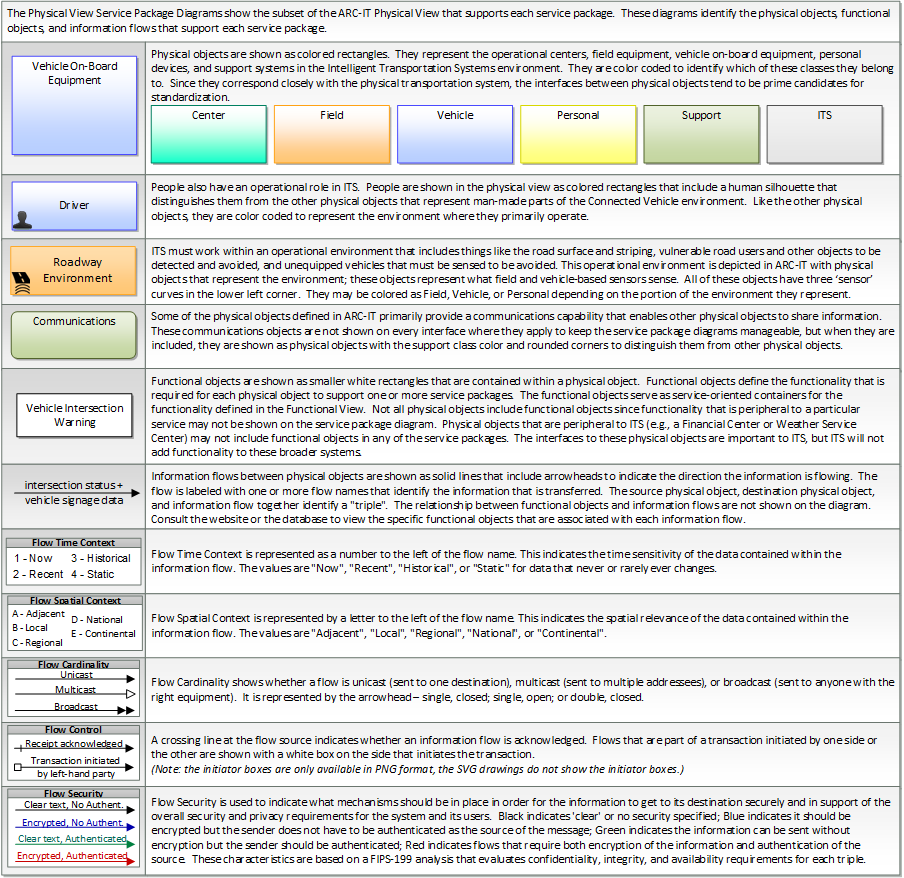
The physical diagram can be viewed in SVG or PNG format and the current format is SVG.SVG Diagram
PNG Diagram
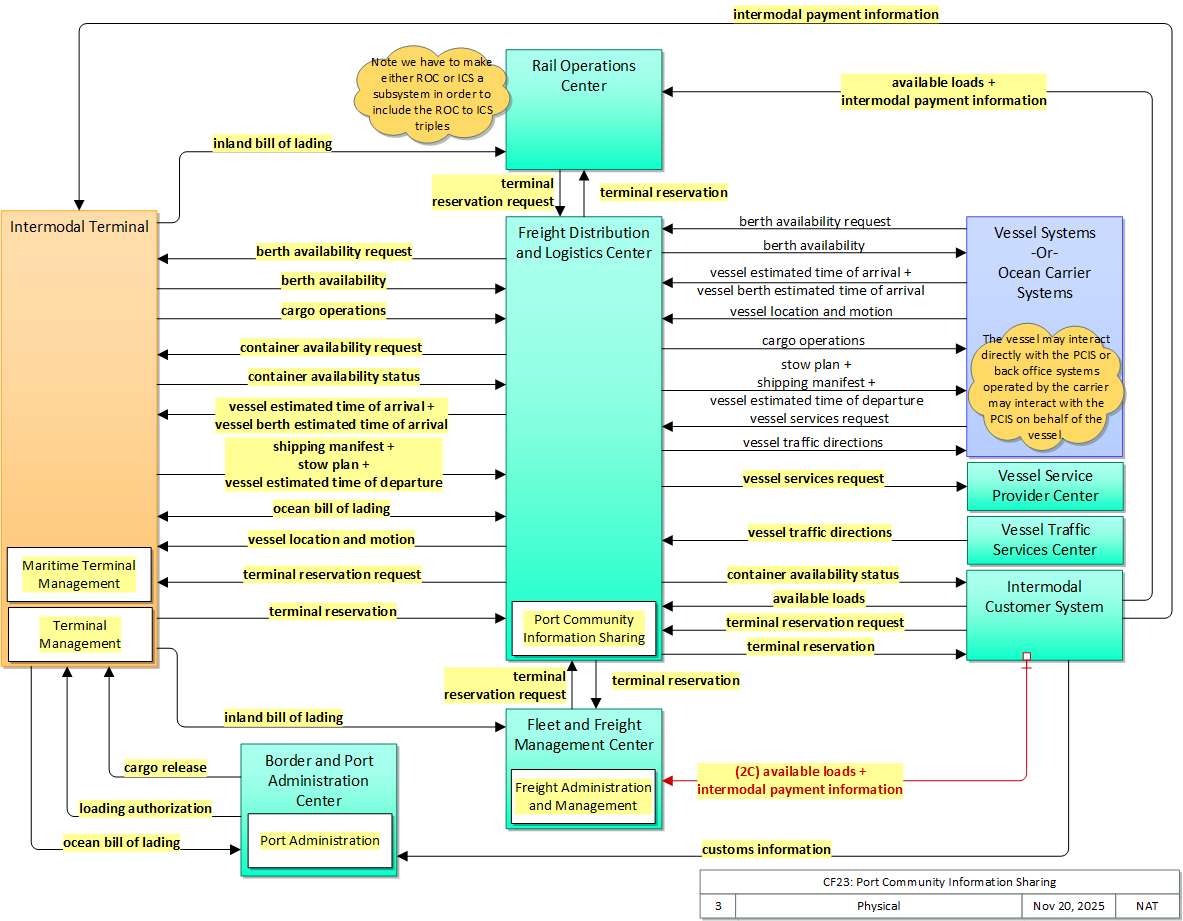
Includes Physical Objects:
| Physical Object | Class | Description |
|---|---|---|
| Border and Port Administration Center | Center | 'Border and Port Administration Center' represents back-office systems and databases run by domestic and foreign governmental agencies responsible for the regulation of trade, and the enforcement of customs and immigration laws. These agencies include U.S. Department of Homeland Security (DHS) and its counterparts in Canada and Mexico. DHS includes components like Customs and Border Protection (CBP), Immigration and Customs Enforcement (ICE), and Transportation Security Administration (TSA). Other agencies include the Maritime Administration, Coast Guard, and Port Authorities for ports and secondary trade agencies (e.g., U.S. Food and Drug Administration, U.S. Department of Agriculture, other USDOT departments, etc.), and agencies from other trading nations. The systems they manage coordinate activities related to land border crossings and ports. These systems support import/export cargo processing and enforcement operations at the port of entry, including programs such as FAST, Automated Commercial Environment (ACE), Nexus (Canada), SENTRI (Mexico), and US-VISIT. |
| Fleet and Freight Management Center | Center | The 'Fleet and Freight Management Center' provides the capability for commercial drivers and fleet-freight managers to receive real-time routing information and access databases containing vehicle and/or freight equipment locations as well as carrier, vehicle, freight equipment and driver information. The 'Fleet and Freight Management Center' also provides the capability for fleet managers to monitor the safety and security of their commercial vehicle drivers and fleet. |
| Freight Distribution and Logistics Center | Center | The 'Freight Distribution and Logistics Center' provides intermodal logistics support and support for the efficient distribution of freight across transport systems and modes. This can include consolidation arrangements, warehousing, information sharing systems, and consignor-to-consignee intermodal shipping arrangements. These capabilities may be provided as part of intermodal fleet management activities or can be provided by an independent logistics specialist. These systems may also include centralized platforms that coordinate vessel operations, cargo documentation, ground transport reservations, and operational information exchange among vessels, terminals, cargo owners, transport operators, and other port stakeholders to support efficient and coordinated port and intermodal freight operations. |
| Intermodal Customer System | Center | The 'Intermodal Customer System' represents organizations that engage in the shipment of freight, either originator (consigner or shipper) or recipient of the cargo shipment. They enable the movement of goods on routes that require the use of other modes of transportation such as heavy rail, air, sea, etc. The Intermodal Customer System includes those personnel responsible for the movement of freight across international borders. |
| Intermodal Terminal | Field | The 'Intermodal Terminal' represents the terminal areas corresponding to modal change points. This includes interfaces between roadway freight transportation and air, rail, and/or water shipping modes. The basic unit of cargo handled by the Intermodal Terminal physical object is the container; less-than-container load handling is typically handled at a different facility (i.e., Freight Consolidation Station). The Intermodal Terminal can include electronic gate control for entrance and exit from the facility, automated guidance of vehicles within the facility, alerting appropriate parties of container arrivals and departures, and inventory and location of temporarily stored containers. |
| Ocean Carrier Systems | Center | 'Ocean Carrier Systems' are the systems operated by overseas cargo carriers to facilitate the management of the vessels and the shipments and cargo they carry across international waters, providing advanced logistics and technology solutions for the ocean carriers. These systems exchange vessel operational status, vessel movement information, cargo documentation, and shipment information with port community systems, terminals, vessel service providers, and other external stakeholders to support coordinated vessel operations, cargo handling, and port logistics activities. |
| Rail Operations Center | Center | 'Rail Operations Center' represents the (usually) centralized control point for a substantial segment of a freight railroad's operations and maintenance activities. It is roughly the railroad equivalent to a highway Traffic Management Center. It is the source and destination of information that can be used to coordinate rail and highway traffic management and maintenance operations. It is also the source and destination for incident, incident response, disaster, or evacuation information that is exchanged with an Emergency Management Center. The use of a single object for multiple sources and destination for information exchange with railroads implies the need for a single, consistent interface between a given railroad's operations and maintenance activities and ITS. |
| Vessel Service Provider Center | Center | 'Vessel Service Provider Center' routinely provides a service or supplies to vessels to facilitate their operations and/or meet regulatory requirements. Vessel service providers include vessel pilots, tug boats, bunker (fueling) providers, ship chandlers, waste reception, inspection services, vessel agents, and others. |
| Vessel Systems | Vehicle | 'Vessel Systems' resides on a vessel and provides the processing, storage, and communications functions that support vessel operations. A vessel is a general classification of maritime vehicles that includes ships, barges, and boats. In ARC-IT we are focused on vessels that provide marine transport of cargo, including containerized cargo, bulk cargo, and vehicles. |
| Vessel Traffic Services Center | Center | 'Vessel Traffic Services Center' provides active monitoring and navigational advice for vessels in particularly confined and busy waterways. It also exchanges vessel traffic status, vessel movement information, and navigational advisories with vessels and external systems to support safe and efficient port operations. |
Includes Functional Objects:
| Functional Object | Description | Physical Object |
|---|---|---|
| FDLC Cargo and Document Management | 'FDLC Cargo and Document Management' provides the capability to receive, store, manage, and distribute cargo-related operational and regulatory documents and information, including manifests, bills of lading, stow plans, cargo availability notices, and cargo operations data. It supports secure access, retrieval, visualization, and dissemination of cargo and shipment documentation to authorized port stakeholders. It supports the exchange of cargo and shipment documentation with vessel systems, terminal systems, and external stakeholders. | Freight Distribution and Logistics Center |
| FDLC Ground Transport Reservation Management | Manages ground transport reservations associated with cargo pickup and delivery, including reservation creation, modification, cancellation, confirmation, and status tracking. Interfaces with ground transport management centers, terminals, and Beneficiary Cargo Owners to coordinate reservation lifecycle and ensure efficient cargo movement. | Freight Distribution and Logistics Center |
| FDLC Port Community Information Sharing | 'FDLC Port Community Information Sharing' connects multiple systems, enabling the secure and efficient exchange of information between the different actors that make up a seaport community. It is a shared platform that is organized and used by public and private stakeholders. It is nominally located in and managed by a port. It is accessed by terminals situated on that port, ships servicing those terminals, Benificial Cargo Owners (Intermodal Customers in ARC-IT), and other actors to improve the efficiency of cargo movements through the port by enhancing the flow of information. This functional object also supports coordination of vessel services, exchange of vessel reporting and operational status information with external vessel traffic and vessel service provider systems, and dissemination of operational information to authorized port community stakeholders. | Freight Distribution and Logistics Center |
| FDLC Vessel Tracking and Monitoring | 'FDLC Vessel Tracking and Monitoring' provides the capability to receive, process, maintain, and distribute vessel operational state information, including vessel location, speed, estimated time of arrival, and motion data. It supports real-time vessel tracking, monitoring, and dissemination of vessel status information to terminals, cargo owners, and other port stakeholders and enables visualization and operational coordination based on vessel movement and arrival information. It supports ingestion of vessel operational reporting information from vessel systems and vessel traffic service systems to maintain accurate situational awareness. | Freight Distribution and Logistics Center |
| Freight Administration and Management | 'Freight Administration and Management' manages the movement of freight from source to destination. It interfaces to intermodal customers to setup and schedule transportation and coordinates with intermodal terminals and freight consolidation stations to coordinate the shipment. It coordinates with the appropriate government agencies to expedite the movement of trucks, their drivers, and their cargo across international borders. The application monitors the status of the freight and freight equipment (container, trailer, or chassis) and monitors freight location and compares it against the planned route. | Fleet and Freight Management Center |
| ICS Intermodal Freight Customer Support | 'ICS Intermodal Freight Customer Support' provides customer support for intermodal freight shipments. It supports load matching to book optimal carriers for outgoing shipments, manages shipping contracts and payment, and tracks the shipments from pickup through delivery to the recipient. This functional object interfaces to all the systems that manage, support, and monitor the shipment on behalf of both shippers and recipients, including systems that regulate trade and enforce customs. It monitors and logs activities associated with border crossings, enforcement, and other events that affect the shipment. | Intermodal Customer System |
| Maritime Terminal Management | 'Maritime Terminal Management' supports the operation of the maritime aspects of an intermodal terminal. The key capabilities include scheduling the use of berths at the terminal, managing the loading and unloading of cargo on the ships at berth, managing longshore and stevedoring labor on the terminal, maintaining site security, including container integrity, and providing an interface to Customs as appropriate. | Intermodal Terminal |
| Port Administration | 'Port Administration' performs administrative functions relating to inspection and adminstration of cargo imports and exports at a port and implementing policy and regulations supporting vessel safety in the port and surrounding waters. It supports coordination of vessel services and regulatory interactions with vessel service providers and vessel traffic service systems. | Border and Port Administration Center |
| Terminal Management | 'Terminal Management' supports the operation of the ground transportation aspects of an intermodal terminal. The key capabilities include the ability to identify and control vehicle traffic entering and departing the facility, guide vehicles to loading and unloading points, maintain site security and monitor container integrity, provide an interface to Customs as appropriate, and acknowledge container pickup and drop-off. Other capabilities include the ability to track container locations within the facility, manage any other required assets, like truck chassis, and provide reservation services to manage congestion at busy terminals. This application also provides information to support load matching services for drayage operators. | Intermodal Terminal |
Includes Information Flows:
| Information Flow | Description |
|---|---|
| available loads | Request from a shipper (consignor) for services to handle shipping of a container or freight load. Aggregated, this information represents the available loads to be shipped from intermodal customer locations in the region. |
| berth availability | Information indicating the availability or assignment of a berth at a destination port where a vessel can dock and conduct cargo operations. This may include berth identification, availability status, assigned berth location, and scheduled availability time to support vessel arrival coordination. |
| berth availability request | Request from a vessel or carrier system to determine or coordinate berth availability at a destination port. This includes vessel identification, estimated time of arrival, and berth scheduling information necessary to support berth allocation and port operational planning. |
| cargo operations | Information describing cargo handling and operational activities at a terminal or vessel. This includes cargo loading, unloading, transfer, handling status, operational coordination, and equipment utilization. This information supports coordination between vessels, terminals, and logistics systems for efficient cargo movement and operational planning. |
| cargo release | Cargo release is essentially an endorsement on a Bill of Lading that states all charges associated with the shipment have been paid, and both parties to the Bill of Lading agree as to the condition of the goods involved to be cleared. |
| container availability request | Request for information on the availability of a container at an Intermodal Terminal. |
| container availability status | Information indicating whether a container or associated cargo is available for pickup, transfer, or processing at an intermodal or maritime terminal. This includes container identification, availability state, availability timing, and readiness for cargo release or pickup. This information may be provided in response to a request or as a notification to authorized systems such as cargo owners, terminals, or transport operators. |
| customs information | Information about the goods being shipped and the consignee and consignors involved that is required by Customs for the importation or exportation of goods across national boundaries. In the United States this information is handled by government authorized portals and is outside of the PCIS. Electronic notices of cargo release are sent by Customs to the marine terminals and BCOs and may be entered into the PCIS. |
| inland bill of lading | The inland bill of lading (B/L) is a legal document or contract that details the type, quantity, and destination of goods being carried. The bill of lading serves as a receipt of shipment when the goods are delivered at the predetermined destination. |
| intermodal payment information | The payment arrangement made by the beneficial cargo owner (Intermodal Customer) or the shipper and the receipt that is sent to the destination terminal. |
| loading authorization | Permission from the government for the goods to be loaded onto ship, secured safely, and made ready for transportation. |
| ocean bill of lading | The ocean bill of lading (B/L) is a legal document or contract between the shipper and ocean carrier which details the type, quantity, and destination of goods being carried. The bill of lading serves as a receipt of shipment when the goods are delivered at the predetermined destination. |
| shipping manifest | The document accounting for all cargo loaded on the ship. The shipping manifest includes details about the vessel voyage and identifying information about the ship. |
| stow plan | The plan showing the distribution of all cargo stored on board of a vessel for a voyage. This plan ensures the most efficient and balanced storage of cargo to maximize the load capacity and safety. Each entry on the plan details the quantity, weight, size, location within the vessel, securing and lashing requirements, special handling requirements (if any), port of discharge, etc. |
| terminal reservation | Information confirming, updating, canceling, or providing status for a reservation for container pick-up or drop-off at an intermodal or maritime terminal. This includes reservation confirmation, modification acknowledgment, cancellation confirmation, reservation status, assigned time window, and terminal coordination details. This flow supports reservation lifecycle coordination between Port Community Information Systems, terminals, and transport operators. |
| terminal reservation request | Request to create, modify, or cancel a reservation for container pick-up or drop-off at an intermodal or maritime terminal. The request includes container identification, terminal location, requested time window, transport information, and reservation action type (create, modify, cancel). This flow supports reservation lifecycle management and coordination between Port Community Information Systems, transport operators, and terminal systems. |
| vessel berth estimated time of arrival | The approximate time that a vessel is expected to arrive at its berth in the destination port. |
| vessel estimated time of arrival | The estimated date and time that a vessel is expected to arrive at its destination port. This information may originate from vessel systems, carrier operational systems, or voyage scheduling systems and is used to support berth planning, terminal preparation, and port operational coordination. |
| vessel estimated time of departure | The estimated date and time when a vessel is expected to depart from a terminal or port berth. This information supports terminal operations planning, berth utilization management, cargo handling coordination, and downstream transport scheduling. |
| vessel location and motion | Information describing the operational state and position of a vessel during its journey. This includes vessel location (latitude and longitude), speed, heading, navigational status, timestamp, vessel identification (such as vessel name, call sign, and MMSI), and other movement or AIS-reported parameters. This information supports vessel tracking, situational awareness, and operational coordination with terminals and port systems. |
| vessel services request | Request from a vessel or carrier system for port services required to support vessel arrival, berthing, servicing, or departure. Typical services include piloting, towing, mooring, bunkering, and other port support services. This information supports service coordination between vessels, port operators, and vessel service providers. |
| vessel traffic directions | Traffic management instructions and navigational guidance provided by Vessel Traffic Services (VTS) or port authorities to support safe and efficient vessel movement within port waters. This includes routing instructions, movement sequencing, priority assignments, navigational restrictions, and operational coordination with other vessels and port infrastructure. |
Goals and Objectives
Associated Planning Factors and Goals
| Planning Factor | Goal |
|---|---|
| A. Support the economic vitality of the metropolitan area, especially by enabling global competitiveness, productivity, and efficiency; | Improve freight network |
| D. Increase the accessibility and mobility of people and for freight; | Reduce congestion |
| G. Promote efficient system management and operation; | Improve efficiency |
Associated Objective Categories 
Associated Objectives and Performance Measures
Needs and Requirements
| Need | Functional Object | Requirement | ||
|---|---|---|---|---|
| 01 | Freight Distribution and Logistics Providers need a process to comply with regulatory requirements (excluding customs) in order to reduce administrative burden and complexity, thereby increasing velocity of flow of goods. | FDLC Port Community Information Sharing | 09 | The center shall send the shipping manifest for the outbound vessel to the vessel. |
| 10 | The center shall send the shipping manifest for the outbound vessel to ocean carrier systems. | |||
| Maritime Terminal Management | 09 | The Intermodal Terminal shall receive information regarding governmental permission to load and secure cargo. | ||
| 17 | The Intermodal Terminal shall send the shipping manifest for the outbound vessel to centers. | |||
| Terminal Management | 14 | The Intermodal Terminal shall receive information regarding governmental permission to load and secure cargo. | ||
| 02 | Freight Distribution and Logistics Providers need to provide and receive essential information and guidance for better allocating energy usage in order to comply with local, state, federal and company energy efficiency initiatives and mandates and benefit the local community. | FDLC Cargo and Document Management | 03 | The center shall receive the stow plan for the outbound vessel. |
| 04 | The center shall send the stow plan to the outbound vessel. | |||
| 05 | The Intermodal Terminal shall send the vessel stow plan to the port center. | |||
| FDLC Ground Transport Reservation Management | 01 | The center shall receive reservation modification request from Ground Transport Management Center (FDLC or Intermodal Terminal). | ||
| 02 | The center shall receive reservation confirmation from Ground Transport Management Center (FDLC or Intermodal Terminal). | |||
| 03 | The center shall receive reservation cancellation from Ground Transport Management Center (FDLC or Intermodal Terminal). | |||
| 04 | The center shall send reservation confirmation to the reservation requestor. | |||
| 05 | The center shall receive reservation requests from other centers. | |||
| 06 | The center shall send reservation requests to the intermodal terminal. | |||
| FDLC Port Community Information Sharing | 02 | The center shall receive the inbound vessel berth availability request from newly arriving vessel or their supporting systems. | ||
| 03 | The center shall send the inbound vessel berth availability request to the intermodal terminal. | |||
| 04 | The center shall send a container availability request to the intermodal terminal. | |||
| 05 | The center shall send information describing the date and time of vessel arrival at the terminal to the intermodal terminal. | |||
| 08 | The center shall send information describing cargo handling procedures, times and other relevant information for vessel load/unload to ocean carrier systems. | |||
| 11 | The center shall send the stow plan to the outbound vessel. | |||
| 12 | The center shall send the stow plan to the outbound vessel's ocean carrier system. | |||
| 13 | The center shall send estimated date and time of departure of the outbound vessel from the berth, to ocean carrier systems. | |||
| 14 | The center shall send estimated date and time of departure of the outbound vessel from the berth, to the vessel. | |||
| 15 | The center shall provide vessel movement and navigational guidance instructions to the vessel. | |||
| 16 | The center shall provide vessel movement and navigational guidance instructions to the ocean carrier systems. | |||
| 17 | The center shall send requests for services in support of vessel movement, servicing or related activity to the service provider. | |||
| 19 | The center shall receive information describing cargo handling procedures, times and other relevant information from the intermodal terminal. | |||
| FDLC Vessel Tracking and Monitoring | 01 | The center shall receive estimated date and time of departure of the outbound vessel from the berth. | ||
| 02 | The center shall receive information describing the date and time of vessel arrival at the terminal from the vessel or their supporting systems. | |||
| 03 | The center shall receive information describing the date and time of vessel arrival at theie berth from the vessel or their supporting systems. | |||
| 04 | The center shall provide information describing the date and time of vessel arrival at the terminal to the Intermodal Terminal. | |||
| 05 | The center shall provide information describing the date and time of vessel arrival at its berth to the Intermodal Terminal. | |||
| 06 | The center shall receive information describing the vessel's location during its journey to the terminal. | |||
| 07 | The center shall send information describing the vessel's location during its journey to the terminal. | |||
| Freight Administration and Management | 24 | The center shall send reservation modification request to the reservation issuer. | ||
| 25 | The center shall send reservation requests to the freight center. | |||
| ICS Intermodal Freight Customer Support | 12 | The center shall receive reservation confirmation from Ground Transport Management Center (FDLC or Intermodal Terminal). | ||
| 13 | The center shall receive reservation cancellation from Ground Transport Management Center (FDLC or Intermodal Terminal). | |||
| 14 | The center shall send reservation modification request to the reservation issuer. | |||
| 15 | The center shall send reservation modification request to the reservation issuer. | |||
| 16 | The intermodal terminal shall receive information describing the vessel's location during its journey to the terminal. | |||
| 17 | The center shall send reservation requests to the freight center. | |||
| Maritime Terminal Management | 03 | The center shall receive reservation modification request from Ground Transport Management Center (FDLC or Intermodal Terminal). | ||
| 04 | The center shall send reservation cancellation to the reservation requestor. | |||
| 05 | The intermodal terminal shall receive information describing the date and time of vessel arrival at the terminal from the FDLC. | |||
| 06 | The intermodal terminal shall receive information describing the date and time of vessel arrival at its berth from the FDLC. | |||
| 07 | The Intermodal Terminal shall receive reservation requests from other centers. | |||
| 10 | The center shall receive the inbound vessel berth availability request from newly arriving vessel or their supporting systems. | |||
| 12 | The center shall receive information describing the vessel's location during its journey to the terminal. | |||
| 15 | The center shall send information describing cargo handling procedures, times and other relevant information for vessel load/unload to centers. | |||
| 18 | The center shall send estimated date and time of departure of the outbound vessel from the berth, to centers. | |||
| Terminal Management | 11 | The Intermodal Terminal shall send reservation information to interested centers. | ||
| 03 | Freight Distribution and Logistics Providers need to provide and receive essential information and guidance to/from stakeholders in order to reduce administrative burden and complexity, thereby increasing velocity of flow of goods. | FDLC Cargo and Document Management | 03 | The center shall receive the stow plan for the outbound vessel. |
| 04 | The center shall send the stow plan to the outbound vessel. | |||
| 05 | The Intermodal Terminal shall send the vessel stow plan to the port center. | |||
| FDLC Ground Transport Reservation Management | 01 | The center shall receive reservation modification request from Ground Transport Management Center (FDLC or Intermodal Terminal). | ||
| 02 | The center shall receive reservation confirmation from Ground Transport Management Center (FDLC or Intermodal Terminal). | |||
| 03 | The center shall receive reservation cancellation from Ground Transport Management Center (FDLC or Intermodal Terminal). | |||
| 04 | The center shall send reservation confirmation to the reservation requestor. | |||
| 05 | The center shall receive reservation requests from other centers. | |||
| 06 | The center shall send reservation requests to the intermodal terminal. | |||
| FDLC Port Community Information Sharing | 01 | The center shall send notice of availability of cargo to the beneficiary cargo owner. | ||
| 02 | The center shall receive the inbound vessel berth availability request from newly arriving vessel or their supporting systems. | |||
| 03 | The center shall send the inbound vessel berth availability request to the intermodal terminal. | |||
| 04 | The center shall send a container availability request to the intermodal terminal. | |||
| 05 | The center shall send information describing the date and time of vessel arrival at the terminal to the intermodal terminal. | |||
| 06 | The center shall provide berth availability information to vessels. | |||
| 07 | The center shall provide berth availability information to ocean carrier systems. | |||
| 08 | The center shall send information describing cargo handling procedures, times and other relevant information for vessel load/unload to ocean carrier systems. | |||
| 11 | The center shall send the stow plan to the outbound vessel. | |||
| 12 | The center shall send the stow plan to the outbound vessel's ocean carrier system. | |||
| 18 | The center shall receive berth availability information from the Intermodal Terminal. | |||
| 19 | The center shall receive information describing cargo handling procedures, times and other relevant information from the intermodal terminal. | |||
| 20 | The center shall receive information about the availability of cargo from the intermodal terminal. | |||
| FDLC Vessel Tracking and Monitoring | 02 | The center shall receive information describing the date and time of vessel arrival at the terminal from the vessel or their supporting systems. | ||
| 03 | The center shall receive information describing the date and time of vessel arrival at theie berth from the vessel or their supporting systems. | |||
| 04 | The center shall provide information describing the date and time of vessel arrival at the terminal to the Intermodal Terminal. | |||
| 05 | The center shall provide information describing the date and time of vessel arrival at its berth to the Intermodal Terminal. | |||
| 06 | The center shall receive information describing the vessel's location during its journey to the terminal. | |||
| 07 | The center shall send information describing the vessel's location during its journey to the terminal. | |||
| Freight Administration and Management | 22 | The center shall receive notice of availability of cargo. | ||
| 24 | The center shall send reservation modification request to the reservation issuer. | |||
| 25 | The center shall send reservation requests to the freight center. | |||
| ICS Intermodal Freight Customer Support | 10 | The center shall send notice of availability of cargo to the beneficiary cargo owner. | ||
| 11 | The center shall receive notice of availability of cargo. | |||
| 12 | The center shall receive reservation confirmation from Ground Transport Management Center (FDLC or Intermodal Terminal). | |||
| 13 | The center shall receive reservation cancellation from Ground Transport Management Center (FDLC or Intermodal Terminal). | |||
| 14 | The center shall send reservation modification request to the reservation issuer. | |||
| 15 | The center shall send reservation modification request to the reservation issuer. | |||
| 16 | The intermodal terminal shall receive information describing the vessel's location during its journey to the terminal. | |||
| 17 | The center shall send reservation requests to the freight center. | |||
| Maritime Terminal Management | 03 | The center shall receive reservation modification request from Ground Transport Management Center (FDLC or Intermodal Terminal). | ||
| 04 | The center shall send reservation cancellation to the reservation requestor. | |||
| 05 | The intermodal terminal shall receive information describing the date and time of vessel arrival at the terminal from the FDLC. | |||
| 06 | The intermodal terminal shall receive information describing the date and time of vessel arrival at its berth from the FDLC. | |||
| 07 | The Intermodal Terminal shall receive reservation requests from other centers. | |||
| 10 | The center shall receive the inbound vessel berth availability request from newly arriving vessel or their supporting systems. | |||
| 12 | The center shall receive information describing the vessel's location during its journey to the terminal. | |||
| 14 | The Intemodal Terminal shall provide berth availability information to centers. | |||
| 15 | The center shall send information describing cargo handling procedures, times and other relevant information for vessel load/unload to centers. | |||
| 16 | The Intermodal Terminal shall send notice of availability of cargo to the beneficiary cargo owner. | |||
| Terminal Management | 10 | The Intermodal Terminal shall provide notice of availability of cargo to the port center. | ||
| 11 | The Intermodal Terminal shall send reservation information to interested centers. | |||
| 04 | Freight Distribution and Logistics Providers need to provide and receive near real-time data for use in optimizing port operations in order to increase velocity of flow of goods; and as a byproduct of port operations optimization, reducing energy usage/emissions. | FDLC Ground Transport Reservation Management | 01 | The center shall receive reservation modification request from Ground Transport Management Center (FDLC or Intermodal Terminal). |
| 02 | The center shall receive reservation confirmation from Ground Transport Management Center (FDLC or Intermodal Terminal). | |||
| 03 | The center shall receive reservation cancellation from Ground Transport Management Center (FDLC or Intermodal Terminal). | |||
| 04 | The center shall send reservation confirmation to the reservation requestor. | |||
| 05 | The center shall receive reservation requests from other centers. | |||
| 06 | The center shall send reservation requests to the intermodal terminal. | |||
| FDLC Port Community Information Sharing | 02 | The center shall receive the inbound vessel berth availability request from newly arriving vessel or their supporting systems. | ||
| 03 | The center shall send the inbound vessel berth availability request to the intermodal terminal. | |||
| 04 | The center shall send a container availability request to the intermodal terminal. | |||
| 05 | The center shall send information describing the date and time of vessel arrival at the terminal to the intermodal terminal. | |||
| 06 | The center shall provide berth availability information to vessels. | |||
| 07 | The center shall provide berth availability information to ocean carrier systems. | |||
| 08 | The center shall send information describing cargo handling procedures, times and other relevant information for vessel load/unload to ocean carrier systems. | |||
| 13 | The center shall send estimated date and time of departure of the outbound vessel from the berth, to ocean carrier systems. | |||
| 14 | The center shall send estimated date and time of departure of the outbound vessel from the berth, to the vessel. | |||
| 15 | The center shall provide vessel movement and navigational guidance instructions to the vessel. | |||
| 16 | The center shall provide vessel movement and navigational guidance instructions to the ocean carrier systems. | |||
| 17 | The center shall send requests for services in support of vessel movement, servicing or related activity to the service provider. | |||
| 18 | The center shall receive berth availability information from the Intermodal Terminal. | |||
| 19 | The center shall receive information describing cargo handling procedures, times and other relevant information from the intermodal terminal. | |||
| FDLC Vessel Tracking and Monitoring | 01 | The center shall receive estimated date and time of departure of the outbound vessel from the berth. | ||
| 02 | The center shall receive information describing the date and time of vessel arrival at the terminal from the vessel or their supporting systems. | |||
| 03 | The center shall receive information describing the date and time of vessel arrival at theie berth from the vessel or their supporting systems. | |||
| 04 | The center shall provide information describing the date and time of vessel arrival at the terminal to the Intermodal Terminal. | |||
| 05 | The center shall provide information describing the date and time of vessel arrival at its berth to the Intermodal Terminal. | |||
| 06 | The center shall receive information describing the vessel's location during its journey to the terminal. | |||
| 07 | The center shall send information describing the vessel's location during its journey to the terminal. | |||
| Freight Administration and Management | 24 | The center shall send reservation modification request to the reservation issuer. | ||
| 25 | The center shall send reservation requests to the freight center. | |||
| ICS Intermodal Freight Customer Support | 12 | The center shall receive reservation confirmation from Ground Transport Management Center (FDLC or Intermodal Terminal). | ||
| 13 | The center shall receive reservation cancellation from Ground Transport Management Center (FDLC or Intermodal Terminal). | |||
| 14 | The center shall send reservation modification request to the reservation issuer. | |||
| 15 | The center shall send reservation modification request to the reservation issuer. | |||
| 16 | The intermodal terminal shall receive information describing the vessel's location during its journey to the terminal. | |||
| 17 | The center shall send reservation requests to the freight center. | |||
| Maritime Terminal Management | 03 | The center shall receive reservation modification request from Ground Transport Management Center (FDLC or Intermodal Terminal). | ||
| 04 | The center shall send reservation cancellation to the reservation requestor. | |||
| 05 | The intermodal terminal shall receive information describing the date and time of vessel arrival at the terminal from the FDLC. | |||
| 06 | The intermodal terminal shall receive information describing the date and time of vessel arrival at its berth from the FDLC. | |||
| 07 | The Intermodal Terminal shall receive reservation requests from other centers. | |||
| 10 | The center shall receive the inbound vessel berth availability request from newly arriving vessel or their supporting systems. | |||
| 12 | The center shall receive information describing the vessel's location during its journey to the terminal. | |||
| 14 | The Intemodal Terminal shall provide berth availability information to centers. | |||
| 15 | The center shall send information describing cargo handling procedures, times and other relevant information for vessel load/unload to centers. | |||
| 18 | The center shall send estimated date and time of departure of the outbound vessel from the berth, to centers. | |||
| Terminal Management | 11 | The Intermodal Terminal shall send reservation information to interested centers. | ||
| 05 | Freight Distribution and Logistics Providers need a reliable supply chain enabled by having near real-time, accurate, data availability regarding cargo status and location. | FDLC Cargo and Document Management | 03 | The center shall receive the stow plan for the outbound vessel. |
| 04 | The center shall send the stow plan to the outbound vessel. | |||
| 05 | The Intermodal Terminal shall send the vessel stow plan to the port center. | |||
| FDLC Ground Transport Reservation Management | 01 | The center shall receive reservation modification request from Ground Transport Management Center (FDLC or Intermodal Terminal). | ||
| 02 | The center shall receive reservation confirmation from Ground Transport Management Center (FDLC or Intermodal Terminal). | |||
| 03 | The center shall receive reservation cancellation from Ground Transport Management Center (FDLC or Intermodal Terminal). | |||
| 04 | The center shall send reservation confirmation to the reservation requestor. | |||
| FDLC Port Community Information Sharing | 01 | The center shall send notice of availability of cargo to the beneficiary cargo owner. | ||
| 06 | The center shall provide berth availability information to vessels. | |||
| 07 | The center shall provide berth availability information to ocean carrier systems. | |||
| 08 | The center shall send information describing cargo handling procedures, times and other relevant information for vessel load/unload to ocean carrier systems. | |||
| 11 | The center shall send the stow plan to the outbound vessel. | |||
| 12 | The center shall send the stow plan to the outbound vessel's ocean carrier system. | |||
| 13 | The center shall send estimated date and time of departure of the outbound vessel from the berth, to ocean carrier systems. | |||
| 14 | The center shall send estimated date and time of departure of the outbound vessel from the berth, to the vessel. | |||
| 15 | The center shall provide vessel movement and navigational guidance instructions to the vessel. | |||
| 16 | The center shall provide vessel movement and navigational guidance instructions to the ocean carrier systems. | |||
| 18 | The center shall receive berth availability information from the Intermodal Terminal. | |||
| 19 | The center shall receive information describing cargo handling procedures, times and other relevant information from the intermodal terminal. | |||
| 20 | The center shall receive information about the availability of cargo from the intermodal terminal. | |||
| Freight Administration and Management | 22 | The center shall receive notice of availability of cargo. | ||
| 23 | The center shall receive the inland bill of lading. | |||
| 24 | The center shall send reservation modification request to the reservation issuer. | |||
| ICS Intermodal Freight Customer Support | 02 | The center shall receive and provide booking status information for loads on request. | ||
| 04 | The center shall provide freight booking matching services. | |||
| 10 | The center shall send notice of availability of cargo to the beneficiary cargo owner. | |||
| 11 | The center shall receive notice of availability of cargo. | |||
| 12 | The center shall receive reservation confirmation from Ground Transport Management Center (FDLC or Intermodal Terminal). | |||
| 13 | The center shall receive reservation cancellation from Ground Transport Management Center (FDLC or Intermodal Terminal). | |||
| 14 | The center shall send reservation modification request to the reservation issuer. | |||
| 15 | The center shall send reservation modification request to the reservation issuer. | |||
| Maritime Terminal Management | 02 | The field system shall send the inland bill of lading to interested parties. | ||
| 03 | The center shall receive reservation modification request from Ground Transport Management Center (FDLC or Intermodal Terminal). | |||
| 04 | The center shall send reservation cancellation to the reservation requestor. | |||
| 14 | The Intemodal Terminal shall provide berth availability information to centers. | |||
| 15 | The center shall send information describing cargo handling procedures, times and other relevant information for vessel load/unload to centers. | |||
| 16 | The Intermodal Terminal shall send notice of availability of cargo to the beneficiary cargo owner. | |||
| Terminal Management | 10 | The Intermodal Terminal shall provide notice of availability of cargo to the port center. | ||
| 11 | The Intermodal Terminal shall send reservation information to interested centers. | |||
| 06 | Freight Distribution and Logistics Providers need to allow commercial revenue to be identified and collected seamlessly in order to reduce administrative burden and complexity, thereby increasing velocity of flow of goods | Freight Administration and Management | 26 | The center shall receive payment information for intermodal shipments. |
| ICS Intermodal Freight Customer Support | 01 | The center shall provide freight booking and payment information. | ||
| 19 | The center shall provide payment information for intermodal shipments. | |||
| Maritime Terminal Management | 08 | The Intermodal Terminal shall receive information regarding payment and release of cargo. | ||
| 13 | The center shall receive payment information for intermodal shipments. | |||
| Terminal Management | 13 | The Intermodal Terminal shall receive information regarding payment and release of cargo. | ||
| 07 | Freight Distribution and Logistics Providers need to improve risk identification and mitigation in order to promote safety and security to protect people and property. | FDLC Port Community Information Sharing | 08 | The center shall send information describing cargo handling procedures, times and other relevant information for vessel load/unload to ocean carrier systems. |
| 09 | The center shall send the shipping manifest for the outbound vessel to the vessel. | |||
| 10 | The center shall send the shipping manifest for the outbound vessel to ocean carrier systems. | |||
| 17 | The center shall send requests for services in support of vessel movement, servicing or related activity to the service provider. | |||
| 19 | The center shall receive information describing cargo handling procedures, times and other relevant information from the intermodal terminal. | |||
| Maritime Terminal Management | 15 | The center shall send information describing cargo handling procedures, times and other relevant information for vessel load/unload to centers. | ||
| 17 | The Intermodal Terminal shall send the shipping manifest for the outbound vessel to centers. | |||
| 08 | Freight Distribution and Logistics Providers need to allow customs and import/ export regulatory compliance, including revenue collection, in order to reduce administrative burden and complexity, thereby increasing velocity of flow of goods. | FDLC Cargo and Document Management | 01 | The center shall receive the shipping manifest for the outbound vessel. |
| 02 | The center shall receive the ocean bill of lading from outbound vessels. | |||
| FDLC Port Community Information Sharing | 08 | The center shall send information describing cargo handling procedures, times and other relevant information for vessel load/unload to ocean carrier systems. | ||
| 09 | The center shall send the shipping manifest for the outbound vessel to the vessel. | |||
| 10 | The center shall send the shipping manifest for the outbound vessel to ocean carrier systems. | |||
| 19 | The center shall receive information describing cargo handling procedures, times and other relevant information from the intermodal terminal. | |||
| ICS Intermodal Freight Customer Support | 05 | The center shall process electronic registration of the importer, carrier, conveyance, and driver, as applicable, for border clearance programs. | ||
| 07 | The center shall support the submission of cargo manifest data to the appropriate government border inspection administration system. | |||
| 18 | The center shall provide information relevant to customs operations to other centers. | |||
| Maritime Terminal Management | 01 | The Intermodal Terminal shall send the ocean bill of lading on behalf of outbound vessels to other centers. | ||
| 09 | The Intermodal Terminal shall receive information regarding governmental permission to load and secure cargo. | |||
| 11 | The center shall receive the ocean bill of lading from outbound vessels. | |||
| 15 | The center shall send information describing cargo handling procedures, times and other relevant information for vessel load/unload to centers. | |||
| 17 | The Intermodal Terminal shall send the shipping manifest for the outbound vessel to centers. | |||
| Port Administration | 01 | The center shall receive information relevant to customs operations. | ||
| Terminal Management | 12 | The Intermodal Terminal shall send the ocean bill of lading on behalf of outbound vessels to other centers. | ||
| 14 | The Intermodal Terminal shall receive information regarding governmental permission to load and secure cargo. | |||
| 09 | Freight Distribution and Logistics Providers need to provide and receive near real-time information on position of goods for visibility into the supply chain in order to provide an accurate view into location of goods for increased supply chain confidence and competitiveness | FDLC Cargo and Document Management | 01 | The center shall receive the shipping manifest for the outbound vessel. |
| FDLC Ground Transport Reservation Management | 05 | The center shall receive reservation requests from other centers. | ||
| 06 | The center shall send reservation requests to the intermodal terminal. | |||
| FDLC Port Community Information Sharing | 01 | The center shall send notice of availability of cargo to the beneficiary cargo owner. | ||
| 02 | The center shall receive the inbound vessel berth availability request from newly arriving vessel or their supporting systems. | |||
| 03 | The center shall send the inbound vessel berth availability request to the intermodal terminal. | |||
| 04 | The center shall send a container availability request to the intermodal terminal. | |||
| 05 | The center shall send information describing the date and time of vessel arrival at the terminal to the intermodal terminal. | |||
| 06 | The center shall provide berth availability information to vessels. | |||
| 07 | The center shall provide berth availability information to ocean carrier systems. | |||
| 13 | The center shall send estimated date and time of departure of the outbound vessel from the berth, to ocean carrier systems. | |||
| 14 | The center shall send estimated date and time of departure of the outbound vessel from the berth, to the vessel. | |||
| 15 | The center shall provide vessel movement and navigational guidance instructions to the vessel. | |||
| 16 | The center shall provide vessel movement and navigational guidance instructions to the ocean carrier systems. | |||
| 18 | The center shall receive berth availability information from the Intermodal Terminal. | |||
| 20 | The center shall receive information about the availability of cargo from the intermodal terminal. | |||
| FDLC Vessel Tracking and Monitoring | 01 | The center shall receive estimated date and time of departure of the outbound vessel from the berth. | ||
| 02 | The center shall receive information describing the date and time of vessel arrival at the terminal from the vessel or their supporting systems. | |||
| 03 | The center shall receive information describing the date and time of vessel arrival at theie berth from the vessel or their supporting systems. | |||
| 04 | The center shall provide information describing the date and time of vessel arrival at the terminal to the Intermodal Terminal. | |||
| 05 | The center shall provide information describing the date and time of vessel arrival at its berth to the Intermodal Terminal. | |||
| 06 | The center shall receive information describing the vessel's location during its journey to the terminal. | |||
| 07 | The center shall send information describing the vessel's location during its journey to the terminal. | |||
| Freight Administration and Management | 22 | The center shall receive notice of availability of cargo. | ||
| 23 | The center shall receive the inland bill of lading. | |||
| 25 | The center shall send reservation requests to the freight center. | |||
| ICS Intermodal Freight Customer Support | 02 | The center shall receive and provide booking status information for loads on request. | ||
| 10 | The center shall send notice of availability of cargo to the beneficiary cargo owner. | |||
| 11 | The center shall receive notice of availability of cargo. | |||
| 16 | The intermodal terminal shall receive information describing the vessel's location during its journey to the terminal. | |||
| 17 | The center shall send reservation requests to the freight center. | |||
| Maritime Terminal Management | 02 | The field system shall send the inland bill of lading to interested parties. | ||
| 05 | The intermodal terminal shall receive information describing the date and time of vessel arrival at the terminal from the FDLC. | |||
| 06 | The intermodal terminal shall receive information describing the date and time of vessel arrival at its berth from the FDLC. | |||
| 07 | The Intermodal Terminal shall receive reservation requests from other centers. | |||
| 10 | The center shall receive the inbound vessel berth availability request from newly arriving vessel or their supporting systems. | |||
| 12 | The center shall receive information describing the vessel's location during its journey to the terminal. | |||
| 14 | The Intemodal Terminal shall provide berth availability information to centers. | |||
| 16 | The Intermodal Terminal shall send notice of availability of cargo to the beneficiary cargo owner. | |||
| 18 | The center shall send estimated date and time of departure of the outbound vessel from the berth, to centers. | |||
| Terminal Management | 10 | The Intermodal Terminal shall provide notice of availability of cargo to the port center. | ||
Related Sources
| Document Name | Version | Publication Date |
|---|---|---|
| None |
Security
In order to participate in this service package, each physical object should meet or exceed the following security levels.
| Physical Object Security | ||||
|---|---|---|---|---|
| Physical Object | Confidentiality | Integrity | Availability | Security Class |
| Border and Port Administration Center | Moderate | Moderate | Moderate | Class 2 |
| Fleet and Freight Management Center | Moderate | Moderate | Moderate | Class 2 |
| Freight Distribution and Logistics Center | Moderate | High | High | Class 5 |
| Intermodal Customer System | Moderate | High | Moderate | Class 3 |
| Intermodal Terminal | Moderate | High | Moderate | Class 3 |
| Ocean Carrier Systems | Moderate | High | High | Class 5 |
| Rail Operations Center | Moderate | Moderate | Moderate | Class 2 |
| Vessel Service Provider Center | Moderate | Moderate | High | Class 5 |
| Vessel Systems | Moderate | High | High | Class 5 |
| Vessel Traffic Services Center | Moderate | High | High | Class 5 |
In order to participate in this service package, each information flow triple should meet or exceed the following security levels.
| Information Flow Security | |||||
|---|---|---|---|---|---|
| Source | Destination | Information Flow | Confidentiality | Integrity | Availability |
| Basis | Basis | Basis | |||
| Border and Port Administration Center | Intermodal Terminal | cargo release | Moderate | Moderate | Moderate |
| Any information related to clearance, border control, cargo impoundment, release or related customs information should be protected from casual observation, as this information could be used against affected parties causing financial or legal harm. | Any information related to clearance, border control, cargo impoundment, release or related customs information needs to be correct and timely so as to not negatively impact the movement of goods, which could cause financial or legal harm. | Any information related to clearance, border control, cargo impoundment, release or related customs information needs to be correct and timely so as to not negatively impact the movement of goods, which could cause financial or legal harm. | |||
| Border and Port Administration Center | Intermodal Terminal | loading authorization | Moderate | Moderate | Moderate |
| Any information related to clearance, border control, cargo impoundment, release or related customs information should be protected from casual observation, as this information could be used against affected parties causing financial or legal harm. | Any information related to clearance, border control, cargo impoundment, release or related customs information needs to be correct and timely so as to not negatively impact the movement of goods, which could cause financial or legal harm. | Any information related to clearance, border control, cargo impoundment, release or related customs information needs to be correct and timely so as to not negatively impact the movement of goods, which could cause financial or legal harm. | |||
| Fleet and Freight Management Center | Freight Distribution and Logistics Center | terminal reservation request | Moderate | Moderate | Moderate |
| Could include information related to carriers and thus business sensitive. | Used to facilitiate proper scheduling of pickup and dropoff activities, which if incorrect or unavailable could cause congestion in the terminal or port generally. | Used to facilitiate proper scheduling of pickup and dropoff activities, which if incorrect or unavailable could cause congestion in the terminal or port generally. | |||
| Freight Distribution and Logistics Center | Fleet and Freight Management Center | terminal reservation | Moderate | Moderate | Moderate |
| Freight status information may be competitive but certainly is trackable data, and needs to be obfuscated to avoid such tracking or business-related espionage. | Freight status information should be correct in real-time, or pickup, delivery and related activities will be confused and slowed, creating supply chain issues and mobility problems. | Freight status information should be correct in real-time, or pickup, delivery and related activities will be confused and slowed, creating supply chain issues and mobility problems. | |||
| Freight Distribution and Logistics Center | Intermodal Customer System | container availability status | Moderate | Moderate | Moderate |
| Container status information may be competitive but certainly is trackable data, and needs to be obfuscated to avoid such tracking or business-related espionage. | Container status information should be correct in real-time, or pickup, delivery and related activities will be confused and slowed, creating supply chain issues and mobility problems. | Container status information should be correct in real-time, or pickup, delivery and related activities will be confused and slowed, creating supply chain issues and mobility problems. | |||
| Freight Distribution and Logistics Center | Intermodal Customer System | terminal reservation | Moderate | Moderate | Moderate |
| Freight status information may be competitive but certainly is trackable data, and needs to be obfuscated to avoid such tracking or business-related espionage. | Freight status information should be correct in real-time, or pickup, delivery and related activities will be confused and slowed, creating supply chain issues and mobility problems. | Freight status information should be correct in real-time, or pickup, delivery and related activities will be confused and slowed, creating supply chain issues and mobility problems. | |||
| Freight Distribution and Logistics Center | Intermodal Terminal | berth availability request | Moderate | Moderate | Moderate |
| All port status information can be considered competitive and sensitive from a physical security standpoint. While many flows describe information that could be ascertained using aerial photography or other in-person methods, widespread availability of port status may impact national security. | This flow contains operational status information that if incorrect, could lead to a vessel making a decision that is impractical and causes a loss of time and/or money. The information contained in the message must be correct and available to avoid such loss. | This flow contains operational status information that if incorrect, could lead to a vessel making a decision that is impractical and causes a loss of time and/or money. The information contained in the message must be correct and available to avoid such loss. | |||
| Freight Distribution and Logistics Center | Intermodal Terminal | container availability request | Moderate | Moderate | Moderate |
| Container status information may be competitive but certainly is trackable data, and needs to be obfuscated to avoid such tracking or business-related espionage. | Container status information should be correct in real-time, or pickup, delivery and related activities will be confused and slowed, creating supply chain issues and mobility problems. | Container status information should be correct in real-time, or pickup, delivery and related activities will be confused and slowed, creating supply chain issues and mobility problems. | |||
| Freight Distribution and Logistics Center | Intermodal Terminal | ocean bill of lading | Moderate | High | Low |
| Contains information describing the contents of a shipment as well as legal terms. Such terms could be competitive, and while some parts of this flow will need to be exposed beyond the shipper and carrier to satisfy customs and inspections, contents should generally be protected from viewing beyond the involved parties. | If this information were compromised, could stall shipment, customs and/or payment, which could have a significant impact on shipping and payment activities. | Unlikely to have any serious time pressure. | |||
| Freight Distribution and Logistics Center | Intermodal Terminal | terminal reservation request | Moderate | Moderate | Moderate |
| Could include information related to carriers and thus business sensitive. | Used to facilitiate proper scheduling of pickup and dropoff activities, which if incorrect or unavailable could cause congestion in the terminal or port generally. | Used to facilitiate proper scheduling of pickup and dropoff activities, which if incorrect or unavailable could cause congestion in the terminal or port generally. | |||
| Freight Distribution and Logistics Center | Intermodal Terminal | vessel berth estimated time of arrival | Low | Moderate | Low |
| This information can be computed based on observation. | Will be used for planning, so should be correct and timely. If incorrect could have an outsize ripple effect, but the lead time here is large given vessel speeds, thus MODERATE integrity and LOW availability. | Will be used for planning, so should be correct and timely. If incorrect could have an outsize ripple effect, but the lead time here is large given vessel speeds, thus MODERATE integrity and LOW availability. | |||
| Freight Distribution and Logistics Center | Intermodal Terminal | vessel estimated time of arrival | Low | Moderate | Low |
| This information can be computed based on observation. | Will be used for planning, so should be correct and timely. If incorrect could have an outsize ripple effect, but the lead time here is large given vessel speeds, thus MODERATE integrity and LOW availability. | Will be used for planning, so should be correct and timely. If incorrect could have an outsize ripple effect, but the lead time here is large given vessel speeds, thus MODERATE integrity and LOW availability. | |||
| Freight Distribution and Logistics Center | Intermodal Terminal | vessel location and motion | Low | Moderate | Low |
| This information can be computed based on observation. | Will be used for planning, so should be correct and timely. If incorrect could have an outsize ripple effect, but the lead time here is large given vessel speeds, thus MODERATE integrity and LOW availability. | Will be used for planning, so should be correct and timely. If incorrect could have an outsize ripple effect, but the lead time here is large given vessel speeds, thus MODERATE integrity and LOW availability. | |||
| Freight Distribution and Logistics Center | Ocean Carrier Systems | berth availability | Moderate | Moderate | Moderate |
| All port status information can be considered competitive and sensitive from a physical security standpoint. While many flows describe information that could be ascertained using aerial photography or other in-person methods, widespread availability of port status may impact national security. | This flow contains or is related to operational status information that if incorrect, could lead to a vessel making a decision that is impractical and causes a loss of time and/or money. The information contained in the message must be correct and available to avoid such loss. | This flow contains operational status information that if incorrect, could lead to a vessel making a decision that is impractical and causes a loss of time and/or money. The information contained in the message must be correct and available to avoid such loss. | |||
| Freight Distribution and Logistics Center | Ocean Carrier Systems | cargo operations | Moderate | Moderate | Moderate |
| All port status information can be considered competitive and sensitive from a physical security standpoint. While many flows describe information that could be ascertained using aerial photography or other in-person methods, widespread availability of port status may impact national security. | This flow contains operational status information that if incorrect, could lead to a vessel making a decision that is impractical and causes a loss of time and/or money. The information contained in the message must be correct and available to avoid such loss. | This flow contains operational status information that if incorrect, could lead to a vessel making a decision that is impractical and causes a loss of time and/or money. The information contained in the message must be correct and available to avoid such loss. | |||
| Freight Distribution and Logistics Center | Ocean Carrier Systems | shipping manifest | Moderate | Moderate | Low |
| Contains information describing the contents of a shipment as well as its path history (based on the carrying vessel). Such terms could be competitive, and while some parts of this flow will need to be exposed beyond the shipper and carrier to satisfy customs and inspections, contents should generally be protected from viewing beyond the involved parties. | If this information were compromised, could stall shipment and/or payment, which could have a significant impact on shipping and payment activities. | Unlikely to have any serious time pressure. | |||
| Freight Distribution and Logistics Center | Ocean Carrier Systems | stow plan | Moderate | Moderate | Moderate |
| Could include sensitive information that would enable an actor bent of nefarious activity, so should be protected from viewing. Only MODERATE because the scope of the stow plan may be limited to cargo and movement relevant to that port. May be HIGH for sensitive or more valuable cargo. | Used to assist loading and unloading operations, and if incorrect or unavailable could cause a bottleneck. | Used to assist loading and unloading operations, and if incorrect or unavailable could cause a bottleneck. | |||
| Freight Distribution and Logistics Center | Ocean Carrier Systems | vessel estimated time of departure | Low | Moderate | Low |
| This information can be computed based on observation. | Will be used for planning, so should be correct and timely. If incorrect could have an outsize ripple effect, but the lead time here is large given vessel speeds, thus MODERATE integrity and LOW availability. | Will be used for planning, so should be correct and timely. If incorrect could have an outsize ripple effect, but the lead time here is large given vessel speeds, thus MODERATE integrity and LOW availability. | |||
| Freight Distribution and Logistics Center | Ocean Carrier Systems | vessel traffic directions | Moderate | High | High |
| Could be operationally sensitive. | Must be timely and correct to ensure proper harbor navigationa and avoid conflicts with other vessels. | Must be timely and correct to ensure proper harbor navigationa and avoid conflicts with other vessels. | |||
| Freight Distribution and Logistics Center | Rail Operations Center | terminal reservation | Moderate | Moderate | Moderate |
| Freight status information may be competitive but certainly is trackable data, and needs to be obfuscated to avoid such tracking or business-related espionage. | Freight status information should be correct in real-time, or pickup, delivery and related activities will be confused and slowed, creating supply chain issues and mobility problems. | Freight status information should be correct in real-time, or pickup, delivery and related activities will be confused and slowed, creating supply chain issues and mobility problems. | |||
| Freight Distribution and Logistics Center | Vessel Service Provider Center | vessel services request | Moderate | High | High |
| Could be operationally sensitive. | Must be timely and correct to ensure proper harbor navigation, docking and other service fulfillment, or schedules and port operations may be significantly impacted. | Must be timely and correct to ensure proper harbor navigation, docking and other service fulfillment, or schedules and port operations may be significantly impacted. | |||
| Freight Distribution and Logistics Center | Vessel Systems | berth availability | Moderate | Moderate | Moderate |
| All port status information can be considered competitive and sensitive from a physical security standpoint. While many flows describe information that could be ascertained using aerial photography or other in-person methods, widespread availability of port status may impact national security. | This flow contains or is related to operational status information that if incorrect, could lead to a vessel making a decision that is impractical and causes a loss of time and/or money. The information contained in the message must be correct and available to avoid such loss. | This flow contains operational status information that if incorrect, could lead to a vessel making a decision that is impractical and causes a loss of time and/or money. The information contained in the message must be correct and available to avoid such loss. | |||
| Freight Distribution and Logistics Center | Vessel Systems | cargo operations | Moderate | Moderate | Moderate |
| All port status information can be considered competitive and sensitive from a physical security standpoint. While many flows describe information that could be ascertained using aerial photography or other in-person methods, widespread availability of port status may impact national security. | This flow contains operational status information that if incorrect, could lead to a vessel making a decision that is impractical and causes a loss of time and/or money. The information contained in the message must be correct and available to avoid such loss. | This flow contains operational status information that if incorrect, could lead to a vessel making a decision that is impractical and causes a loss of time and/or money. The information contained in the message must be correct and available to avoid such loss. | |||
| Freight Distribution and Logistics Center | Vessel Systems | shipping manifest | Moderate | Moderate | Low |
| Contains information describing the contents of a shipment as well as its path history (based on the carrying vessel). Such terms could be competitive, and while some parts of this flow will need to be exposed beyond the shipper and carrier to satisfy customs and inspections, contents should generally be protected from viewing beyond the involved parties. | If this information were compromised, could stall shipment and/or payment, which could have a significant impact on shipping and payment activities. | Unlikely to have any serious time pressure. | |||
| Freight Distribution and Logistics Center | Vessel Systems | stow plan | Moderate | Moderate | Moderate |
| Could include sensitive information that would enable an actor bent of nefarious activity, so should be protected from viewing. Only MODERATE because the scope of the stow plan may be limited to cargo and movement relevant to that port. May be HIGH for sensitive or more valuable cargo. | Used to assist loading and unloading operations, and if incorrect or unavailable could cause a bottleneck. | Used to assist loading and unloading operations, and if incorrect or unavailable could cause a bottleneck. | |||
| Freight Distribution and Logistics Center | Vessel Systems | vessel estimated time of departure | Low | Moderate | Low |
| This information can be computed based on observation. | Will be used for planning, so should be correct and timely. If incorrect could have an outsize ripple effect, but the lead time here is large given vessel speeds, thus MODERATE integrity and LOW availability. | Will be used for planning, so should be correct and timely. If incorrect could have an outsize ripple effect, but the lead time here is large given vessel speeds, thus MODERATE integrity and LOW availability. | |||
| Freight Distribution and Logistics Center | Vessel Systems | vessel traffic directions | Moderate | High | High |
| Could be operationally sensitive. | Must be timely and correct to ensure proper harbor navigationa and avoid conflicts with other vessels. | Must be timely and correct to ensure proper harbor navigationa and avoid conflicts with other vessels. | |||
| Intermodal Customer System | Border and Port Administration Center | customs information | Moderate | Moderate | Moderate |
| Any information related to clearance, border control, cargo impoundment, release or related customs information should be protected from casual observation, as this information could be used against affected parties causing financial or legal harm. | Any information related to clearance, border control, cargo impoundment, release or related customs information needs to be correct and timely so as to not negatively impact the movement of goods, which could cause financial or legal harm. | Any information related to clearance, border control, cargo impoundment, release or related customs information needs to be correct and timely so as to not negatively impact the movement of goods, which could cause financial or legal harm. | |||
| Intermodal Customer System | Fleet and Freight Management Center | available loads | Moderate | Moderate | Moderate |
| Contains company information including load delivery specifics. While possibly not competitive, could be considered 'need-to-know', as anyone not providing transport services could have minimal legitimate use for this information. Possible abuses could leverage arrival and delivery information or transport operator locations. | CVO decisions including job acceptance, routing and work planning are impacted by the quality of this data, so incorrect, unavailable or fraudulent data could have a significant financial impact. | CVO decisions including job acceptance, routing and work planning are impacted by the quality of this data, so incorrect, unavailable or fraudulent data could have a significant financial impact. | |||
| Intermodal Customer System | Fleet and Freight Management Center | intermodal payment information | Moderate | High | Low |
| Contains an identifier linked to a transaction and an electronic signature. In some cases may contain account information, and so should be considered HIGH. | Payment related information needs to be correct or the user may be inconvenienced or defrauded. Individual transactions may seem small in scope, but as this information is likely used in similar ways for many transactions, compromise could have a significant ripple effect. | No time pressure likely on this flow. | |||
| Intermodal Customer System | Freight Distribution and Logistics Center | available loads | Moderate | Moderate | Moderate |
| Contains company information including load delivery specifics. While possibly not competitive, could be considered 'need-to-know', as anyone not providing transport services could have minimal legitimate use for this information. Possible abuses could leverage arrival and delivery information or transport operator locations. | CVO decisions including job acceptance, routing and work planning are impacted by the quality of this data, so incorrect, unavailable or fraudulent data could have a significant financial impact. | CVO decisions including job acceptance, routing and work planning are impacted by the quality of this data, so incorrect, unavailable or fraudulent data could have a significant financial impact. | |||
| Intermodal Customer System | Freight Distribution and Logistics Center | terminal reservation request | Moderate | Moderate | Moderate |
| Could include information related to carriers and thus business sensitive. | Used to facilitiate proper scheduling of pickup and dropoff activities, which if incorrect or unavailable could cause congestion in the terminal or port generally. | Used to facilitiate proper scheduling of pickup and dropoff activities, which if incorrect or unavailable could cause congestion in the terminal or port generally. | |||
| Intermodal Customer System | Intermodal Terminal | intermodal payment information | Moderate | High | Low |
| Contains an identifier linked to a transaction and an electronic signature. In some cases may contain account information, and so should be considered HIGH. | Payment related information needs to be correct or the user may be inconvenienced or defrauded. Individual transactions may seem small in scope, but as this information is likely used in similar ways for many transactions, compromise could have a significant ripple effect. | No time pressure likely on this flow. | |||
| Intermodal Customer System | Rail Operations Center | available loads | Moderate | Moderate | Moderate |
| Contains company information including load delivery specifics. While possibly not competitive, could be considered 'need-to-know', as anyone not providing transport services could have minimal legitimate use for this information. Possible abuses could leverage arrival and delivery information or transport operator locations. | CVO decisions including job acceptance, routing and work planning are impacted by the quality of this data, so incorrect, unavailable or fraudulent data could have a significant financial impact. | CVO decisions including job acceptance, routing and work planning are impacted by the quality of this data, so incorrect, unavailable or fraudulent data could have a significant financial impact. | |||
| Intermodal Customer System | Rail Operations Center | intermodal payment information | Moderate | High | Low |
| Contains an identifier linked to a transaction and an electronic signature. In some cases may contain account information, and so should be considered HIGH. | Payment related information needs to be correct or the user may be inconvenienced or defrauded. Individual transactions may seem small in scope, but as this information is likely used in similar ways for many transactions, compromise could have a significant ripple effect. | No time pressure likely on this flow. | |||
| Intermodal Terminal | Border and Port Administration Center | ocean bill of lading | Moderate | High | Low |
| Contains information describing the contents of a shipment as well as legal terms. Such terms could be competitive, and while some parts of this flow will need to be exposed beyond the shipper and carrier to satisfy customs and inspections, contents should generally be protected from viewing beyond the involved parties. | If this information were compromised, could stall shipment, customs and/or payment, which could have a significant impact on shipping and payment activities. | Unlikely to have any serious time pressure. | |||
| Intermodal Terminal | Fleet and Freight Management Center | inland bill of lading | Moderate | Moderate | Low |
| Contains some competitive, commercial information and should not be shared beyond intended and necessary recipients to protect the financial and legal interests of the shipper. | As a legel document, must be protected from change and include a guarantee of authenticity to protect all parties from legal ramifications. | Must be delivered promptly to complete shipment processes. Likely does not need to happen often (i.e., one bill for an entire ship, that happens once on arrival). If frequency greater, then MODERATE. | |||
| Intermodal Terminal | Freight Distribution and Logistics Center | berth availability | Moderate | Moderate | Moderate |
| All port status information can be considered competitive and sensitive from a physical security standpoint. While many flows describe information that could be ascertained using aerial photography or other in-person methods, widespread availability of port status may impact national security. | This flow contains or is related to operational status information that if incorrect, could lead to a vessel making a decision that is impractical and causes a loss of time and/or money. The information contained in the message must be correct and available to avoid such loss. | This flow contains operational status information that if incorrect, could lead to a vessel making a decision that is impractical and causes a loss of time and/or money. The information contained in the message must be correct and available to avoid such loss. | |||
| Intermodal Terminal | Freight Distribution and Logistics Center | cargo operations | Moderate | Moderate | Moderate |
| All port status information can be considered competitive and sensitive from a physical security standpoint. While many flows describe information that could be ascertained using aerial photography or other in-person methods, widespread availability of port status may impact national security. | This flow contains operational status information that if incorrect, could lead to a vessel making a decision that is impractical and causes a loss of time and/or money. The information contained in the message must be correct and available to avoid such loss. | This flow contains operational status information that if incorrect, could lead to a vessel making a decision that is impractical and causes a loss of time and/or money. The information contained in the message must be correct and available to avoid such loss. | |||
| Intermodal Terminal | Freight Distribution and Logistics Center | container availability status | Moderate | Moderate | Moderate |
| Container status information may be competitive but certainly is trackable data, and needs to be obfuscated to avoid such tracking or business-related espionage. | Container status information should be correct in real-time, or pickup, delivery and related activities will be confused and slowed, creating supply chain issues and mobility problems. | Container status information should be correct in real-time, or pickup, delivery and related activities will be confused and slowed, creating supply chain issues and mobility problems. | |||
| Intermodal Terminal | Freight Distribution and Logistics Center | ocean bill of lading | Moderate | High | Low |
| Contains information describing the contents of a shipment as well as legal terms. Such terms could be competitive, and while some parts of this flow will need to be exposed beyond the shipper and carrier to satisfy customs and inspections, contents should generally be protected from viewing beyond the involved parties. | If this information were compromised, could stall shipment, customs and/or payment, which could have a significant impact on shipping and payment activities. | Unlikely to have any serious time pressure. | |||
| Intermodal Terminal | Freight Distribution and Logistics Center | shipping manifest | Moderate | Moderate | Low |
| Contains information describing the contents of a shipment as well as its path history (based on the carrying vessel). Such terms could be competitive, and while some parts of this flow will need to be exposed beyond the shipper and carrier to satisfy customs and inspections, contents should generally be protected from viewing beyond the involved parties. | If this information were compromised, could stall shipment and/or payment, which could have a significant impact on shipping and payment activities. | Unlikely to have any serious time pressure. | |||
| Intermodal Terminal | Freight Distribution and Logistics Center | stow plan | Moderate | Moderate | Moderate |
| Could include sensitive information that would enable an actor bent of nefarious activity, so should be protected from viewing. Only MODERATE because the scope of the stow plan may be limited to cargo and movement relevant to that port. May be HIGH for sensitive or more valuable cargo. | Used to assist loading and unloading operations, and if incorrect or unavailable could cause a bottleneck. | Used to assist loading and unloading operations, and if incorrect or unavailable could cause a bottleneck. | |||
| Intermodal Terminal | Freight Distribution and Logistics Center | terminal reservation | Moderate | Moderate | Moderate |
| Freight status information may be competitive but certainly is trackable data, and needs to be obfuscated to avoid such tracking or business-related espionage. | Freight status information should be correct in real-time, or pickup, delivery and related activities will be confused and slowed, creating supply chain issues and mobility problems. | Freight status information should be correct in real-time, or pickup, delivery and related activities will be confused and slowed, creating supply chain issues and mobility problems. | |||
| Intermodal Terminal | Freight Distribution and Logistics Center | vessel estimated time of departure | Low | Moderate | Low |
| This information can be computed based on observation. | Will be used for planning, so should be correct and timely. If incorrect could have an outsize ripple effect, but the lead time here is large given vessel speeds, thus MODERATE integrity and LOW availability. | Will be used for planning, so should be correct and timely. If incorrect could have an outsize ripple effect, but the lead time here is large given vessel speeds, thus MODERATE integrity and LOW availability. | |||
| Intermodal Terminal | Rail Operations Center | inland bill of lading | Moderate | Moderate | Low |
| Contains some competitive, commercial information and should not be shared beyond intended and necessary recipients to protect the financial and legal interests of the shipper. | As a legel document, must be protected from change and include a guarantee of authenticity to protect all parties from legal ramifications. | Must be delivered promptly to complete shipment processes. Likely does not need to happen often (i.e., one bill for an entire ship, that happens once on arrival). If frequency greater, then MODERATE. | |||
| Ocean Carrier Systems | Freight Distribution and Logistics Center | berth availability request | Moderate | Moderate | Moderate |
| All port status information can be considered competitive and sensitive from a physical security standpoint. While many flows describe information that could be ascertained using aerial photography or other in-person methods, widespread availability of port status may impact national security. | This flow contains operational status information that if incorrect, could lead to a vessel making a decision that is impractical and causes a loss of time and/or money. The information contained in the message must be correct and available to avoid such loss. | This flow contains operational status information that if incorrect, could lead to a vessel making a decision that is impractical and causes a loss of time and/or money. The information contained in the message must be correct and available to avoid such loss. | |||
| Ocean Carrier Systems | Freight Distribution and Logistics Center | vessel berth estimated time of arrival | Low | Moderate | Low |
| This information can be computed based on observation. | Will be used for planning, so should be correct and timely. If incorrect could have an outsize ripple effect, but the lead time here is large given vessel speeds, thus MODERATE integrity and LOW availability. | Will be used for planning, so should be correct and timely. If incorrect could have an outsize ripple effect, but the lead time here is large given vessel speeds, thus MODERATE integrity and LOW availability. | |||
| Ocean Carrier Systems | Freight Distribution and Logistics Center | vessel estimated time of arrival | Low | Moderate | Low |
| This information can be computed based on observation. | Will be used for planning, so should be correct and timely. If incorrect could have an outsize ripple effect, but the lead time here is large given vessel speeds, thus MODERATE integrity and LOW availability. | Will be used for planning, so should be correct and timely. If incorrect could have an outsize ripple effect, but the lead time here is large given vessel speeds, thus MODERATE integrity and LOW availability. | |||
| Ocean Carrier Systems | Freight Distribution and Logistics Center | vessel location and motion | Low | Moderate | Low |
| This information can be computed based on observation. | Will be used for planning, so should be correct and timely. If incorrect could have an outsize ripple effect, but the lead time here is large given vessel speeds, thus MODERATE integrity and LOW availability. | Will be used for planning, so should be correct and timely. If incorrect could have an outsize ripple effect, but the lead time here is large given vessel speeds, thus MODERATE integrity and LOW availability. | |||
| Ocean Carrier Systems | Freight Distribution and Logistics Center | vessel services request | Moderate | High | High |
| Could be operationally sensitive. | Must be timely and correct to ensure proper harbor navigation, docking and other service fulfillment, or schedules and port operations may be significantly impacted. | Must be timely and correct to ensure proper harbor navigation, docking and other service fulfillment, or schedules and port operations may be significantly impacted. | |||
| Rail Operations Center | Freight Distribution and Logistics Center | terminal reservation request | Moderate | Moderate | Moderate |
| Could include information related to carriers and thus business sensitive. | Used to facilitiate proper scheduling of pickup and dropoff activities, which if incorrect or unavailable could cause congestion in the terminal or port generally. | Used to facilitiate proper scheduling of pickup and dropoff activities, which if incorrect or unavailable could cause congestion in the terminal or port generally. | |||
| Vessel Systems | Freight Distribution and Logistics Center | berth availability request | Moderate | Moderate | Moderate |
| All port status information can be considered competitive and sensitive from a physical security standpoint. While many flows describe information that could be ascertained using aerial photography or other in-person methods, widespread availability of port status may impact national security. | This flow contains operational status information that if incorrect, could lead to a vessel making a decision that is impractical and causes a loss of time and/or money. The information contained in the message must be correct and available to avoid such loss. | This flow contains operational status information that if incorrect, could lead to a vessel making a decision that is impractical and causes a loss of time and/or money. The information contained in the message must be correct and available to avoid such loss. | |||
| Vessel Systems | Freight Distribution and Logistics Center | vessel berth estimated time of arrival | Low | Moderate | Low |
| This information can be computed based on observation. | Will be used for planning, so should be correct and timely. If incorrect could have an outsize ripple effect, but the lead time here is large given vessel speeds, thus MODERATE integrity and LOW availability. | Will be used for planning, so should be correct and timely. If incorrect could have an outsize ripple effect, but the lead time here is large given vessel speeds, thus MODERATE integrity and LOW availability. | |||
| Vessel Systems | Freight Distribution and Logistics Center | vessel estimated time of arrival | Low | Moderate | Low |
| This information can be computed based on observation. | Will be used for planning, so should be correct and timely. If incorrect could have an outsize ripple effect, but the lead time here is large given vessel speeds, thus MODERATE integrity and LOW availability. | Will be used for planning, so should be correct and timely. If incorrect could have an outsize ripple effect, but the lead time here is large given vessel speeds, thus MODERATE integrity and LOW availability. | |||
| Vessel Systems | Freight Distribution and Logistics Center | vessel location and motion | Low | Moderate | Low |
| This information can be computed based on observation. | Will be used for planning, so should be correct and timely. If incorrect could have an outsize ripple effect, but the lead time here is large given vessel speeds, thus MODERATE integrity and LOW availability. | Will be used for planning, so should be correct and timely. If incorrect could have an outsize ripple effect, but the lead time here is large given vessel speeds, thus MODERATE integrity and LOW availability. | |||
| Vessel Systems | Freight Distribution and Logistics Center | vessel services request | Moderate | High | High |
| Could be operationally sensitive. | Must be timely and correct to ensure proper harbor navigation, docking and other service fulfillment, or schedules and port operations may be significantly impacted. | Must be timely and correct to ensure proper harbor navigation, docking and other service fulfillment, or schedules and port operations may be significantly impacted. | |||
| Vessel Traffic Services Center | Freight Distribution and Logistics Center | vessel traffic directions | Moderate | High | High |
| Could be operationally sensitive. | Must be timely and correct to ensure proper harbor navigationa and avoid conflicts with other vessels. | Must be timely and correct to ensure proper harbor navigationa and avoid conflicts with other vessels. | |||
Standards
The diagram here shows the primary standards associated with the physical objects and information flows in this service package. Click on the standard # to go to the page explaining that standard in more detail. The tables that follow the diagram list the standards associated with the information flows in this service package that should drive development decisions. Click on the standard name for more information from the Communications View about a particular standard, including the solutions and information flow triples associated with the standard and any gaps or overlaps. This table is based primarily on standards used in North America. For information concerning standards and communications solutions in other regions consult the Communications View.
This material should be considered 'draft for review' and may change separately from ARC-IT version revisions. The date on the diagram relates to the date of the physical service package diagram on which this is based; standards-related information should be considered up-to-date as of the 'last updated' date on this page.
Communication Standards: Standards associated with data, message or dialog definitions, communications protocols and management and security of data exchanges. All standards here are also illustrated in information flow triple communications view diagrams.
| Name | Title |
|---|---|
| ITS Application Entity | |
| ACE CATAIR | CATAIR Implementation Guide In-bond |
| ACE Ocean Manifest | Automated Commercial Environment: Import Ocean Manifest ANSI X.12 |
| ANSI X12 EDI 309 | Electronic Data Interchange ANSI X12 - Transaction Set 309: Customs Manifest |
| ANSI X12 EDI TS211 | Motor Carrier Bill of Lading |
| ANSI X12 EDI TS310 | Electronic Data Interchange ANSI X12 - Transaction Set 310: Freight Receipt and Invoice (Ocean) |
| ANSI X12 EDI TS322 | Electronic Data Interchange ANSI X12 - Transaction Set 322: Terminal Operations and Intermodal Ramp Activity |
| ANSI X12 EDI TS324 | Electronic Data Interchange ANSI X12 - Transaction Set 324: Vessel Stow Plan (Ocean) |
| ANSI X12 TS317 | Electronic Data Interchange ANSI X12 - Transaction Set 317: Delivery/Pickup Order Transaction Set |
| ANSI X12 TS323 | Electronic Data Interchange ANSI X12 - Transaction Set 323: Vessel Schedule and Itinerary (Ocean) |
| APHIS CORE ACE PGA Guide | APHIS (CORE) ACE PGA Message Set: Implementation Guide |
| APHIS Supplemental | APHIS Supplemental Trade Guide - Appendix APH-A |
| CBP Automated Manifest | CBP Automated Manifest Interface Requirements |
| DCSA Electronic Bill of Lading (eBL) | DCSA Bill of Lading |
| DCSA Just-in-Time Port Call | DCSA Just-in-Time Port Call |
| DCSA Operational Vessel Schedules | DCSA Interface Standard for Operational Vessel Schedules |
| DCSA Track and Trace | DCSA Interface Standard for Track and Trace |
| GS1 GLN | GS1 Global location numbers (GLN) |
| IALA S-100 | Universal Hydrographic Data Model |
| IPCSA (PROTECT) BERMAN | PROTECT Message scenario |
| ISO 20022-1 | Financial services -- Universal financial industry message scheme Part 1: metamodel |
| ISO 28005-2 EPC Core data elements | Ships and marine technology — Electronic port clearance (EPC) — Part 2: Core data elements |
| ISO 28005-3 EPC Data elements for ship and port operation | ISO 28005-3 Ships and marine technology — Electronic port clearance (EPC) — Part 3: Data elements for ship and port operation |
| ISO 8601 Date and time format | Date and time format |
| ISO 9711-1 | Freight containers - Information related to containers on board vessels - Part 1: Bay plan system |
| ITU-R AIS Technical Characteristics | |
| NMEA 2000 | |
| UN/CEFACT CII | |
| UN/EDIFACT BAPLIE SMDG | Bayplan message implementation guide |
| UN/EDIFACT COARRI | Container discharge/loading report message |
| UN/EDIFACT CODECO | Container gate-in/gate-out report message |
| UN/EDIFACT CUSRES | Customs response message |
| UN/EDIFACT D.17A - Message (BAPLIE) | Bayplan/stowage plan occupied and empty locations message |
| UN/EDIFACTG BERMAN | Berth management message |
| United Nations eCMR | Convention on the Contract for the International Carriage of Goods by Road (CMR) |
| USDA PGA MS | USDA Agricultural Marketing Service PGA Message Set |
| WCO Data Model | WCO Data Model |
| Security Entity | |
| Secure Session Alternatives | Secure Session Alternatives |
| Management Entity | |
| Bundle: SNMPv3 MIB | SNMPv3 & Networking MIBs |
| Networking and Transport Layer | |
| IETF RFC 9293 TCP | Transmission Control Protocol |
| Internet Transport Alternatives | Internet Transport Alternatives |
| IP Alternatives | Internet Protocol Alternative Set |
| Access Layer | |
| Internet Subnet Alternatives | Internet Subnet Alternatives |
Physical Standards: Standards associated with device physical, environmental or performance requirements.
The following table lists the standards associated with physical objects in this service package. Click on the standard name for more information about a particular standard.
| Name | Title |
|---|---|
| US FMC MTDS | US Federal Maritime Commision Final Recommendations on the Maritime Transportation System Data Requirements |
Service-Level Standards: Standards associated service package structure, messaging patterns, user needs, requirements or similar systems-engineering content that describe one or more use cases satisfied by the service package.
The following table lists the standards that are associated with the service package as a whole. Click on the standard name for more information about a particular standard.
| Name | Title |
|---|---|
| US FMC MTDS | US Federal Maritime Commision Final Recommendations on the Maritime Transportation System Data Requirements |
System Requirements
| System Requirement | Need | ||
|---|---|---|---|
| 001 | The system shall receive the shipping manifest for the outbound vessel. | 08 | Freight Distribution and Logistics Providers need to allow customs and import/ export regulatory compliance, including revenue collection, in order to reduce administrative burden and complexity, thereby increasing velocity of flow of goods. |
| 09 | Freight Distribution and Logistics Providers need to provide and receive near real-time information on position of goods for visibility into the supply chain in order to provide an accurate view into location of goods for increased supply chain confidence and competitiveness | ||
| 002 | The system shall receive the shipping manifest for the outbound vessel. | 08 | Freight Distribution and Logistics Providers need to allow customs and import/ export regulatory compliance, including revenue collection, in order to reduce administrative burden and complexity, thereby increasing velocity of flow of goods. |
| 09 | Freight Distribution and Logistics Providers need to provide and receive near real-time information on position of goods for visibility into the supply chain in order to provide an accurate view into location of goods for increased supply chain confidence and competitiveness | ||
| 003 | The system shall receive the ocean bill of lading from outbound vessels. | 08 | Freight Distribution and Logistics Providers need to allow customs and import/ export regulatory compliance, including revenue collection, in order to reduce administrative burden and complexity, thereby increasing velocity of flow of goods. |
| 004 | The system shall receive the ocean bill of lading from outbound vessels. | 08 | Freight Distribution and Logistics Providers need to allow customs and import/ export regulatory compliance, including revenue collection, in order to reduce administrative burden and complexity, thereby increasing velocity of flow of goods. |
| 005 | The system shall receive the stow plan for the outbound vessel. | 02 | Freight Distribution and Logistics Providers need to provide and receive essential information and guidance for better allocating energy usage in order to comply with local, state, federal and company energy efficiency initiatives and mandates and benefit the local community. |
| 03 | Freight Distribution and Logistics Providers need to provide and receive essential information and guidance to/from stakeholders in order to reduce administrative burden and complexity, thereby increasing velocity of flow of goods. | ||
| 05 | Freight Distribution and Logistics Providers need a reliable supply chain enabled by having near real-time, accurate, data availability regarding cargo status and location. | ||
| 006 | The system shall receive the stow plan for the outbound vessel. | 02 | Freight Distribution and Logistics Providers need to provide and receive essential information and guidance for better allocating energy usage in order to comply with local, state, federal and company energy efficiency initiatives and mandates and benefit the local community. |
| 03 | Freight Distribution and Logistics Providers need to provide and receive essential information and guidance to/from stakeholders in order to reduce administrative burden and complexity, thereby increasing velocity of flow of goods. | ||
| 05 | Freight Distribution and Logistics Providers need a reliable supply chain enabled by having near real-time, accurate, data availability regarding cargo status and location. | ||
| 007 | The system shall send the stow plan to the outbound vessel. | 02 | Freight Distribution and Logistics Providers need to provide and receive essential information and guidance for better allocating energy usage in order to comply with local, state, federal and company energy efficiency initiatives and mandates and benefit the local community. |
| 03 | Freight Distribution and Logistics Providers need to provide and receive essential information and guidance to/from stakeholders in order to reduce administrative burden and complexity, thereby increasing velocity of flow of goods. | ||
| 05 | Freight Distribution and Logistics Providers need a reliable supply chain enabled by having near real-time, accurate, data availability regarding cargo status and location. | ||
| 008 | The system shall send the stow plan to the outbound vessel. | 02 | Freight Distribution and Logistics Providers need to provide and receive essential information and guidance for better allocating energy usage in order to comply with local, state, federal and company energy efficiency initiatives and mandates and benefit the local community. |
| 03 | Freight Distribution and Logistics Providers need to provide and receive essential information and guidance to/from stakeholders in order to reduce administrative burden and complexity, thereby increasing velocity of flow of goods. | ||
| 05 | Freight Distribution and Logistics Providers need a reliable supply chain enabled by having near real-time, accurate, data availability regarding cargo status and location. | ||
| 009 | The system shall send the vessel stow plan to the port center. | 02 | Freight Distribution and Logistics Providers need to provide and receive essential information and guidance for better allocating energy usage in order to comply with local, state, federal and company energy efficiency initiatives and mandates and benefit the local community. |
| 03 | Freight Distribution and Logistics Providers need to provide and receive essential information and guidance to/from stakeholders in order to reduce administrative burden and complexity, thereby increasing velocity of flow of goods. | ||
| 05 | Freight Distribution and Logistics Providers need a reliable supply chain enabled by having near real-time, accurate, data availability regarding cargo status and location. | ||
| 010 | The system shall send the vessel stow plan to the port center. | 02 | Freight Distribution and Logistics Providers need to provide and receive essential information and guidance for better allocating energy usage in order to comply with local, state, federal and company energy efficiency initiatives and mandates and benefit the local community. |
| 03 | Freight Distribution and Logistics Providers need to provide and receive essential information and guidance to/from stakeholders in order to reduce administrative burden and complexity, thereby increasing velocity of flow of goods. | ||
| 05 | Freight Distribution and Logistics Providers need a reliable supply chain enabled by having near real-time, accurate, data availability regarding cargo status and location. | ||
| 011 | The system shall receive reservation modification request from Ground Transport Management Center (FDLC or Intermodal Terminal). | 02 | Freight Distribution and Logistics Providers need to provide and receive essential information and guidance for better allocating energy usage in order to comply with local, state, federal and company energy efficiency initiatives and mandates and benefit the local community. |
| 03 | Freight Distribution and Logistics Providers need to provide and receive essential information and guidance to/from stakeholders in order to reduce administrative burden and complexity, thereby increasing velocity of flow of goods. | ||
| 04 | Freight Distribution and Logistics Providers need to provide and receive near real-time data for use in optimizing port operations in order to increase velocity of flow of goods; and as a byproduct of port operations optimization, reducing energy usage/emissions. | ||
| 05 | Freight Distribution and Logistics Providers need a reliable supply chain enabled by having near real-time, accurate, data availability regarding cargo status and location. | ||
| 012 | The system shall receive reservation modification request from Ground Transport Management Center (FDLC or Intermodal Terminal). | 02 | Freight Distribution and Logistics Providers need to provide and receive essential information and guidance for better allocating energy usage in order to comply with local, state, federal and company energy efficiency initiatives and mandates and benefit the local community. |
| 03 | Freight Distribution and Logistics Providers need to provide and receive essential information and guidance to/from stakeholders in order to reduce administrative burden and complexity, thereby increasing velocity of flow of goods. | ||
| 04 | Freight Distribution and Logistics Providers need to provide and receive near real-time data for use in optimizing port operations in order to increase velocity of flow of goods; and as a byproduct of port operations optimization, reducing energy usage/emissions. | ||
| 05 | Freight Distribution and Logistics Providers need a reliable supply chain enabled by having near real-time, accurate, data availability regarding cargo status and location. | ||
| 013 | The system shall send reservation confirmation to the reservation requestor. | 02 | Freight Distribution and Logistics Providers need to provide and receive essential information and guidance for better allocating energy usage in order to comply with local, state, federal and company energy efficiency initiatives and mandates and benefit the local community. |
| 03 | Freight Distribution and Logistics Providers need to provide and receive essential information and guidance to/from stakeholders in order to reduce administrative burden and complexity, thereby increasing velocity of flow of goods. | ||
| 04 | Freight Distribution and Logistics Providers need to provide and receive near real-time data for use in optimizing port operations in order to increase velocity of flow of goods; and as a byproduct of port operations optimization, reducing energy usage/emissions. | ||
| 05 | Freight Distribution and Logistics Providers need a reliable supply chain enabled by having near real-time, accurate, data availability regarding cargo status and location. | ||
| 014 | The system shall send reservation confirmation to the reservation requestor. | 02 | Freight Distribution and Logistics Providers need to provide and receive essential information and guidance for better allocating energy usage in order to comply with local, state, federal and company energy efficiency initiatives and mandates and benefit the local community. |
| 03 | Freight Distribution and Logistics Providers need to provide and receive essential information and guidance to/from stakeholders in order to reduce administrative burden and complexity, thereby increasing velocity of flow of goods. | ||
| 04 | Freight Distribution and Logistics Providers need to provide and receive near real-time data for use in optimizing port operations in order to increase velocity of flow of goods; and as a byproduct of port operations optimization, reducing energy usage/emissions. | ||
| 05 | Freight Distribution and Logistics Providers need a reliable supply chain enabled by having near real-time, accurate, data availability regarding cargo status and location. | ||
| 015 | The system shall receive reservation requests from other centers. | 02 | Freight Distribution and Logistics Providers need to provide and receive essential information and guidance for better allocating energy usage in order to comply with local, state, federal and company energy efficiency initiatives and mandates and benefit the local community. |
| 03 | Freight Distribution and Logistics Providers need to provide and receive essential information and guidance to/from stakeholders in order to reduce administrative burden and complexity, thereby increasing velocity of flow of goods. | ||
| 04 | Freight Distribution and Logistics Providers need to provide and receive near real-time data for use in optimizing port operations in order to increase velocity of flow of goods; and as a byproduct of port operations optimization, reducing energy usage/emissions. | ||
| 09 | Freight Distribution and Logistics Providers need to provide and receive near real-time information on position of goods for visibility into the supply chain in order to provide an accurate view into location of goods for increased supply chain confidence and competitiveness | ||
| 016 | The system shall receive reservation requests from other centers. | 02 | Freight Distribution and Logistics Providers need to provide and receive essential information and guidance for better allocating energy usage in order to comply with local, state, federal and company energy efficiency initiatives and mandates and benefit the local community. |
| 03 | Freight Distribution and Logistics Providers need to provide and receive essential information and guidance to/from stakeholders in order to reduce administrative burden and complexity, thereby increasing velocity of flow of goods. | ||
| 04 | Freight Distribution and Logistics Providers need to provide and receive near real-time data for use in optimizing port operations in order to increase velocity of flow of goods; and as a byproduct of port operations optimization, reducing energy usage/emissions. | ||
| 09 | Freight Distribution and Logistics Providers need to provide and receive near real-time information on position of goods for visibility into the supply chain in order to provide an accurate view into location of goods for increased supply chain confidence and competitiveness | ||
| 017 | The system shall send reservation requests to the intermodal terminal. | 02 | Freight Distribution and Logistics Providers need to provide and receive essential information and guidance for better allocating energy usage in order to comply with local, state, federal and company energy efficiency initiatives and mandates and benefit the local community. |
| 03 | Freight Distribution and Logistics Providers need to provide and receive essential information and guidance to/from stakeholders in order to reduce administrative burden and complexity, thereby increasing velocity of flow of goods. | ||
| 04 | Freight Distribution and Logistics Providers need to provide and receive near real-time data for use in optimizing port operations in order to increase velocity of flow of goods; and as a byproduct of port operations optimization, reducing energy usage/emissions. | ||
| 09 | Freight Distribution and Logistics Providers need to provide and receive near real-time information on position of goods for visibility into the supply chain in order to provide an accurate view into location of goods for increased supply chain confidence and competitiveness | ||
| 018 | The system shall send reservation requests to the intermodal terminal. | 02 | Freight Distribution and Logistics Providers need to provide and receive essential information and guidance for better allocating energy usage in order to comply with local, state, federal and company energy efficiency initiatives and mandates and benefit the local community. |
| 03 | Freight Distribution and Logistics Providers need to provide and receive essential information and guidance to/from stakeholders in order to reduce administrative burden and complexity, thereby increasing velocity of flow of goods. | ||
| 04 | Freight Distribution and Logistics Providers need to provide and receive near real-time data for use in optimizing port operations in order to increase velocity of flow of goods; and as a byproduct of port operations optimization, reducing energy usage/emissions. | ||
| 09 | Freight Distribution and Logistics Providers need to provide and receive near real-time information on position of goods for visibility into the supply chain in order to provide an accurate view into location of goods for increased supply chain confidence and competitiveness | ||
| 019 | The system shall send notice of availability of cargo to the beneficiary cargo owner. | 03 | Freight Distribution and Logistics Providers need to provide and receive essential information and guidance to/from stakeholders in order to reduce administrative burden and complexity, thereby increasing velocity of flow of goods. |
| 05 | Freight Distribution and Logistics Providers need a reliable supply chain enabled by having near real-time, accurate, data availability regarding cargo status and location. | ||
| 09 | Freight Distribution and Logistics Providers need to provide and receive near real-time information on position of goods for visibility into the supply chain in order to provide an accurate view into location of goods for increased supply chain confidence and competitiveness | ||
| 020 | The system shall send notice of availability of cargo to the beneficiary cargo owner. | 03 | Freight Distribution and Logistics Providers need to provide and receive essential information and guidance to/from stakeholders in order to reduce administrative burden and complexity, thereby increasing velocity of flow of goods. |
| 05 | Freight Distribution and Logistics Providers need a reliable supply chain enabled by having near real-time, accurate, data availability regarding cargo status and location. | ||
| 09 | Freight Distribution and Logistics Providers need to provide and receive near real-time information on position of goods for visibility into the supply chain in order to provide an accurate view into location of goods for increased supply chain confidence and competitiveness | ||
| 021 | The system shall receive the inbound vessel berth availability request from newly arriving vessel or their supporting systems. | 02 | Freight Distribution and Logistics Providers need to provide and receive essential information and guidance for better allocating energy usage in order to comply with local, state, federal and company energy efficiency initiatives and mandates and benefit the local community. |
| 03 | Freight Distribution and Logistics Providers need to provide and receive essential information and guidance to/from stakeholders in order to reduce administrative burden and complexity, thereby increasing velocity of flow of goods. | ||
| 04 | Freight Distribution and Logistics Providers need to provide and receive near real-time data for use in optimizing port operations in order to increase velocity of flow of goods; and as a byproduct of port operations optimization, reducing energy usage/emissions. | ||
| 09 | Freight Distribution and Logistics Providers need to provide and receive near real-time information on position of goods for visibility into the supply chain in order to provide an accurate view into location of goods for increased supply chain confidence and competitiveness | ||
| 022 | The system shall receive the inbound vessel berth availability request from newly arriving vessel or their supporting systems. | 02 | Freight Distribution and Logistics Providers need to provide and receive essential information and guidance for better allocating energy usage in order to comply with local, state, federal and company energy efficiency initiatives and mandates and benefit the local community. |
| 03 | Freight Distribution and Logistics Providers need to provide and receive essential information and guidance to/from stakeholders in order to reduce administrative burden and complexity, thereby increasing velocity of flow of goods. | ||
| 04 | Freight Distribution and Logistics Providers need to provide and receive near real-time data for use in optimizing port operations in order to increase velocity of flow of goods; and as a byproduct of port operations optimization, reducing energy usage/emissions. | ||
| 09 | Freight Distribution and Logistics Providers need to provide and receive near real-time information on position of goods for visibility into the supply chain in order to provide an accurate view into location of goods for increased supply chain confidence and competitiveness | ||
| 023 | The system shall send the inbound vessel berth availability request to the intermodal terminal. | 02 | Freight Distribution and Logistics Providers need to provide and receive essential information and guidance for better allocating energy usage in order to comply with local, state, federal and company energy efficiency initiatives and mandates and benefit the local community. |
| 03 | Freight Distribution and Logistics Providers need to provide and receive essential information and guidance to/from stakeholders in order to reduce administrative burden and complexity, thereby increasing velocity of flow of goods. | ||
| 04 | Freight Distribution and Logistics Providers need to provide and receive near real-time data for use in optimizing port operations in order to increase velocity of flow of goods; and as a byproduct of port operations optimization, reducing energy usage/emissions. | ||
| 09 | Freight Distribution and Logistics Providers need to provide and receive near real-time information on position of goods for visibility into the supply chain in order to provide an accurate view into location of goods for increased supply chain confidence and competitiveness | ||
| 024 | The system shall send the inbound vessel berth availability request to the intermodal terminal. | 02 | Freight Distribution and Logistics Providers need to provide and receive essential information and guidance for better allocating energy usage in order to comply with local, state, federal and company energy efficiency initiatives and mandates and benefit the local community. |
| 03 | Freight Distribution and Logistics Providers need to provide and receive essential information and guidance to/from stakeholders in order to reduce administrative burden and complexity, thereby increasing velocity of flow of goods. | ||
| 04 | Freight Distribution and Logistics Providers need to provide and receive near real-time data for use in optimizing port operations in order to increase velocity of flow of goods; and as a byproduct of port operations optimization, reducing energy usage/emissions. | ||
| 09 | Freight Distribution and Logistics Providers need to provide and receive near real-time information on position of goods for visibility into the supply chain in order to provide an accurate view into location of goods for increased supply chain confidence and competitiveness | ||
| 025 | The system shall send a container availability request to the intermodal terminal. | 02 | Freight Distribution and Logistics Providers need to provide and receive essential information and guidance for better allocating energy usage in order to comply with local, state, federal and company energy efficiency initiatives and mandates and benefit the local community. |
| 03 | Freight Distribution and Logistics Providers need to provide and receive essential information and guidance to/from stakeholders in order to reduce administrative burden and complexity, thereby increasing velocity of flow of goods. | ||
| 04 | Freight Distribution and Logistics Providers need to provide and receive near real-time data for use in optimizing port operations in order to increase velocity of flow of goods; and as a byproduct of port operations optimization, reducing energy usage/emissions. | ||
| 09 | Freight Distribution and Logistics Providers need to provide and receive near real-time information on position of goods for visibility into the supply chain in order to provide an accurate view into location of goods for increased supply chain confidence and competitiveness | ||
| 026 | The system shall send a container availability request to the intermodal terminal. | 02 | Freight Distribution and Logistics Providers need to provide and receive essential information and guidance for better allocating energy usage in order to comply with local, state, federal and company energy efficiency initiatives and mandates and benefit the local community. |
| 03 | Freight Distribution and Logistics Providers need to provide and receive essential information and guidance to/from stakeholders in order to reduce administrative burden and complexity, thereby increasing velocity of flow of goods. | ||
| 04 | Freight Distribution and Logistics Providers need to provide and receive near real-time data for use in optimizing port operations in order to increase velocity of flow of goods; and as a byproduct of port operations optimization, reducing energy usage/emissions. | ||
| 09 | Freight Distribution and Logistics Providers need to provide and receive near real-time information on position of goods for visibility into the supply chain in order to provide an accurate view into location of goods for increased supply chain confidence and competitiveness | ||
| 027 | The system shall send information describing the date and time of vessel arrival at the terminal to the intermodal terminal. | 02 | Freight Distribution and Logistics Providers need to provide and receive essential information and guidance for better allocating energy usage in order to comply with local, state, federal and company energy efficiency initiatives and mandates and benefit the local community. |
| 03 | Freight Distribution and Logistics Providers need to provide and receive essential information and guidance to/from stakeholders in order to reduce administrative burden and complexity, thereby increasing velocity of flow of goods. | ||
| 04 | Freight Distribution and Logistics Providers need to provide and receive near real-time data for use in optimizing port operations in order to increase velocity of flow of goods; and as a byproduct of port operations optimization, reducing energy usage/emissions. | ||
| 09 | Freight Distribution and Logistics Providers need to provide and receive near real-time information on position of goods for visibility into the supply chain in order to provide an accurate view into location of goods for increased supply chain confidence and competitiveness | ||
| 028 | The system shall send information describing the date and time of vessel arrival at the terminal to the intermodal terminal. | 02 | Freight Distribution and Logistics Providers need to provide and receive essential information and guidance for better allocating energy usage in order to comply with local, state, federal and company energy efficiency initiatives and mandates and benefit the local community. |
| 03 | Freight Distribution and Logistics Providers need to provide and receive essential information and guidance to/from stakeholders in order to reduce administrative burden and complexity, thereby increasing velocity of flow of goods. | ||
| 04 | Freight Distribution and Logistics Providers need to provide and receive near real-time data for use in optimizing port operations in order to increase velocity of flow of goods; and as a byproduct of port operations optimization, reducing energy usage/emissions. | ||
| 09 | Freight Distribution and Logistics Providers need to provide and receive near real-time information on position of goods for visibility into the supply chain in order to provide an accurate view into location of goods for increased supply chain confidence and competitiveness | ||
| 029 | The system shall provide berth availability information to vessels. | 03 | Freight Distribution and Logistics Providers need to provide and receive essential information and guidance to/from stakeholders in order to reduce administrative burden and complexity, thereby increasing velocity of flow of goods. |
| 04 | Freight Distribution and Logistics Providers need to provide and receive near real-time data for use in optimizing port operations in order to increase velocity of flow of goods; and as a byproduct of port operations optimization, reducing energy usage/emissions. | ||
| 05 | Freight Distribution and Logistics Providers need a reliable supply chain enabled by having near real-time, accurate, data availability regarding cargo status and location. | ||
| 09 | Freight Distribution and Logistics Providers need to provide and receive near real-time information on position of goods for visibility into the supply chain in order to provide an accurate view into location of goods for increased supply chain confidence and competitiveness | ||
| 030 | The system shall provide berth availability information to vessels. | 03 | Freight Distribution and Logistics Providers need to provide and receive essential information and guidance to/from stakeholders in order to reduce administrative burden and complexity, thereby increasing velocity of flow of goods. |
| 04 | Freight Distribution and Logistics Providers need to provide and receive near real-time data for use in optimizing port operations in order to increase velocity of flow of goods; and as a byproduct of port operations optimization, reducing energy usage/emissions. | ||
| 05 | Freight Distribution and Logistics Providers need a reliable supply chain enabled by having near real-time, accurate, data availability regarding cargo status and location. | ||
| 09 | Freight Distribution and Logistics Providers need to provide and receive near real-time information on position of goods for visibility into the supply chain in order to provide an accurate view into location of goods for increased supply chain confidence and competitiveness | ||
| 031 | The system shall provide berth availability information to ocean carrier systems. | 03 | Freight Distribution and Logistics Providers need to provide and receive essential information and guidance to/from stakeholders in order to reduce administrative burden and complexity, thereby increasing velocity of flow of goods. |
| 04 | Freight Distribution and Logistics Providers need to provide and receive near real-time data for use in optimizing port operations in order to increase velocity of flow of goods; and as a byproduct of port operations optimization, reducing energy usage/emissions. | ||
| 05 | Freight Distribution and Logistics Providers need a reliable supply chain enabled by having near real-time, accurate, data availability regarding cargo status and location. | ||
| 09 | Freight Distribution and Logistics Providers need to provide and receive near real-time information on position of goods for visibility into the supply chain in order to provide an accurate view into location of goods for increased supply chain confidence and competitiveness | ||
| 032 | The system shall provide berth availability information to ocean carrier systems. | 03 | Freight Distribution and Logistics Providers need to provide and receive essential information and guidance to/from stakeholders in order to reduce administrative burden and complexity, thereby increasing velocity of flow of goods. |
| 04 | Freight Distribution and Logistics Providers need to provide and receive near real-time data for use in optimizing port operations in order to increase velocity of flow of goods; and as a byproduct of port operations optimization, reducing energy usage/emissions. | ||
| 05 | Freight Distribution and Logistics Providers need a reliable supply chain enabled by having near real-time, accurate, data availability regarding cargo status and location. | ||
| 09 | Freight Distribution and Logistics Providers need to provide and receive near real-time information on position of goods for visibility into the supply chain in order to provide an accurate view into location of goods for increased supply chain confidence and competitiveness | ||
| 033 | The system shall send information describing cargo handling procedures, times and other relevant information for vessel load/unload to ocean carrier systems. | 02 | Freight Distribution and Logistics Providers need to provide and receive essential information and guidance for better allocating energy usage in order to comply with local, state, federal and company energy efficiency initiatives and mandates and benefit the local community. |
| 03 | Freight Distribution and Logistics Providers need to provide and receive essential information and guidance to/from stakeholders in order to reduce administrative burden and complexity, thereby increasing velocity of flow of goods. | ||
| 04 | Freight Distribution and Logistics Providers need to provide and receive near real-time data for use in optimizing port operations in order to increase velocity of flow of goods; and as a byproduct of port operations optimization, reducing energy usage/emissions. | ||
| 05 | Freight Distribution and Logistics Providers need a reliable supply chain enabled by having near real-time, accurate, data availability regarding cargo status and location. | ||
| 07 | Freight Distribution and Logistics Providers need to improve risk identification and mitigation in order to promote safety and security to protect people and property. | ||
| 08 | Freight Distribution and Logistics Providers need to allow customs and import/ export regulatory compliance, including revenue collection, in order to reduce administrative burden and complexity, thereby increasing velocity of flow of goods. | ||
| 034 | The system shall send information describing cargo handling procedures, times and other relevant information for vessel load/unload to ocean carrier systems. | 02 | Freight Distribution and Logistics Providers need to provide and receive essential information and guidance for better allocating energy usage in order to comply with local, state, federal and company energy efficiency initiatives and mandates and benefit the local community. |
| 03 | Freight Distribution and Logistics Providers need to provide and receive essential information and guidance to/from stakeholders in order to reduce administrative burden and complexity, thereby increasing velocity of flow of goods. | ||
| 04 | Freight Distribution and Logistics Providers need to provide and receive near real-time data for use in optimizing port operations in order to increase velocity of flow of goods; and as a byproduct of port operations optimization, reducing energy usage/emissions. | ||
| 05 | Freight Distribution and Logistics Providers need a reliable supply chain enabled by having near real-time, accurate, data availability regarding cargo status and location. | ||
| 07 | Freight Distribution and Logistics Providers need to improve risk identification and mitigation in order to promote safety and security to protect people and property. | ||
| 08 | Freight Distribution and Logistics Providers need to allow customs and import/ export regulatory compliance, including revenue collection, in order to reduce administrative burden and complexity, thereby increasing velocity of flow of goods. | ||
| 035 | The system shall send the shipping manifest for the outbound vessel to the vessel. | 01 | Freight Distribution and Logistics Providers need a process to comply with regulatory requirements (excluding customs) in order to reduce administrative burden and complexity, thereby increasing velocity of flow of goods. |
| 07 | Freight Distribution and Logistics Providers need to improve risk identification and mitigation in order to promote safety and security to protect people and property. | ||
| 08 | Freight Distribution and Logistics Providers need to allow customs and import/ export regulatory compliance, including revenue collection, in order to reduce administrative burden and complexity, thereby increasing velocity of flow of goods. | ||
| 036 | The system shall send the shipping manifest for the outbound vessel to the vessel. | 01 | Freight Distribution and Logistics Providers need a process to comply with regulatory requirements (excluding customs) in order to reduce administrative burden and complexity, thereby increasing velocity of flow of goods. |
| 07 | Freight Distribution and Logistics Providers need to improve risk identification and mitigation in order to promote safety and security to protect people and property. | ||
| 08 | Freight Distribution and Logistics Providers need to allow customs and import/ export regulatory compliance, including revenue collection, in order to reduce administrative burden and complexity, thereby increasing velocity of flow of goods. | ||
| 037 | The system shall send the shipping manifest for the outbound vessel to ocean carrier systems. | 01 | Freight Distribution and Logistics Providers need a process to comply with regulatory requirements (excluding customs) in order to reduce administrative burden and complexity, thereby increasing velocity of flow of goods. |
| 07 | Freight Distribution and Logistics Providers need to improve risk identification and mitigation in order to promote safety and security to protect people and property. | ||
| 08 | Freight Distribution and Logistics Providers need to allow customs and import/ export regulatory compliance, including revenue collection, in order to reduce administrative burden and complexity, thereby increasing velocity of flow of goods. | ||
| 038 | The system shall send the shipping manifest for the outbound vessel to ocean carrier systems. | 01 | Freight Distribution and Logistics Providers need a process to comply with regulatory requirements (excluding customs) in order to reduce administrative burden and complexity, thereby increasing velocity of flow of goods. |
| 07 | Freight Distribution and Logistics Providers need to improve risk identification and mitigation in order to promote safety and security to protect people and property. | ||
| 08 | Freight Distribution and Logistics Providers need to allow customs and import/ export regulatory compliance, including revenue collection, in order to reduce administrative burden and complexity, thereby increasing velocity of flow of goods. | ||
| 039 | The system shall send the stow plan to the outbound vessel's ocean carrier system. | 02 | Freight Distribution and Logistics Providers need to provide and receive essential information and guidance for better allocating energy usage in order to comply with local, state, federal and company energy efficiency initiatives and mandates and benefit the local community. |
| 03 | Freight Distribution and Logistics Providers need to provide and receive essential information and guidance to/from stakeholders in order to reduce administrative burden and complexity, thereby increasing velocity of flow of goods. | ||
| 05 | Freight Distribution and Logistics Providers need a reliable supply chain enabled by having near real-time, accurate, data availability regarding cargo status and location. | ||
| 040 | The system shall send the stow plan to the outbound vessel's ocean carrier system. | 02 | Freight Distribution and Logistics Providers need to provide and receive essential information and guidance for better allocating energy usage in order to comply with local, state, federal and company energy efficiency initiatives and mandates and benefit the local community. |
| 03 | Freight Distribution and Logistics Providers need to provide and receive essential information and guidance to/from stakeholders in order to reduce administrative burden and complexity, thereby increasing velocity of flow of goods. | ||
| 05 | Freight Distribution and Logistics Providers need a reliable supply chain enabled by having near real-time, accurate, data availability regarding cargo status and location. | ||
| 041 | The system shall send estimated date and time of departure of the outbound vessel from the berth, to ocean carrier systems. | 02 | Freight Distribution and Logistics Providers need to provide and receive essential information and guidance for better allocating energy usage in order to comply with local, state, federal and company energy efficiency initiatives and mandates and benefit the local community. |
| 04 | Freight Distribution and Logistics Providers need to provide and receive near real-time data for use in optimizing port operations in order to increase velocity of flow of goods; and as a byproduct of port operations optimization, reducing energy usage/emissions. | ||
| 05 | Freight Distribution and Logistics Providers need a reliable supply chain enabled by having near real-time, accurate, data availability regarding cargo status and location. | ||
| 09 | Freight Distribution and Logistics Providers need to provide and receive near real-time information on position of goods for visibility into the supply chain in order to provide an accurate view into location of goods for increased supply chain confidence and competitiveness | ||
| 042 | The system shall send estimated date and time of departure of the outbound vessel from the berth, to ocean carrier systems. | 02 | Freight Distribution and Logistics Providers need to provide and receive essential information and guidance for better allocating energy usage in order to comply with local, state, federal and company energy efficiency initiatives and mandates and benefit the local community. |
| 04 | Freight Distribution and Logistics Providers need to provide and receive near real-time data for use in optimizing port operations in order to increase velocity of flow of goods; and as a byproduct of port operations optimization, reducing energy usage/emissions. | ||
| 05 | Freight Distribution and Logistics Providers need a reliable supply chain enabled by having near real-time, accurate, data availability regarding cargo status and location. | ||
| 09 | Freight Distribution and Logistics Providers need to provide and receive near real-time information on position of goods for visibility into the supply chain in order to provide an accurate view into location of goods for increased supply chain confidence and competitiveness | ||
| 043 | The system shall send estimated date and time of departure of the outbound vessel from the berth, to the vessel. | 02 | Freight Distribution and Logistics Providers need to provide and receive essential information and guidance for better allocating energy usage in order to comply with local, state, federal and company energy efficiency initiatives and mandates and benefit the local community. |
| 04 | Freight Distribution and Logistics Providers need to provide and receive near real-time data for use in optimizing port operations in order to increase velocity of flow of goods; and as a byproduct of port operations optimization, reducing energy usage/emissions. | ||
| 05 | Freight Distribution and Logistics Providers need a reliable supply chain enabled by having near real-time, accurate, data availability regarding cargo status and location. | ||
| 09 | Freight Distribution and Logistics Providers need to provide and receive near real-time information on position of goods for visibility into the supply chain in order to provide an accurate view into location of goods for increased supply chain confidence and competitiveness | ||
| 044 | The system shall send estimated date and time of departure of the outbound vessel from the berth, to the vessel. | 02 | Freight Distribution and Logistics Providers need to provide and receive essential information and guidance for better allocating energy usage in order to comply with local, state, federal and company energy efficiency initiatives and mandates and benefit the local community. |
| 04 | Freight Distribution and Logistics Providers need to provide and receive near real-time data for use in optimizing port operations in order to increase velocity of flow of goods; and as a byproduct of port operations optimization, reducing energy usage/emissions. | ||
| 05 | Freight Distribution and Logistics Providers need a reliable supply chain enabled by having near real-time, accurate, data availability regarding cargo status and location. | ||
| 09 | Freight Distribution and Logistics Providers need to provide and receive near real-time information on position of goods for visibility into the supply chain in order to provide an accurate view into location of goods for increased supply chain confidence and competitiveness | ||
| 045 | The system shall provide vessel movement and navigational guidance instructions to the vessel. | 02 | Freight Distribution and Logistics Providers need to provide and receive essential information and guidance for better allocating energy usage in order to comply with local, state, federal and company energy efficiency initiatives and mandates and benefit the local community. |
| 04 | Freight Distribution and Logistics Providers need to provide and receive near real-time data for use in optimizing port operations in order to increase velocity of flow of goods; and as a byproduct of port operations optimization, reducing energy usage/emissions. | ||
| 05 | Freight Distribution and Logistics Providers need a reliable supply chain enabled by having near real-time, accurate, data availability regarding cargo status and location. | ||
| 09 | Freight Distribution and Logistics Providers need to provide and receive near real-time information on position of goods for visibility into the supply chain in order to provide an accurate view into location of goods for increased supply chain confidence and competitiveness | ||
| 046 | The system shall provide vessel movement and navigational guidance instructions to the vessel. | 02 | Freight Distribution and Logistics Providers need to provide and receive essential information and guidance for better allocating energy usage in order to comply with local, state, federal and company energy efficiency initiatives and mandates and benefit the local community. |
| 04 | Freight Distribution and Logistics Providers need to provide and receive near real-time data for use in optimizing port operations in order to increase velocity of flow of goods; and as a byproduct of port operations optimization, reducing energy usage/emissions. | ||
| 05 | Freight Distribution and Logistics Providers need a reliable supply chain enabled by having near real-time, accurate, data availability regarding cargo status and location. | ||
| 09 | Freight Distribution and Logistics Providers need to provide and receive near real-time information on position of goods for visibility into the supply chain in order to provide an accurate view into location of goods for increased supply chain confidence and competitiveness | ||
| 047 | The system shall provide vessel movement and navigational guidance instructions to the ocean carrier systems. | 02 | Freight Distribution and Logistics Providers need to provide and receive essential information and guidance for better allocating energy usage in order to comply with local, state, federal and company energy efficiency initiatives and mandates and benefit the local community. |
| 04 | Freight Distribution and Logistics Providers need to provide and receive near real-time data for use in optimizing port operations in order to increase velocity of flow of goods; and as a byproduct of port operations optimization, reducing energy usage/emissions. | ||
| 05 | Freight Distribution and Logistics Providers need a reliable supply chain enabled by having near real-time, accurate, data availability regarding cargo status and location. | ||
| 09 | Freight Distribution and Logistics Providers need to provide and receive near real-time information on position of goods for visibility into the supply chain in order to provide an accurate view into location of goods for increased supply chain confidence and competitiveness | ||
| 048 | The system shall provide vessel movement and navigational guidance instructions to the ocean carrier systems. | 02 | Freight Distribution and Logistics Providers need to provide and receive essential information and guidance for better allocating energy usage in order to comply with local, state, federal and company energy efficiency initiatives and mandates and benefit the local community. |
| 04 | Freight Distribution and Logistics Providers need to provide and receive near real-time data for use in optimizing port operations in order to increase velocity of flow of goods; and as a byproduct of port operations optimization, reducing energy usage/emissions. | ||
| 05 | Freight Distribution and Logistics Providers need a reliable supply chain enabled by having near real-time, accurate, data availability regarding cargo status and location. | ||
| 09 | Freight Distribution and Logistics Providers need to provide and receive near real-time information on position of goods for visibility into the supply chain in order to provide an accurate view into location of goods for increased supply chain confidence and competitiveness | ||
| 049 | The system shall send requests for services in support of vessel movement, servicing or related activity to the service provider. | 02 | Freight Distribution and Logistics Providers need to provide and receive essential information and guidance for better allocating energy usage in order to comply with local, state, federal and company energy efficiency initiatives and mandates and benefit the local community. |
| 04 | Freight Distribution and Logistics Providers need to provide and receive near real-time data for use in optimizing port operations in order to increase velocity of flow of goods; and as a byproduct of port operations optimization, reducing energy usage/emissions. | ||
| 07 | Freight Distribution and Logistics Providers need to improve risk identification and mitigation in order to promote safety and security to protect people and property. | ||
| 050 | The system shall send requests for services in support of vessel movement, servicing or related activity to the service provider. | 02 | Freight Distribution and Logistics Providers need to provide and receive essential information and guidance for better allocating energy usage in order to comply with local, state, federal and company energy efficiency initiatives and mandates and benefit the local community. |
| 04 | Freight Distribution and Logistics Providers need to provide and receive near real-time data for use in optimizing port operations in order to increase velocity of flow of goods; and as a byproduct of port operations optimization, reducing energy usage/emissions. | ||
| 07 | Freight Distribution and Logistics Providers need to improve risk identification and mitigation in order to promote safety and security to protect people and property. | ||
| 051 | The system shall receive berth availability information from the Intermodal Terminal. | 03 | Freight Distribution and Logistics Providers need to provide and receive essential information and guidance to/from stakeholders in order to reduce administrative burden and complexity, thereby increasing velocity of flow of goods. |
| 04 | Freight Distribution and Logistics Providers need to provide and receive near real-time data for use in optimizing port operations in order to increase velocity of flow of goods; and as a byproduct of port operations optimization, reducing energy usage/emissions. | ||
| 05 | Freight Distribution and Logistics Providers need a reliable supply chain enabled by having near real-time, accurate, data availability regarding cargo status and location. | ||
| 09 | Freight Distribution and Logistics Providers need to provide and receive near real-time information on position of goods for visibility into the supply chain in order to provide an accurate view into location of goods for increased supply chain confidence and competitiveness | ||
| 052 | The system shall receive berth availability information from the Intermodal Terminal. | 03 | Freight Distribution and Logistics Providers need to provide and receive essential information and guidance to/from stakeholders in order to reduce administrative burden and complexity, thereby increasing velocity of flow of goods. |
| 04 | Freight Distribution and Logistics Providers need to provide and receive near real-time data for use in optimizing port operations in order to increase velocity of flow of goods; and as a byproduct of port operations optimization, reducing energy usage/emissions. | ||
| 05 | Freight Distribution and Logistics Providers need a reliable supply chain enabled by having near real-time, accurate, data availability regarding cargo status and location. | ||
| 09 | Freight Distribution and Logistics Providers need to provide and receive near real-time information on position of goods for visibility into the supply chain in order to provide an accurate view into location of goods for increased supply chain confidence and competitiveness | ||
| 053 | The system shall receive information describing cargo handling procedures, times and other relevant information from the intermodal terminal. | 02 | Freight Distribution and Logistics Providers need to provide and receive essential information and guidance for better allocating energy usage in order to comply with local, state, federal and company energy efficiency initiatives and mandates and benefit the local community. |
| 03 | Freight Distribution and Logistics Providers need to provide and receive essential information and guidance to/from stakeholders in order to reduce administrative burden and complexity, thereby increasing velocity of flow of goods. | ||
| 04 | Freight Distribution and Logistics Providers need to provide and receive near real-time data for use in optimizing port operations in order to increase velocity of flow of goods; and as a byproduct of port operations optimization, reducing energy usage/emissions. | ||
| 05 | Freight Distribution and Logistics Providers need a reliable supply chain enabled by having near real-time, accurate, data availability regarding cargo status and location. | ||
| 07 | Freight Distribution and Logistics Providers need to improve risk identification and mitigation in order to promote safety and security to protect people and property. | ||
| 08 | Freight Distribution and Logistics Providers need to allow customs and import/ export regulatory compliance, including revenue collection, in order to reduce administrative burden and complexity, thereby increasing velocity of flow of goods. | ||
| 054 | The system shall receive information describing cargo handling procedures, times and other relevant information from the intermodal terminal. | 02 | Freight Distribution and Logistics Providers need to provide and receive essential information and guidance for better allocating energy usage in order to comply with local, state, federal and company energy efficiency initiatives and mandates and benefit the local community. |
| 03 | Freight Distribution and Logistics Providers need to provide and receive essential information and guidance to/from stakeholders in order to reduce administrative burden and complexity, thereby increasing velocity of flow of goods. | ||
| 04 | Freight Distribution and Logistics Providers need to provide and receive near real-time data for use in optimizing port operations in order to increase velocity of flow of goods; and as a byproduct of port operations optimization, reducing energy usage/emissions. | ||
| 05 | Freight Distribution and Logistics Providers need a reliable supply chain enabled by having near real-time, accurate, data availability regarding cargo status and location. | ||
| 07 | Freight Distribution and Logistics Providers need to improve risk identification and mitigation in order to promote safety and security to protect people and property. | ||
| 08 | Freight Distribution and Logistics Providers need to allow customs and import/ export regulatory compliance, including revenue collection, in order to reduce administrative burden and complexity, thereby increasing velocity of flow of goods. | ||
| 055 | The system shall receive information about the availability of cargo from the intermodal terminal. | 03 | Freight Distribution and Logistics Providers need to provide and receive essential information and guidance to/from stakeholders in order to reduce administrative burden and complexity, thereby increasing velocity of flow of goods. |
| 05 | Freight Distribution and Logistics Providers need a reliable supply chain enabled by having near real-time, accurate, data availability regarding cargo status and location. | ||
| 09 | Freight Distribution and Logistics Providers need to provide and receive near real-time information on position of goods for visibility into the supply chain in order to provide an accurate view into location of goods for increased supply chain confidence and competitiveness | ||
| 056 | The system shall receive information about the availability of cargo from the intermodal terminal. | 03 | Freight Distribution and Logistics Providers need to provide and receive essential information and guidance to/from stakeholders in order to reduce administrative burden and complexity, thereby increasing velocity of flow of goods. |
| 05 | Freight Distribution and Logistics Providers need a reliable supply chain enabled by having near real-time, accurate, data availability regarding cargo status and location. | ||
| 09 | Freight Distribution and Logistics Providers need to provide and receive near real-time information on position of goods for visibility into the supply chain in order to provide an accurate view into location of goods for increased supply chain confidence and competitiveness | ||
| 057 | The system shall receive estimated date and time of departure of the outbound vessel from the berth. | 02 | Freight Distribution and Logistics Providers need to provide and receive essential information and guidance for better allocating energy usage in order to comply with local, state, federal and company energy efficiency initiatives and mandates and benefit the local community. |
| 04 | Freight Distribution and Logistics Providers need to provide and receive near real-time data for use in optimizing port operations in order to increase velocity of flow of goods; and as a byproduct of port operations optimization, reducing energy usage/emissions. | ||
| 09 | Freight Distribution and Logistics Providers need to provide and receive near real-time information on position of goods for visibility into the supply chain in order to provide an accurate view into location of goods for increased supply chain confidence and competitiveness | ||
| 058 | The system shall receive estimated date and time of departure of the outbound vessel from the berth. | 02 | Freight Distribution and Logistics Providers need to provide and receive essential information and guidance for better allocating energy usage in order to comply with local, state, federal and company energy efficiency initiatives and mandates and benefit the local community. |
| 04 | Freight Distribution and Logistics Providers need to provide and receive near real-time data for use in optimizing port operations in order to increase velocity of flow of goods; and as a byproduct of port operations optimization, reducing energy usage/emissions. | ||
| 09 | Freight Distribution and Logistics Providers need to provide and receive near real-time information on position of goods for visibility into the supply chain in order to provide an accurate view into location of goods for increased supply chain confidence and competitiveness | ||
| 059 | The system shall receive information describing the date and time of vessel arrival at the terminal from the vessel or their supporting systems. | 02 | Freight Distribution and Logistics Providers need to provide and receive essential information and guidance for better allocating energy usage in order to comply with local, state, federal and company energy efficiency initiatives and mandates and benefit the local community. |
| 03 | Freight Distribution and Logistics Providers need to provide and receive essential information and guidance to/from stakeholders in order to reduce administrative burden and complexity, thereby increasing velocity of flow of goods. | ||
| 04 | Freight Distribution and Logistics Providers need to provide and receive near real-time data for use in optimizing port operations in order to increase velocity of flow of goods; and as a byproduct of port operations optimization, reducing energy usage/emissions. | ||
| 09 | Freight Distribution and Logistics Providers need to provide and receive near real-time information on position of goods for visibility into the supply chain in order to provide an accurate view into location of goods for increased supply chain confidence and competitiveness | ||
| 060 | The system shall receive information describing the date and time of vessel arrival at the terminal from the vessel or their supporting systems. | 02 | Freight Distribution and Logistics Providers need to provide and receive essential information and guidance for better allocating energy usage in order to comply with local, state, federal and company energy efficiency initiatives and mandates and benefit the local community. |
| 03 | Freight Distribution and Logistics Providers need to provide and receive essential information and guidance to/from stakeholders in order to reduce administrative burden and complexity, thereby increasing velocity of flow of goods. | ||
| 04 | Freight Distribution and Logistics Providers need to provide and receive near real-time data for use in optimizing port operations in order to increase velocity of flow of goods; and as a byproduct of port operations optimization, reducing energy usage/emissions. | ||
| 09 | Freight Distribution and Logistics Providers need to provide and receive near real-time information on position of goods for visibility into the supply chain in order to provide an accurate view into location of goods for increased supply chain confidence and competitiveness | ||
| 061 | The system shall receive information describing the date and time of vessel arrival at theie berth from the vessel or their supporting systems. | 02 | Freight Distribution and Logistics Providers need to provide and receive essential information and guidance for better allocating energy usage in order to comply with local, state, federal and company energy efficiency initiatives and mandates and benefit the local community. |
| 03 | Freight Distribution and Logistics Providers need to provide and receive essential information and guidance to/from stakeholders in order to reduce administrative burden and complexity, thereby increasing velocity of flow of goods. | ||
| 04 | Freight Distribution and Logistics Providers need to provide and receive near real-time data for use in optimizing port operations in order to increase velocity of flow of goods; and as a byproduct of port operations optimization, reducing energy usage/emissions. | ||
| 09 | Freight Distribution and Logistics Providers need to provide and receive near real-time information on position of goods for visibility into the supply chain in order to provide an accurate view into location of goods for increased supply chain confidence and competitiveness | ||
| 062 | The system shall receive information describing the date and time of vessel arrival at theie berth from the vessel or their supporting systems. | 02 | Freight Distribution and Logistics Providers need to provide and receive essential information and guidance for better allocating energy usage in order to comply with local, state, federal and company energy efficiency initiatives and mandates and benefit the local community. |
| 03 | Freight Distribution and Logistics Providers need to provide and receive essential information and guidance to/from stakeholders in order to reduce administrative burden and complexity, thereby increasing velocity of flow of goods. | ||
| 04 | Freight Distribution and Logistics Providers need to provide and receive near real-time data for use in optimizing port operations in order to increase velocity of flow of goods; and as a byproduct of port operations optimization, reducing energy usage/emissions. | ||
| 09 | Freight Distribution and Logistics Providers need to provide and receive near real-time information on position of goods for visibility into the supply chain in order to provide an accurate view into location of goods for increased supply chain confidence and competitiveness | ||
| 063 | The system shall provide information describing the date and time of vessel arrival at the terminal to the Intermodal Terminal. | 02 | Freight Distribution and Logistics Providers need to provide and receive essential information and guidance for better allocating energy usage in order to comply with local, state, federal and company energy efficiency initiatives and mandates and benefit the local community. |
| 03 | Freight Distribution and Logistics Providers need to provide and receive essential information and guidance to/from stakeholders in order to reduce administrative burden and complexity, thereby increasing velocity of flow of goods. | ||
| 04 | Freight Distribution and Logistics Providers need to provide and receive near real-time data for use in optimizing port operations in order to increase velocity of flow of goods; and as a byproduct of port operations optimization, reducing energy usage/emissions. | ||
| 09 | Freight Distribution and Logistics Providers need to provide and receive near real-time information on position of goods for visibility into the supply chain in order to provide an accurate view into location of goods for increased supply chain confidence and competitiveness | ||
| 064 | The system shall provide information describing the date and time of vessel arrival at the terminal to the Intermodal Terminal. | 02 | Freight Distribution and Logistics Providers need to provide and receive essential information and guidance for better allocating energy usage in order to comply with local, state, federal and company energy efficiency initiatives and mandates and benefit the local community. |
| 03 | Freight Distribution and Logistics Providers need to provide and receive essential information and guidance to/from stakeholders in order to reduce administrative burden and complexity, thereby increasing velocity of flow of goods. | ||
| 04 | Freight Distribution and Logistics Providers need to provide and receive near real-time data for use in optimizing port operations in order to increase velocity of flow of goods; and as a byproduct of port operations optimization, reducing energy usage/emissions. | ||
| 09 | Freight Distribution and Logistics Providers need to provide and receive near real-time information on position of goods for visibility into the supply chain in order to provide an accurate view into location of goods for increased supply chain confidence and competitiveness | ||
| 065 | The system shall provide information describing the date and time of vessel arrival at its berth to the Intermodal Terminal. | 02 | Freight Distribution and Logistics Providers need to provide and receive essential information and guidance for better allocating energy usage in order to comply with local, state, federal and company energy efficiency initiatives and mandates and benefit the local community. |
| 03 | Freight Distribution and Logistics Providers need to provide and receive essential information and guidance to/from stakeholders in order to reduce administrative burden and complexity, thereby increasing velocity of flow of goods. | ||
| 04 | Freight Distribution and Logistics Providers need to provide and receive near real-time data for use in optimizing port operations in order to increase velocity of flow of goods; and as a byproduct of port operations optimization, reducing energy usage/emissions. | ||
| 09 | Freight Distribution and Logistics Providers need to provide and receive near real-time information on position of goods for visibility into the supply chain in order to provide an accurate view into location of goods for increased supply chain confidence and competitiveness | ||
| 066 | The system shall provide information describing the date and time of vessel arrival at its berth to the Intermodal Terminal. | 02 | Freight Distribution and Logistics Providers need to provide and receive essential information and guidance for better allocating energy usage in order to comply with local, state, federal and company energy efficiency initiatives and mandates and benefit the local community. |
| 03 | Freight Distribution and Logistics Providers need to provide and receive essential information and guidance to/from stakeholders in order to reduce administrative burden and complexity, thereby increasing velocity of flow of goods. | ||
| 04 | Freight Distribution and Logistics Providers need to provide and receive near real-time data for use in optimizing port operations in order to increase velocity of flow of goods; and as a byproduct of port operations optimization, reducing energy usage/emissions. | ||
| 09 | Freight Distribution and Logistics Providers need to provide and receive near real-time information on position of goods for visibility into the supply chain in order to provide an accurate view into location of goods for increased supply chain confidence and competitiveness | ||
| 067 | The system shall receive information describing the vessel's location during its journey to the terminal. | 02 | Freight Distribution and Logistics Providers need to provide and receive essential information and guidance for better allocating energy usage in order to comply with local, state, federal and company energy efficiency initiatives and mandates and benefit the local community. |
| 03 | Freight Distribution and Logistics Providers need to provide and receive essential information and guidance to/from stakeholders in order to reduce administrative burden and complexity, thereby increasing velocity of flow of goods. | ||
| 04 | Freight Distribution and Logistics Providers need to provide and receive near real-time data for use in optimizing port operations in order to increase velocity of flow of goods; and as a byproduct of port operations optimization, reducing energy usage/emissions. | ||
| 09 | Freight Distribution and Logistics Providers need to provide and receive near real-time information on position of goods for visibility into the supply chain in order to provide an accurate view into location of goods for increased supply chain confidence and competitiveness | ||
| 068 | The system shall send information describing the vessel's location during its journey to the terminal. | 02 | Freight Distribution and Logistics Providers need to provide and receive essential information and guidance for better allocating energy usage in order to comply with local, state, federal and company energy efficiency initiatives and mandates and benefit the local community. |
| 03 | Freight Distribution and Logistics Providers need to provide and receive essential information and guidance to/from stakeholders in order to reduce administrative burden and complexity, thereby increasing velocity of flow of goods. | ||
| 04 | Freight Distribution and Logistics Providers need to provide and receive near real-time data for use in optimizing port operations in order to increase velocity of flow of goods; and as a byproduct of port operations optimization, reducing energy usage/emissions. | ||
| 09 | Freight Distribution and Logistics Providers need to provide and receive near real-time information on position of goods for visibility into the supply chain in order to provide an accurate view into location of goods for increased supply chain confidence and competitiveness | ||
| 069 | The system shall receive the inland bill of lading. | 05 | Freight Distribution and Logistics Providers need a reliable supply chain enabled by having near real-time, accurate, data availability regarding cargo status and location. |
| 09 | Freight Distribution and Logistics Providers need to provide and receive near real-time information on position of goods for visibility into the supply chain in order to provide an accurate view into location of goods for increased supply chain confidence and competitiveness | ||
| 070 | The system shall send information describing the vessel's location during its journey to the terminal. | 02 | Freight Distribution and Logistics Providers need to provide and receive essential information and guidance for better allocating energy usage in order to comply with local, state, federal and company energy efficiency initiatives and mandates and benefit the local community. |
| 03 | Freight Distribution and Logistics Providers need to provide and receive essential information and guidance to/from stakeholders in order to reduce administrative burden and complexity, thereby increasing velocity of flow of goods. | ||
| 04 | Freight Distribution and Logistics Providers need to provide and receive near real-time data for use in optimizing port operations in order to increase velocity of flow of goods; and as a byproduct of port operations optimization, reducing energy usage/emissions. | ||
| 09 | Freight Distribution and Logistics Providers need to provide and receive near real-time information on position of goods for visibility into the supply chain in order to provide an accurate view into location of goods for increased supply chain confidence and competitiveness | ||
| 071 | The system shall send reservation requests to the freight center. | 02 | Freight Distribution and Logistics Providers need to provide and receive essential information and guidance for better allocating energy usage in order to comply with local, state, federal and company energy efficiency initiatives and mandates and benefit the local community. |
| 03 | Freight Distribution and Logistics Providers need to provide and receive essential information and guidance to/from stakeholders in order to reduce administrative burden and complexity, thereby increasing velocity of flow of goods. | ||
| 04 | Freight Distribution and Logistics Providers need to provide and receive near real-time data for use in optimizing port operations in order to increase velocity of flow of goods; and as a byproduct of port operations optimization, reducing energy usage/emissions. | ||
| 09 | Freight Distribution and Logistics Providers need to provide and receive near real-time information on position of goods for visibility into the supply chain in order to provide an accurate view into location of goods for increased supply chain confidence and competitiveness | ||
| 072 | The system shall receive the inland bill of lading. | 05 | Freight Distribution and Logistics Providers need a reliable supply chain enabled by having near real-time, accurate, data availability regarding cargo status and location. |
| 09 | Freight Distribution and Logistics Providers need to provide and receive near real-time information on position of goods for visibility into the supply chain in order to provide an accurate view into location of goods for increased supply chain confidence and competitiveness | ||
| 073 | The system shall send reservation requests to the freight center. | 02 | Freight Distribution and Logistics Providers need to provide and receive essential information and guidance for better allocating energy usage in order to comply with local, state, federal and company energy efficiency initiatives and mandates and benefit the local community. |
| 03 | Freight Distribution and Logistics Providers need to provide and receive essential information and guidance to/from stakeholders in order to reduce administrative burden and complexity, thereby increasing velocity of flow of goods. | ||
| 04 | Freight Distribution and Logistics Providers need to provide and receive near real-time data for use in optimizing port operations in order to increase velocity of flow of goods; and as a byproduct of port operations optimization, reducing energy usage/emissions. | ||
| 09 | Freight Distribution and Logistics Providers need to provide and receive near real-time information on position of goods for visibility into the supply chain in order to provide an accurate view into location of goods for increased supply chain confidence and competitiveness | ||
| 074 | The system shall provide freight booking and payment information. | 06 | Freight Distribution and Logistics Providers need to allow commercial revenue to be identified and collected seamlessly in order to reduce administrative burden and complexity, thereby increasing velocity of flow of goods |
| 075 | The system shall receive and provide booking status information for loads on request. | 05 | Freight Distribution and Logistics Providers need a reliable supply chain enabled by having near real-time, accurate, data availability regarding cargo status and location. |
| 09 | Freight Distribution and Logistics Providers need to provide and receive near real-time information on position of goods for visibility into the supply chain in order to provide an accurate view into location of goods for increased supply chain confidence and competitiveness | ||
| 076 | The system shall provide freight booking matching services. | 05 | Freight Distribution and Logistics Providers need a reliable supply chain enabled by having near real-time, accurate, data availability regarding cargo status and location. |
| 077 | The system shall receive notice of availability of cargo. | 03 | Freight Distribution and Logistics Providers need to provide and receive essential information and guidance to/from stakeholders in order to reduce administrative burden and complexity, thereby increasing velocity of flow of goods. |
| 05 | Freight Distribution and Logistics Providers need a reliable supply chain enabled by having near real-time, accurate, data availability regarding cargo status and location. | ||
| 09 | Freight Distribution and Logistics Providers need to provide and receive near real-time information on position of goods for visibility into the supply chain in order to provide an accurate view into location of goods for increased supply chain confidence and competitiveness | ||
| 078 | The system shall receive notice of availability of cargo. | 03 | Freight Distribution and Logistics Providers need to provide and receive essential information and guidance to/from stakeholders in order to reduce administrative burden and complexity, thereby increasing velocity of flow of goods. |
| 05 | Freight Distribution and Logistics Providers need a reliable supply chain enabled by having near real-time, accurate, data availability regarding cargo status and location. | ||
| 09 | Freight Distribution and Logistics Providers need to provide and receive near real-time information on position of goods for visibility into the supply chain in order to provide an accurate view into location of goods for increased supply chain confidence and competitiveness | ||
| 079 | The system shall receive reservation confirmation from Ground Transport Management Center (FDLC or Intermodal Terminal). | 02 | Freight Distribution and Logistics Providers need to provide and receive essential information and guidance for better allocating energy usage in order to comply with local, state, federal and company energy efficiency initiatives and mandates and benefit the local community. |
| 03 | Freight Distribution and Logistics Providers need to provide and receive essential information and guidance to/from stakeholders in order to reduce administrative burden and complexity, thereby increasing velocity of flow of goods. | ||
| 04 | Freight Distribution and Logistics Providers need to provide and receive near real-time data for use in optimizing port operations in order to increase velocity of flow of goods; and as a byproduct of port operations optimization, reducing energy usage/emissions. | ||
| 05 | Freight Distribution and Logistics Providers need a reliable supply chain enabled by having near real-time, accurate, data availability regarding cargo status and location. | ||
| 080 | The system shall receive reservation confirmation from Ground Transport Management Center (FDLC or Intermodal Terminal). | 02 | Freight Distribution and Logistics Providers need to provide and receive essential information and guidance for better allocating energy usage in order to comply with local, state, federal and company energy efficiency initiatives and mandates and benefit the local community. |
| 03 | Freight Distribution and Logistics Providers need to provide and receive essential information and guidance to/from stakeholders in order to reduce administrative burden and complexity, thereby increasing velocity of flow of goods. | ||
| 04 | Freight Distribution and Logistics Providers need to provide and receive near real-time data for use in optimizing port operations in order to increase velocity of flow of goods; and as a byproduct of port operations optimization, reducing energy usage/emissions. | ||
| 05 | Freight Distribution and Logistics Providers need a reliable supply chain enabled by having near real-time, accurate, data availability regarding cargo status and location. | ||
| 081 | The system shall receive reservation cancellation from Ground Transport Management Center (FDLC or Intermodal Terminal). | 02 | Freight Distribution and Logistics Providers need to provide and receive essential information and guidance for better allocating energy usage in order to comply with local, state, federal and company energy efficiency initiatives and mandates and benefit the local community. |
| 03 | Freight Distribution and Logistics Providers need to provide and receive essential information and guidance to/from stakeholders in order to reduce administrative burden and complexity, thereby increasing velocity of flow of goods. | ||
| 04 | Freight Distribution and Logistics Providers need to provide and receive near real-time data for use in optimizing port operations in order to increase velocity of flow of goods; and as a byproduct of port operations optimization, reducing energy usage/emissions. | ||
| 05 | Freight Distribution and Logistics Providers need a reliable supply chain enabled by having near real-time, accurate, data availability regarding cargo status and location. | ||
| 082 | The system shall receive reservation cancellation from Ground Transport Management Center (FDLC or Intermodal Terminal). | 02 | Freight Distribution and Logistics Providers need to provide and receive essential information and guidance for better allocating energy usage in order to comply with local, state, federal and company energy efficiency initiatives and mandates and benefit the local community. |
| 03 | Freight Distribution and Logistics Providers need to provide and receive essential information and guidance to/from stakeholders in order to reduce administrative burden and complexity, thereby increasing velocity of flow of goods. | ||
| 04 | Freight Distribution and Logistics Providers need to provide and receive near real-time data for use in optimizing port operations in order to increase velocity of flow of goods; and as a byproduct of port operations optimization, reducing energy usage/emissions. | ||
| 05 | Freight Distribution and Logistics Providers need a reliable supply chain enabled by having near real-time, accurate, data availability regarding cargo status and location. | ||
| 083 | The system shall send reservation modification request to the reservation issuer. | 02 | Freight Distribution and Logistics Providers need to provide and receive essential information and guidance for better allocating energy usage in order to comply with local, state, federal and company energy efficiency initiatives and mandates and benefit the local community. |
| 03 | Freight Distribution and Logistics Providers need to provide and receive essential information and guidance to/from stakeholders in order to reduce administrative burden and complexity, thereby increasing velocity of flow of goods. | ||
| 04 | Freight Distribution and Logistics Providers need to provide and receive near real-time data for use in optimizing port operations in order to increase velocity of flow of goods; and as a byproduct of port operations optimization, reducing energy usage/emissions. | ||
| 05 | Freight Distribution and Logistics Providers need a reliable supply chain enabled by having near real-time, accurate, data availability regarding cargo status and location. | ||
| 084 | The system shall send reservation modification request to the reservation issuer. | 02 | Freight Distribution and Logistics Providers need to provide and receive essential information and guidance for better allocating energy usage in order to comply with local, state, federal and company energy efficiency initiatives and mandates and benefit the local community. |
| 03 | Freight Distribution and Logistics Providers need to provide and receive essential information and guidance to/from stakeholders in order to reduce administrative burden and complexity, thereby increasing velocity of flow of goods. | ||
| 04 | Freight Distribution and Logistics Providers need to provide and receive near real-time data for use in optimizing port operations in order to increase velocity of flow of goods; and as a byproduct of port operations optimization, reducing energy usage/emissions. | ||
| 05 | Freight Distribution and Logistics Providers need a reliable supply chain enabled by having near real-time, accurate, data availability regarding cargo status and location. | ||
| 085 | The system shall provide information relevant to customs operations to other centers. | 08 | Freight Distribution and Logistics Providers need to allow customs and import/ export regulatory compliance, including revenue collection, in order to reduce administrative burden and complexity, thereby increasing velocity of flow of goods. |
| 086 | The system shall provide information relevant to customs operations to other centers. | 08 | Freight Distribution and Logistics Providers need to allow customs and import/ export regulatory compliance, including revenue collection, in order to reduce administrative burden and complexity, thereby increasing velocity of flow of goods. |
| 087 | The system shall provide payment information for intermodal shipments. | 06 | Freight Distribution and Logistics Providers need to allow commercial revenue to be identified and collected seamlessly in order to reduce administrative burden and complexity, thereby increasing velocity of flow of goods |
| 088 | The system shall provide payment information for intermodal shipments. | 06 | Freight Distribution and Logistics Providers need to allow commercial revenue to be identified and collected seamlessly in order to reduce administrative burden and complexity, thereby increasing velocity of flow of goods |
| 089 | The system shall receive information relevant to customs operations. | 08 | Freight Distribution and Logistics Providers need to allow customs and import/ export regulatory compliance, including revenue collection, in order to reduce administrative burden and complexity, thereby increasing velocity of flow of goods. |
| 090 | The system shall receive information relevant to customs operations. | 08 | Freight Distribution and Logistics Providers need to allow customs and import/ export regulatory compliance, including revenue collection, in order to reduce administrative burden and complexity, thereby increasing velocity of flow of goods. |
| 091 | The system shall send the ocean bill of lading on behalf of outbound vessels to other centers. | 08 | Freight Distribution and Logistics Providers need to allow customs and import/ export regulatory compliance, including revenue collection, in order to reduce administrative burden and complexity, thereby increasing velocity of flow of goods. |
| 092 | The system shall send the ocean bill of lading on behalf of outbound vessels to other centers. | 08 | Freight Distribution and Logistics Providers need to allow customs and import/ export regulatory compliance, including revenue collection, in order to reduce administrative burden and complexity, thereby increasing velocity of flow of goods. |
| 093 | The system shall send the inland bill of lading to interested parties. | 05 | Freight Distribution and Logistics Providers need a reliable supply chain enabled by having near real-time, accurate, data availability regarding cargo status and location. |
| 09 | Freight Distribution and Logistics Providers need to provide and receive near real-time information on position of goods for visibility into the supply chain in order to provide an accurate view into location of goods for increased supply chain confidence and competitiveness | ||
| 094 | The system shall send the inland bill of lading to interested parties. | 05 | Freight Distribution and Logistics Providers need a reliable supply chain enabled by having near real-time, accurate, data availability regarding cargo status and location. |
| 09 | Freight Distribution and Logistics Providers need to provide and receive near real-time information on position of goods for visibility into the supply chain in order to provide an accurate view into location of goods for increased supply chain confidence and competitiveness | ||
| 095 | The system shall send reservation cancellation to the reservation requestor. | 02 | Freight Distribution and Logistics Providers need to provide and receive essential information and guidance for better allocating energy usage in order to comply with local, state, federal and company energy efficiency initiatives and mandates and benefit the local community. |
| 03 | Freight Distribution and Logistics Providers need to provide and receive essential information and guidance to/from stakeholders in order to reduce administrative burden and complexity, thereby increasing velocity of flow of goods. | ||
| 04 | Freight Distribution and Logistics Providers need to provide and receive near real-time data for use in optimizing port operations in order to increase velocity of flow of goods; and as a byproduct of port operations optimization, reducing energy usage/emissions. | ||
| 05 | Freight Distribution and Logistics Providers need a reliable supply chain enabled by having near real-time, accurate, data availability regarding cargo status and location. | ||
| 096 | The system shall receive information describing the date and time of vessel arrival at the terminal from the FDLC. | 02 | Freight Distribution and Logistics Providers need to provide and receive essential information and guidance for better allocating energy usage in order to comply with local, state, federal and company energy efficiency initiatives and mandates and benefit the local community. |
| 03 | Freight Distribution and Logistics Providers need to provide and receive essential information and guidance to/from stakeholders in order to reduce administrative burden and complexity, thereby increasing velocity of flow of goods. | ||
| 04 | Freight Distribution and Logistics Providers need to provide and receive near real-time data for use in optimizing port operations in order to increase velocity of flow of goods; and as a byproduct of port operations optimization, reducing energy usage/emissions. | ||
| 09 | Freight Distribution and Logistics Providers need to provide and receive near real-time information on position of goods for visibility into the supply chain in order to provide an accurate view into location of goods for increased supply chain confidence and competitiveness | ||
| 097 | The system shall send reservation cancellation to the reservation requestor. | 02 | Freight Distribution and Logistics Providers need to provide and receive essential information and guidance for better allocating energy usage in order to comply with local, state, federal and company energy efficiency initiatives and mandates and benefit the local community. |
| 03 | Freight Distribution and Logistics Providers need to provide and receive essential information and guidance to/from stakeholders in order to reduce administrative burden and complexity, thereby increasing velocity of flow of goods. | ||
| 04 | Freight Distribution and Logistics Providers need to provide and receive near real-time data for use in optimizing port operations in order to increase velocity of flow of goods; and as a byproduct of port operations optimization, reducing energy usage/emissions. | ||
| 05 | Freight Distribution and Logistics Providers need a reliable supply chain enabled by having near real-time, accurate, data availability regarding cargo status and location. | ||
| 098 | The system shall receive information describing the date and time of vessel arrival at the terminal from the FDLC. | 02 | Freight Distribution and Logistics Providers need to provide and receive essential information and guidance for better allocating energy usage in order to comply with local, state, federal and company energy efficiency initiatives and mandates and benefit the local community. |
| 03 | Freight Distribution and Logistics Providers need to provide and receive essential information and guidance to/from stakeholders in order to reduce administrative burden and complexity, thereby increasing velocity of flow of goods. | ||
| 04 | Freight Distribution and Logistics Providers need to provide and receive near real-time data for use in optimizing port operations in order to increase velocity of flow of goods; and as a byproduct of port operations optimization, reducing energy usage/emissions. | ||
| 09 | Freight Distribution and Logistics Providers need to provide and receive near real-time information on position of goods for visibility into the supply chain in order to provide an accurate view into location of goods for increased supply chain confidence and competitiveness | ||
| 099 | The system shall receive information describing the date and time of vessel arrival at its berth from the FDLC. | 02 | Freight Distribution and Logistics Providers need to provide and receive essential information and guidance for better allocating energy usage in order to comply with local, state, federal and company energy efficiency initiatives and mandates and benefit the local community. |
| 03 | Freight Distribution and Logistics Providers need to provide and receive essential information and guidance to/from stakeholders in order to reduce administrative burden and complexity, thereby increasing velocity of flow of goods. | ||
| 04 | Freight Distribution and Logistics Providers need to provide and receive near real-time data for use in optimizing port operations in order to increase velocity of flow of goods; and as a byproduct of port operations optimization, reducing energy usage/emissions. | ||
| 09 | Freight Distribution and Logistics Providers need to provide and receive near real-time information on position of goods for visibility into the supply chain in order to provide an accurate view into location of goods for increased supply chain confidence and competitiveness | ||
| 100 | The system shall receive information regarding payment and release of cargo. | 06 | Freight Distribution and Logistics Providers need to allow commercial revenue to be identified and collected seamlessly in order to reduce administrative burden and complexity, thereby increasing velocity of flow of goods |
| 101 | The system shall receive information describing the date and time of vessel arrival at its berth from the FDLC. | 02 | Freight Distribution and Logistics Providers need to provide and receive essential information and guidance for better allocating energy usage in order to comply with local, state, federal and company energy efficiency initiatives and mandates and benefit the local community. |
| 03 | Freight Distribution and Logistics Providers need to provide and receive essential information and guidance to/from stakeholders in order to reduce administrative burden and complexity, thereby increasing velocity of flow of goods. | ||
| 04 | Freight Distribution and Logistics Providers need to provide and receive near real-time data for use in optimizing port operations in order to increase velocity of flow of goods; and as a byproduct of port operations optimization, reducing energy usage/emissions. | ||
| 09 | Freight Distribution and Logistics Providers need to provide and receive near real-time information on position of goods for visibility into the supply chain in order to provide an accurate view into location of goods for increased supply chain confidence and competitiveness | ||
| 102 | The system shall receive information regarding governmental permission to load and secure cargo. | 01 | Freight Distribution and Logistics Providers need a process to comply with regulatory requirements (excluding customs) in order to reduce administrative burden and complexity, thereby increasing velocity of flow of goods. |
| 08 | Freight Distribution and Logistics Providers need to allow customs and import/ export regulatory compliance, including revenue collection, in order to reduce administrative burden and complexity, thereby increasing velocity of flow of goods. | ||
| 103 | The system shall receive information regarding payment and release of cargo. | 06 | Freight Distribution and Logistics Providers need to allow commercial revenue to be identified and collected seamlessly in order to reduce administrative burden and complexity, thereby increasing velocity of flow of goods |
| 104 | The system shall receive information regarding governmental permission to load and secure cargo. | 01 | Freight Distribution and Logistics Providers need a process to comply with regulatory requirements (excluding customs) in order to reduce administrative burden and complexity, thereby increasing velocity of flow of goods. |
| 08 | Freight Distribution and Logistics Providers need to allow customs and import/ export regulatory compliance, including revenue collection, in order to reduce administrative burden and complexity, thereby increasing velocity of flow of goods. | ||
| 105 | The system shall receive information describing the vessel's location during its journey to the terminal. | 02 | Freight Distribution and Logistics Providers need to provide and receive essential information and guidance for better allocating energy usage in order to comply with local, state, federal and company energy efficiency initiatives and mandates and benefit the local community. |
| 03 | Freight Distribution and Logistics Providers need to provide and receive essential information and guidance to/from stakeholders in order to reduce administrative burden and complexity, thereby increasing velocity of flow of goods. | ||
| 04 | Freight Distribution and Logistics Providers need to provide and receive near real-time data for use in optimizing port operations in order to increase velocity of flow of goods; and as a byproduct of port operations optimization, reducing energy usage/emissions. | ||
| 09 | Freight Distribution and Logistics Providers need to provide and receive near real-time information on position of goods for visibility into the supply chain in order to provide an accurate view into location of goods for increased supply chain confidence and competitiveness | ||
| 106 | The system shall receive payment information for intermodal shipments. | 06 | Freight Distribution and Logistics Providers need to allow commercial revenue to be identified and collected seamlessly in order to reduce administrative burden and complexity, thereby increasing velocity of flow of goods |
| 107 | The system shall receive payment information for intermodal shipments. | 06 | Freight Distribution and Logistics Providers need to allow commercial revenue to be identified and collected seamlessly in order to reduce administrative burden and complexity, thereby increasing velocity of flow of goods |
| 108 | The system shall provide berth availability information to centers. | 03 | Freight Distribution and Logistics Providers need to provide and receive essential information and guidance to/from stakeholders in order to reduce administrative burden and complexity, thereby increasing velocity of flow of goods. |
| 04 | Freight Distribution and Logistics Providers need to provide and receive near real-time data for use in optimizing port operations in order to increase velocity of flow of goods; and as a byproduct of port operations optimization, reducing energy usage/emissions. | ||
| 05 | Freight Distribution and Logistics Providers need a reliable supply chain enabled by having near real-time, accurate, data availability regarding cargo status and location. | ||
| 09 | Freight Distribution and Logistics Providers need to provide and receive near real-time information on position of goods for visibility into the supply chain in order to provide an accurate view into location of goods for increased supply chain confidence and competitiveness | ||
| 109 | The system shall provide berth availability information to centers. | 03 | Freight Distribution and Logistics Providers need to provide and receive essential information and guidance to/from stakeholders in order to reduce administrative burden and complexity, thereby increasing velocity of flow of goods. |
| 04 | Freight Distribution and Logistics Providers need to provide and receive near real-time data for use in optimizing port operations in order to increase velocity of flow of goods; and as a byproduct of port operations optimization, reducing energy usage/emissions. | ||
| 05 | Freight Distribution and Logistics Providers need a reliable supply chain enabled by having near real-time, accurate, data availability regarding cargo status and location. | ||
| 09 | Freight Distribution and Logistics Providers need to provide and receive near real-time information on position of goods for visibility into the supply chain in order to provide an accurate view into location of goods for increased supply chain confidence and competitiveness | ||
| 110 | The system shall send information describing cargo handling procedures, times and other relevant information for vessel load/unload to centers. | 02 | Freight Distribution and Logistics Providers need to provide and receive essential information and guidance for better allocating energy usage in order to comply with local, state, federal and company energy efficiency initiatives and mandates and benefit the local community. |
| 03 | Freight Distribution and Logistics Providers need to provide and receive essential information and guidance to/from stakeholders in order to reduce administrative burden and complexity, thereby increasing velocity of flow of goods. | ||
| 04 | Freight Distribution and Logistics Providers need to provide and receive near real-time data for use in optimizing port operations in order to increase velocity of flow of goods; and as a byproduct of port operations optimization, reducing energy usage/emissions. | ||
| 05 | Freight Distribution and Logistics Providers need a reliable supply chain enabled by having near real-time, accurate, data availability regarding cargo status and location. | ||
| 07 | Freight Distribution and Logistics Providers need to improve risk identification and mitigation in order to promote safety and security to protect people and property. | ||
| 08 | Freight Distribution and Logistics Providers need to allow customs and import/ export regulatory compliance, including revenue collection, in order to reduce administrative burden and complexity, thereby increasing velocity of flow of goods. | ||
| 111 | The system shall send information describing cargo handling procedures, times and other relevant information for vessel load/unload to centers. | 02 | Freight Distribution and Logistics Providers need to provide and receive essential information and guidance for better allocating energy usage in order to comply with local, state, federal and company energy efficiency initiatives and mandates and benefit the local community. |
| 03 | Freight Distribution and Logistics Providers need to provide and receive essential information and guidance to/from stakeholders in order to reduce administrative burden and complexity, thereby increasing velocity of flow of goods. | ||
| 04 | Freight Distribution and Logistics Providers need to provide and receive near real-time data for use in optimizing port operations in order to increase velocity of flow of goods; and as a byproduct of port operations optimization, reducing energy usage/emissions. | ||
| 05 | Freight Distribution and Logistics Providers need a reliable supply chain enabled by having near real-time, accurate, data availability regarding cargo status and location. | ||
| 07 | Freight Distribution and Logistics Providers need to improve risk identification and mitigation in order to promote safety and security to protect people and property. | ||
| 08 | Freight Distribution and Logistics Providers need to allow customs and import/ export regulatory compliance, including revenue collection, in order to reduce administrative burden and complexity, thereby increasing velocity of flow of goods. | ||
| 112 | The system shall send the shipping manifest for the outbound vessel to centers. | 01 | Freight Distribution and Logistics Providers need a process to comply with regulatory requirements (excluding customs) in order to reduce administrative burden and complexity, thereby increasing velocity of flow of goods. |
| 07 | Freight Distribution and Logistics Providers need to improve risk identification and mitigation in order to promote safety and security to protect people and property. | ||
| 08 | Freight Distribution and Logistics Providers need to allow customs and import/ export regulatory compliance, including revenue collection, in order to reduce administrative burden and complexity, thereby increasing velocity of flow of goods. | ||
| 113 | The system shall send the shipping manifest for the outbound vessel to centers. | 01 | Freight Distribution and Logistics Providers need a process to comply with regulatory requirements (excluding customs) in order to reduce administrative burden and complexity, thereby increasing velocity of flow of goods. |
| 07 | Freight Distribution and Logistics Providers need to improve risk identification and mitigation in order to promote safety and security to protect people and property. | ||
| 08 | Freight Distribution and Logistics Providers need to allow customs and import/ export regulatory compliance, including revenue collection, in order to reduce administrative burden and complexity, thereby increasing velocity of flow of goods. | ||
| 114 | The system shall send estimated date and time of departure of the outbound vessel from the berth, to centers. | 02 | Freight Distribution and Logistics Providers need to provide and receive essential information and guidance for better allocating energy usage in order to comply with local, state, federal and company energy efficiency initiatives and mandates and benefit the local community. |
| 04 | Freight Distribution and Logistics Providers need to provide and receive near real-time data for use in optimizing port operations in order to increase velocity of flow of goods; and as a byproduct of port operations optimization, reducing energy usage/emissions. | ||
| 09 | Freight Distribution and Logistics Providers need to provide and receive near real-time information on position of goods for visibility into the supply chain in order to provide an accurate view into location of goods for increased supply chain confidence and competitiveness | ||
| 115 | The system shall send estimated date and time of departure of the outbound vessel from the berth, to centers. | 02 | Freight Distribution and Logistics Providers need to provide and receive essential information and guidance for better allocating energy usage in order to comply with local, state, federal and company energy efficiency initiatives and mandates and benefit the local community. |
| 04 | Freight Distribution and Logistics Providers need to provide and receive near real-time data for use in optimizing port operations in order to increase velocity of flow of goods; and as a byproduct of port operations optimization, reducing energy usage/emissions. | ||
| 09 | Freight Distribution and Logistics Providers need to provide and receive near real-time information on position of goods for visibility into the supply chain in order to provide an accurate view into location of goods for increased supply chain confidence and competitiveness | ||
| 116 | The system shall provide notice of availability of cargo to the port center. | 03 | Freight Distribution and Logistics Providers need to provide and receive essential information and guidance to/from stakeholders in order to reduce administrative burden and complexity, thereby increasing velocity of flow of goods. |
| 05 | Freight Distribution and Logistics Providers need a reliable supply chain enabled by having near real-time, accurate, data availability regarding cargo status and location. | ||
| 09 | Freight Distribution and Logistics Providers need to provide and receive near real-time information on position of goods for visibility into the supply chain in order to provide an accurate view into location of goods for increased supply chain confidence and competitiveness | ||
| 117 | The system shall provide notice of availability of cargo to the port center. | 03 | Freight Distribution and Logistics Providers need to provide and receive essential information and guidance to/from stakeholders in order to reduce administrative burden and complexity, thereby increasing velocity of flow of goods. |
| 05 | Freight Distribution and Logistics Providers need a reliable supply chain enabled by having near real-time, accurate, data availability regarding cargo status and location. | ||
| 09 | Freight Distribution and Logistics Providers need to provide and receive near real-time information on position of goods for visibility into the supply chain in order to provide an accurate view into location of goods for increased supply chain confidence and competitiveness | ||
| 118 | The system shall send reservation information to interested centers. | 02 | Freight Distribution and Logistics Providers need to provide and receive essential information and guidance for better allocating energy usage in order to comply with local, state, federal and company energy efficiency initiatives and mandates and benefit the local community. |
| 03 | Freight Distribution and Logistics Providers need to provide and receive essential information and guidance to/from stakeholders in order to reduce administrative burden and complexity, thereby increasing velocity of flow of goods. | ||
| 04 | Freight Distribution and Logistics Providers need to provide and receive near real-time data for use in optimizing port operations in order to increase velocity of flow of goods; and as a byproduct of port operations optimization, reducing energy usage/emissions. | ||
| 05 | Freight Distribution and Logistics Providers need a reliable supply chain enabled by having near real-time, accurate, data availability regarding cargo status and location. | ||
| 119 | The system shall send reservation information to interested centers. | 02 | Freight Distribution and Logistics Providers need to provide and receive essential information and guidance for better allocating energy usage in order to comply with local, state, federal and company energy efficiency initiatives and mandates and benefit the local community. |
| 03 | Freight Distribution and Logistics Providers need to provide and receive essential information and guidance to/from stakeholders in order to reduce administrative burden and complexity, thereby increasing velocity of flow of goods. | ||
| 04 | Freight Distribution and Logistics Providers need to provide and receive near real-time data for use in optimizing port operations in order to increase velocity of flow of goods; and as a byproduct of port operations optimization, reducing energy usage/emissions. | ||
| 05 | Freight Distribution and Logistics Providers need a reliable supply chain enabled by having near real-time, accurate, data availability regarding cargo status and location. | ||
